
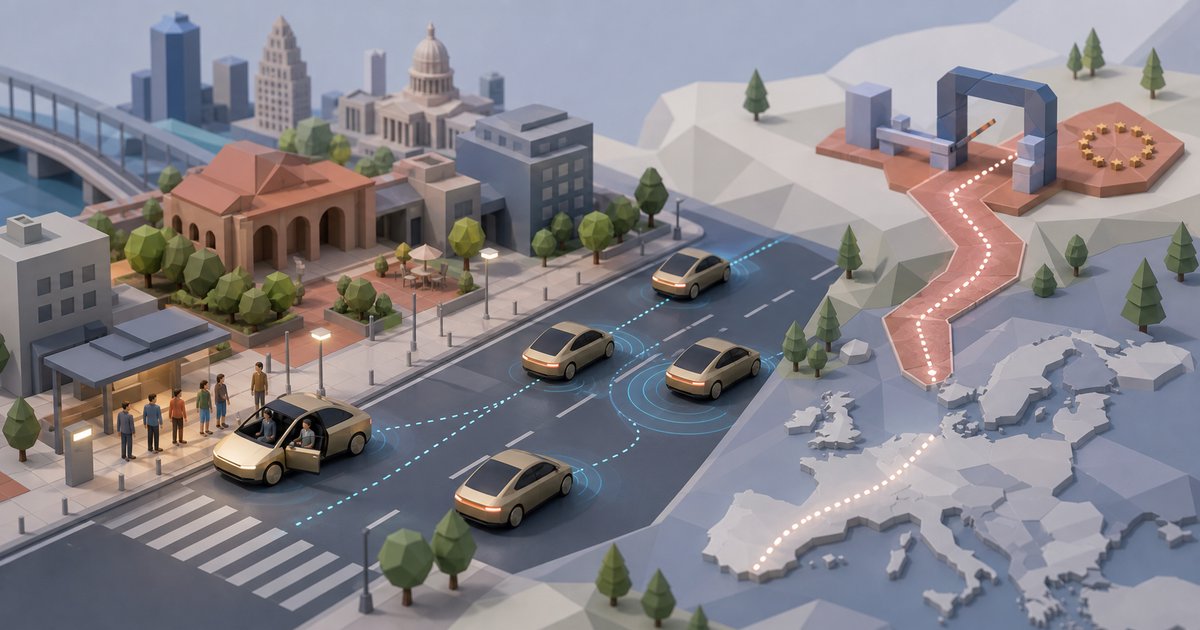
Tesla has told employees it is preparing a public launch of the Cybercab in Austin, Texas as soon as this month, according to a report by Grace Kay at The Information. The internal target is the end of August, and Tesla has since opened a drawing for a Cybercab launch event with an entry deadline of 23 August.
The plan described to staff runs in two stages: Tesla employees ride first, on public roads, and Cybercabs join the paying Robotaxi service in Austin a few days later. Preparations already visible include campus test driving since July and emergency-response training with Austin first responders, confirmed by city officials.
What is actually launching
The Cybercab is a two-seater built without a steering wheel and without pedals — the first Tesla ever made that a person cannot drive. Production began at Gigafactory Texas in February 2026, and more than 100 units were spotted in factory lots by July.
That design decision is the whole story. A car with no controls is worth nothing except as a node in an autonomous fleet, so this is not a vehicle launch in the ordinary sense. It is a bet that the software is ready.
The numbers say Tesla is early. Tesla had accumulated roughly 380,000 cumulative driverless miles as of July; Waymo has logged more than 220 million rider-only miles since 2020. Of the 186 Model Y vehicles registered to the Austin fleet, only around 17 are reported to run without a safety monitor aboard, down from about 25 in the spring. The Cybercab has no fallback driver to remove.
| Tesla | Waymo | |
|---|---|---|
| Cumulative driverless miles | ~380,000 (July 2026) | 220 million+ (since 2020) |
| Operating area | Austin, Dallas, Houston, Miami, Tampa, Orlando | 18 California counties and others |
| Purpose-built vehicle | Cybercab, launching | Zeekr and Jaguar platforms |
What this means for Europe
The reflexive answer is that Europe cannot have a car without a steering wheel. That answer is now out of date.
The EU spent the first half of 2026 dismantling exactly that obstacle. Commission Implementing Regulation (EU) 2026/481, adopted on 3 March 2026, amended the type-approval rules for the automated driving systems of fully automated vehicles, extending the path beyond the small-series limits that previously boxed such vehicles in. Alongside it the Commission has set out regulatory sandboxes and cross-border automated-driving corridors from 2026, under a single permitting scheme rather than 27 national ones.
So the barrier is no longer the rulebook. It is Tesla's position in Europe, which is several steps behind the vehicle. Tesla is still seeking approval for FSD Supervised — the version with a driver in it — and that process has been slow and contested: France refused to back an EU-wide approval, Germany's KBA opened its own review, and Czechia declined to join the consensus. A driverless two-seater is a much higher approval class than the one Tesla has not yet cleared.
Competitors are already using the new framework. Momenta secured Level 4 testing approval in Germany in July.
What to hold lightly
The end-of-August date comes from a single report of internal communications, and Tesla has not announced a public launch date itself. The Information notes the schedule could move. What is confirmed is narrower: a launch-event drawing with a 23 August deadline, first-responder training that took place, and Cybercabs already testing on public roads.
For European owners the practical takeaway is not the launch. It is that the EU has quietly built the door the Cybercab would need, and Tesla is still queuing at an earlier one.
Update: 2026-08-21
A JPMorgan note made public on 20 August 2026, after an analyst tour of Fremont, supplies Tesla's own reasoning for the fleet numbers above. Tesla's investor-relations team said it is intentionally not adding further Model Y cars to the robotaxi fleet, because it expects to put the Cybercab into the mix shortly, as Not a Tesla App reported. The stated logic is unit economics: a purpose-built two-seater suits the one- and two-passenger rides that dominate the service, and Model Ys left unconverted stay available for retail sale. That reframes the conversion count quoted above — the flat number of driverless Model Ys is a deliberate hold, not a ceiling Tesla has run into. It is a bank's summary of what Tesla said rather than a Tesla announcement, and no Cybercab fleet target came with it.
Update: 2026-08-22
On 22 August 2026 Tesla began emailing invitations that fix the Cybercab launch event to 3 September in Austin, as Not a Tesla App reported. That answers the open question above: Tesla has now named a date itself, and it is not the end of August — the internal target reported by The Information has slipped into September. Drive Tesla and Teslarati read the same date from the invitations, which offer recipients a chance to “experience the future of autonomy” — wording that points to public rides rather than a static reveal. Tesla’s own event page sets out the conditions: winners of the ride drawing are announced on 25 August, attendees must be 21 or over with ID checked on the door, and the single permitted guest may not be a content creator.