
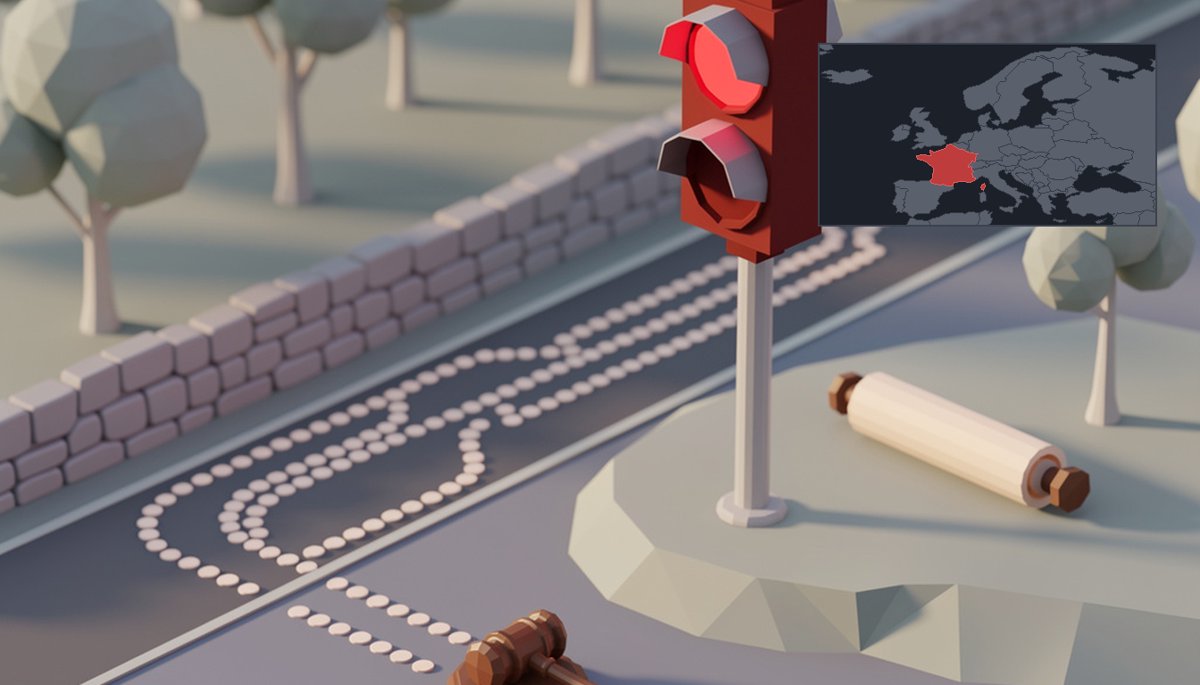
Tesla's push to bring Full Self-Driving (Supervised) to European roads has hit its most significant obstacle yet. France's Transport Minister, Philippe Tabarot, has confirmed that the country will not authorise the system "as it currently stands", citing safety concerns — but the decision is less an outright rejection of Tesla than a demand that Europe approve the technology together rather than one country at a time.
Two safety objections
Tabarot pointed to two specific problems. The first is speed. As currently configured, FSD can exceed the posted limit by as much as 50% to keep pace with surrounding traffic — driving 70 km/h in a 50 km/h zone, for example — without the driver asking it to. For a country that has spent years tightening urban speed enforcement, a driver-assistance system that speeds by design is a hard sell.
The second concern is attention. French regulators are not convinced that Tesla's current driver-monitoring setup keeps drivers engaged enough during complex city manoeuvres such as lane changes and roundabouts, where a supervising driver needs to be ready to take over instantly.
Not a door slammed shut
Crucially, France is not banning FSD outright. What it is refusing to do is rubber-stamp the national approval already granted in the Netherlands, whose vehicle authority cleared the system for Dutch roads earlier this year. Under EU type-approval rules, one member state's national authorisation can help open the door for others — but France would rather hold out for a proper bloc-wide sign-off than inherit another country's decision.
A representative from the French transport ministry travelled to the Netherlands for technical discussions, and France says it is continuing talks with the Dutch authority, other European states and Tesla itself to refine its assessment. This is a negotiation, not a final verdict.
Why an EU-wide approval is hard
A continent-wide green light is a high bar. EU-wide authorisation of a system like FSD runs through the Technical Committee on Motor Vehicles, where a qualified majority is required: at least 15 of the 27 member states, representing 65% of the bloc's population, must vote in favour.
That arithmetic gives the largest countries outsized influence. Germany, France and Italy together carry enough demographic weight to shape — or stall — any decision, and so far none of the three has approved FSD nationally. France's stance therefore matters well beyond its own borders: without the big three on board, a qualified majority is difficult to assemble.
What it means for European owners
For now, the patchwork continues. Several smaller markets have already approved FSD (Supervised) nationally — as TeslAnt covered when Belgium became the fifth European country to approve Tesla FSD — while the largest markets hold back. French owners hoping to switch on a feature many have already paid for will have to wait, and Tesla's cleanest path forward now runs through Brussels rather than any single national capital.
The company has consistently framed FSD's European rollout as a matter of "when, not if". France's message is that "when" depends on satisfying regulators on speed compliance and driver attention first — and, ideally, on doing it for the whole bloc at once.
Update: 2026-07-24
On 23 July 2026, Elon Musk responded publicly to France's decision, writing on X that "delaying the approval of FSD in France will cost lives" — Tesla's standard argument that supervised automation is safer than unassisted human driving, as Teslarati reported. The exchange turns a technical regulatory review into a public political dispute, pointing to a drawn-out negotiation rather than a quick resolution. Meanwhile the European picture is diverging: as France holds out, Greece has signalled it is moving toward approving FSD, reinforcing that the rollout will advance country by country rather than through a single bloc-wide decision.