
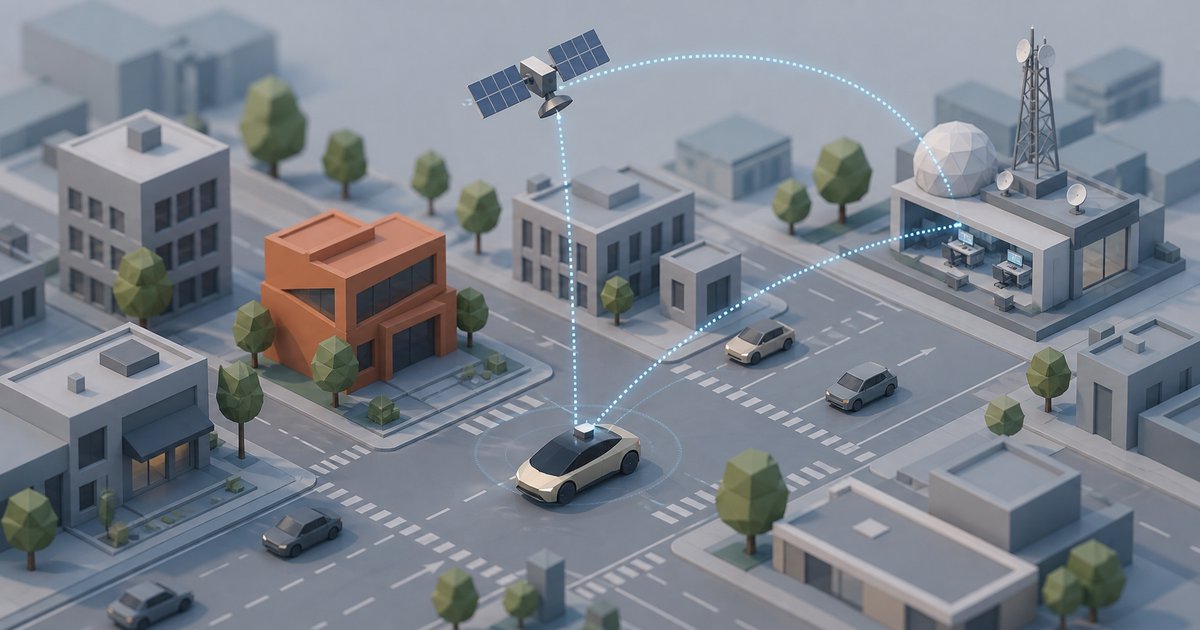
Tesla has been running Cybercabs on public roads for months. What is new is the hardware on the roof: a gold Cybercab carrying an integrated Starlink antenna has been filmed driving in Houston, Texas, the first public sighting of the satellite-equipped car in road testing rather than parked at a factory.
The reveal came about a week earlier, when Tesla posted images of what it called the first Cybercab with Starlink integration — a low-profile terminal set into a square cut-out in the roof, on a gold car at Gigafactory Texas. TeslAnt covered the underlying decision when Tesla first confirmed the Cybercab would carry a built-in Starlink terminal in July.
What the hardware is
The unit is the Starlink V5 terminal, the generation Tesla confirmed in late July. Its published specifications are download speeds above 375 Mbps, a body 35% smaller and 62% lighter than the V4 at 1.1 kg, roughly half the power draw, and a wind rating to 265 km/h. Those numbers are what make roof integration plausible at all — a V4-sized dish on a two-seater would have been a styling and efficiency problem.
Two stated purposes, and one that matters more
Elon Musk has pitched the passenger side: riders watching live sport, films or games in 4K, or working, during an autonomous trip. That is the consumer-facing version.
The operational reason is the more interesting one. Head of AI Ashok Elluswamy has framed Starlink as enabling constant connectivity between Tesla and the Cybercab fleet, so riders have support available in a breakdown, a collision or another emergency. A driverless car with no steering wheel has no fallback human in the seat; the connection is the fallback. Read that way, Starlink is less an entertainment feature than a condition of operating the service at all.
Worth being precise about what it is not: the Cybercab drives on its onboard AI4 computer and does not need an internet connection to drive. Starlink is redundancy and service, not autonomy.
Beyond the Cybercab
Tesla has indicated the Cybercab is the first of many vehicles to use the SpaceX link, with deployment eventually across the lineup. Musk has separately hinted the same thing. Nothing is committed — no model, no market, no date — so treat lineup-wide Starlink as direction of travel rather than a roadmap.
Production is under way at Gigafactory Texas, and public Cybercab rides are expected by the end of the year. The robotaxi service currently runs in Austin, Houston, Dallas and Miami, which is why a Houston sighting is unsurprising in location and notable only for what was on the roof.
What it would mean for European owners
Nothing yet, and it is worth saying that plainly: there is no announced European Cybercab, and no announced Starlink option for cars already on European roads.
The reason to watch it anyway is that Europe is where cellular dead zones bite hardest on the features Tesla owners actually use — navigation re-routing, live Supercharger occupancy, streaming — on Alpine passes, Nordic trunk roads and the long empty stretches of Iberia. A satellite link that Tesla can fit into a production roof for a two-seat robotaxi is a link it could fit elsewhere. If it reaches the wider lineup, the European case for it is stronger than the American one.