
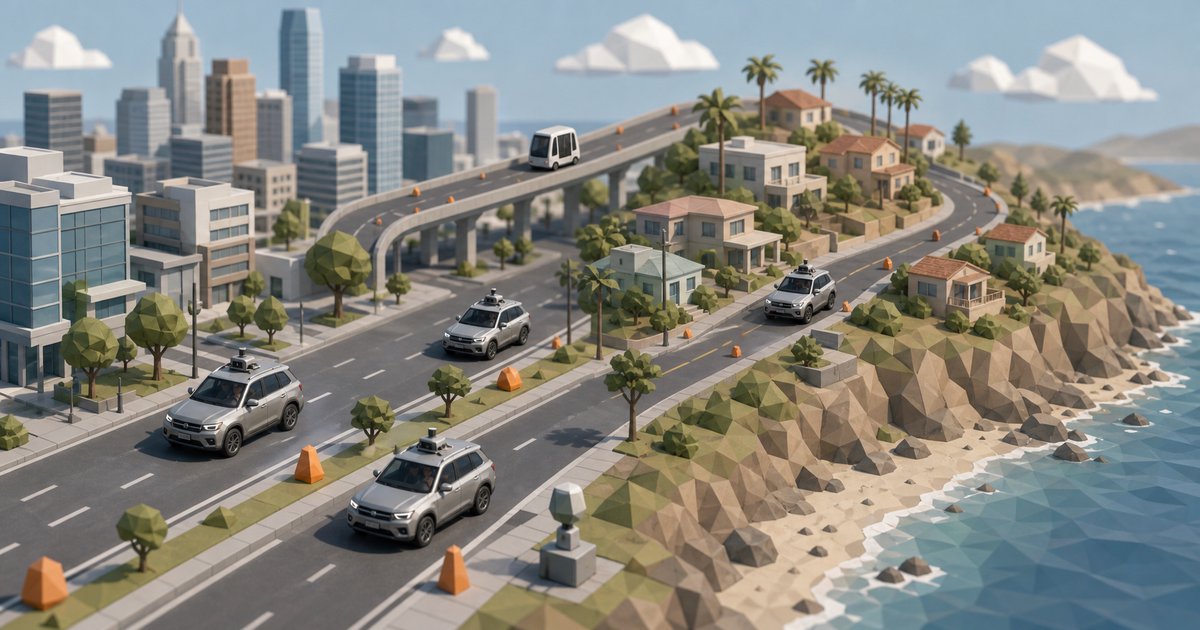
Amazon-owned Zoox is beginning autonomous-vehicle mapping and testing in Houston and San Diego this month, taking the number of US markets where it operates or tests to twelve.
The approach is the one Zoox has used in every new city. Retrofitted Toyota Highlanders carrying cameras, lidar and radar go in first, with a safety driver behind the wheel, mapping local roads and gathering the data the driving system is tuned against. The purpose-built robotaxi — the one with no steering wheel and no pedals — follows only after that.
Why these two cities
Zoox chose both for what they break. It calls Houston "our most sprawling market to date", citing service-road networks, unusual merging geometry, and weather running from severe heat to heavy rain and urban flooding. San Diego is the opposite problem: a concentrated coastal corridor that leans heavily on highways, which the company frames as preparation for freeway operation, plus a thick marine fog layer that is real perception validation rather than a nice-to-have.
Neither reason is about population. These are the conditions on which a sensor suite and a planner fail, picked deliberately.
Twelve markets, three very different things
The city count is the number most easily over-read, because the twelve are not the same kind of presence at all.
| Status | Markets |
|---|---|
| Paid commercial service | Las Vegas (since 10 August 2026) |
| Free public rides | San Francisco, Austin, Miami |
| Mapping and testing only | Seattle, Atlanta, Los Angeles, Washington D.C., Dallas, Phoenix, and now Houston and San Diego |
Las Vegas is the only market where Zoox charges, having cleared an NHTSA hurdle before switching from free rides on 10 August. San Francisco and Austin still carry the public for nothing, because California requires two further permits before commercial operation. Zoox says it has carried close to a million riders since launching public service.
Houston and San Diego sit at the beginning of that pipeline, not the end: this announcement is testing, not rides.
What it means next to Tesla
Zoox is the closest structural comparison to Cybercab that exists. Both are purpose-built vehicles without manual controls — a harder regulatory object than a converted car — and Zoox has already had to publish a safety case for a vehicle with no driver controls before it could carry the public.
The two overlap on the ground, too. Austin and Dallas are Zoox markets and Tesla robotaxi markets both, and Tesla expanded its Austin service area to 288 square miles days ago with 45 Cybercabs newly on the Texas robotaxi register ahead of its 3 September launch event. Waymo, meanwhile, took its service public in Denver, San Diego and Tampa this week — a later and more demanding step than the one Zoox reached here, which makes San Diego a city where both companies now work at different stages at once.
What this means for Europe
None of these twelve markets is European, and that is worth drawing out rather than glossing over.
A vehicle with no steering wheel and no pedals cannot be type-approved in the EU under the existing rules; it needs a derogation, and there is no established route for granting one. The Article 39 mechanism Tesla is using to seek EU-wide approval for FSD (Supervised) covers a supervised system in an ordinary car — a far smaller ask than a car with no controls at all.
Europe will therefore get these vehicles late, and get them with an evidence base built entirely on American roads. Houston's flooding and San Diego's fog are useful validation, but neither teaches a planner about a Dutch roundabout or Nordic winter light.
What the expansion does establish is a queue. By the time a no-controls robotaxi asks an EU regulator for an exemption, more than one company will have built a safety case for it — and whoever goes first sets the precedent for what Tesla is asked to prove for Cybercab.