
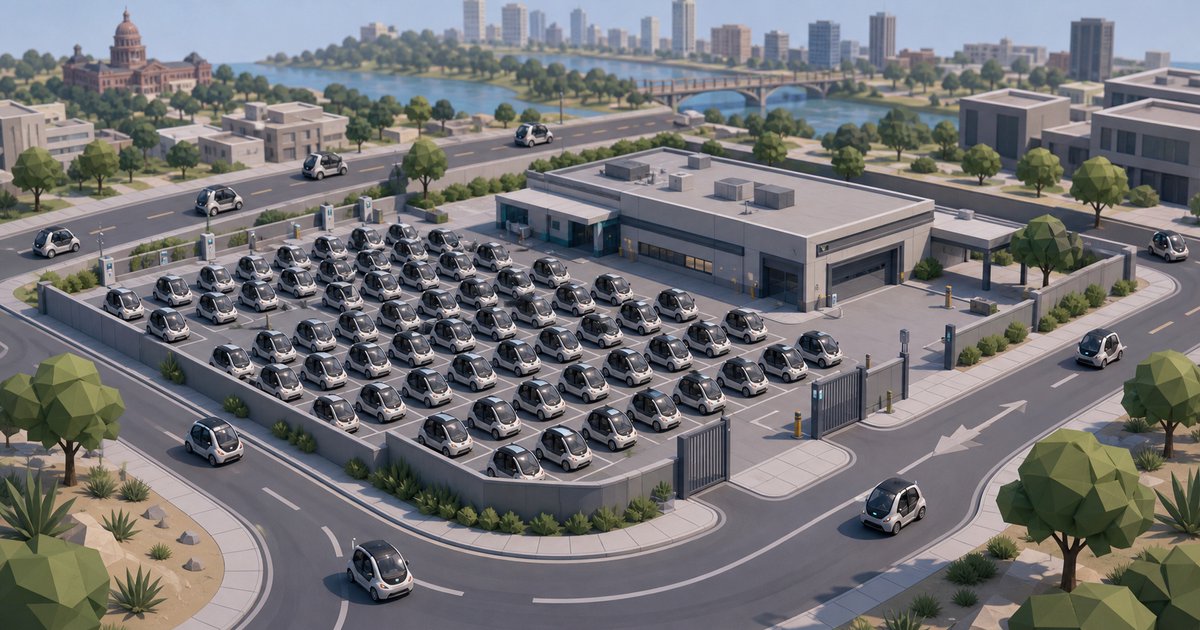
Tesla's Cybercab count on the Texas robotaxi register went from seven to 45 in a matter of hours on 31 August 2026, three days before the car's launch event in Austin.
The entries sit in the Texas Motor Carrier Credentialing System — the state's Motor Carrier and Automated Motor Vehicle Operator lookup — filed under Tesla Robotaxi, LLC, with vehicle identification numbers carrying the 5YJA prefix that marks the purpose-built two-seater. Teslarati reports the first seven appeared earlier in the day and the total had reached 45 by mid-afternoon Eastern time, a jump first flagged by Sawyer Merritt. Drive Tesla records the batch as the first Cybercabs Tesla has ever registered for commercial autonomous operation.
A register entry is a permission slip, not a service
This is worth stating precisely, because the number invites over-reading. Appearing on that register is the legal prerequisite for running an automated vehicle commercially in Texas. It is not evidence that any of these cars is carrying a paying passenger, and Drive Tesla makes the point explicitly: registration does not equal unsupervised public rides.
The proportions are easy to lose too. Tesla already had roughly 270 Model Y robotaxis on the Texas register by late August, so 45 is a small addition in volume. It is a different kind of entry, though — the Model Ys are converted production cars with steering wheels, and the Cybercab has neither wheel nor pedals.
| Texas robotaxi register | Count |
|---|---|
| Model Y robotaxis, late August | about 270 |
| Cybercabs, earlier on 31 August | 7 |
| Cybercabs, mid-afternoon 31 August | 45 |
They are already driving with nobody in them
Alongside the paperwork, Cybercabs have been filmed on Austin streets and highways between 27 and 31 August with no driver and no safety monitor on board. Tesla Oracle collected the sightings, posted to X on 29 and 30 August, and reports the cars running unsupervised FSD, described in that account as v15, a version Tesla has not itself detailed. None of the clips shows a passenger, so these read as validation runs rather than service.
It fits the rest of the week. Tesla expanded the Austin service map for the first time since October, enlarged the Dallas area days earlier, and had a Starlink-equipped Cybercab on public roads in mid-August. The launch event itself is set for 3 September in Austin and will be livestreamed.
What Europe should read into it
None of this reaches a European road. Tesla has no robotaxi permission in any European country, and the Cybercab's missing controls are the harder problem: a car with no steering wheel needs an exemption route a converted Model Y does not, which is why Europe's paper route to a Cybercab matters more than the launch date. Zoox had to publish a safety case for a vehicle with no controls before it could carry the public, and Cybercab will need the same argument in the EU.
So the useful figure for a European reader is not 45 but the ratio behind it — how many registered cars actually run, and under what supervision. Tesla's unsupervised Austin fleet has been counted in the low tens against a register in the hundreds, and the service day there now ends at 10 PM, four hours earlier than a year ago. A state list is cheap to join. Waymo, by contrast, has named Munich and a date.
Update: 2026-09-01
On 1 September 2026, two days before the launch event, Teslarati reported that Tesla's fleet running with no safety monitor on board had reached nearly 200 vehicles across Austin, Dallas and Houston — a roughly sevenfold rise in about three weeks, on figures compiled by the crowdsourced Robotaxi Tracker. That revises the "low tens" count given above, which covered Austin alone and stood at roughly 30 cars there as recently as June. Two caveats hold: the tracker is crowdsourced rather than official, and Tesla publishes no unsupervised-fleet figure of its own. For scale, Waymo runs about 200 fully driverless vehicles in Austin by itself.