
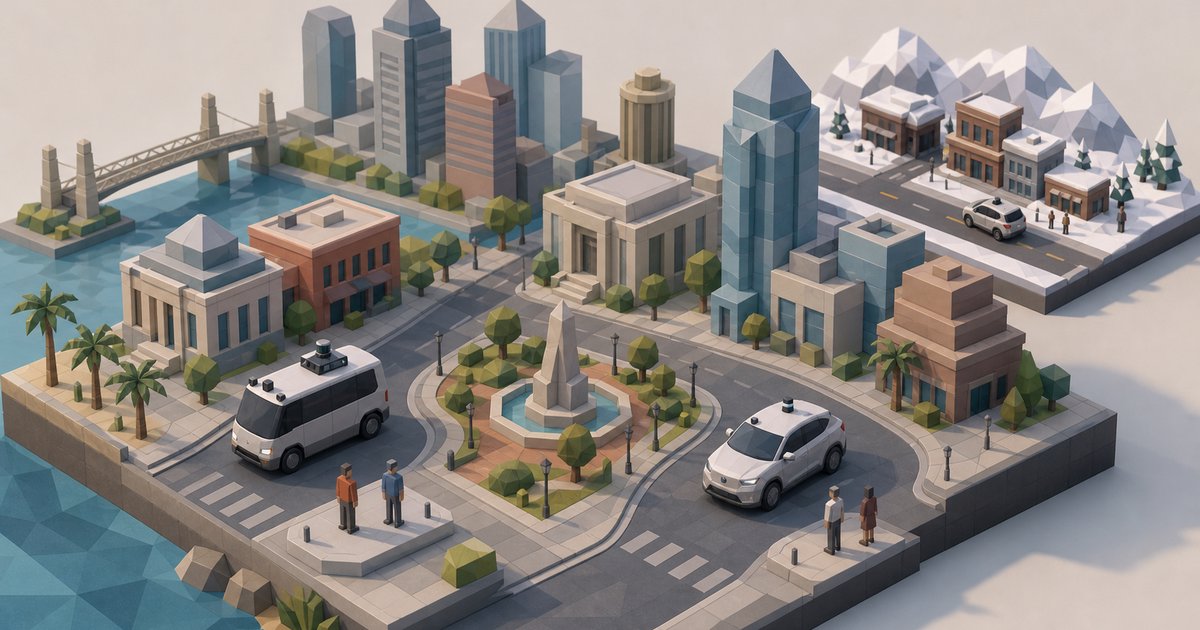
Waymo started carrying members of the public in Denver, San Diego and Tampa on 1 September 2026. That takes the Alphabet subsidiary to 14 US cities. Tens of thousands of people had already joined the waitlist in each market, and Waymo says it will admit them gradually rather than all at once.
These are not new deployments so much as a change of gear. Waymo has been driving in all three cities since July with employees only in the back seat. What changed this week is who is allowed to pay for a ride.
Tampa is the one to watch
Tesla launched its own driverless Robotaxi service in Tampa on 21 July 2026, using Model Ys across a service area of roughly 25 to 45 square miles centred on downtown, Ybor City, Tampa Heights and West Tampa. As of this week, both companies are selling autonomous rides to the public in the same Florida city.
That is a genuinely new situation, and it is the first place where the two technical bets can be compared on equal terms rather than through press releases. Waymo runs lidar, radar and cameras with pre-built high-definition maps. Tesla runs cameras only, and has argued for years that dropping lidar is what will let it scale faster and cheaper once the software is good enough.
The scoreboard so far favours the expensive approach. Waymo operates more than 4,000 vehicles across 14 cities. Tesla's fleet in Tampa has not been disclosed, and its Austin operation — its largest — covers 288 square miles with a fleet that only reached 45 registered Cybercabs last week. Tesla's own Q2 chart showed service growth going flat.
The counter-argument has not gone away, though: Tesla's per-vehicle cost is a fraction of Waymo's, and its Cybercab launch event on 3 September is the moment it intends to make that point.
New hardware, and a European timetable
Riders in Denver and San Diego get the Zeekr-built Ojai minivan running Waymo's next-generation Driver — currently the only vehicle available in those two cities, from a fleet of roughly 300. Tampa gets the older Jaguar I-Pace.
Denver is the real test. Waymo has so far operated in warm, dry places; Denver gets around 56 inches of snow a year. Snow degrades lidar returns and hides lane markings, and a system that depends on precise prior maps has to cope with a road surface that no longer looks like the map.
For European readers the relevant line is what comes after the US. Waymo has named Tokyo, Munich and London as international targets. London was originally aimed at 2026 and is reportedly slipping on technical and regulatory grounds. Nevada has separately approved Waymo for up to 1,000 vehicles over the next year.
If Munich arrives on schedule, European drivers will get a working comparison between a mapped lidar robotaxi and Tesla's FSD (Supervised) — which is still waiting on an EU vote scheduled for 6 October before it can operate here at all.