
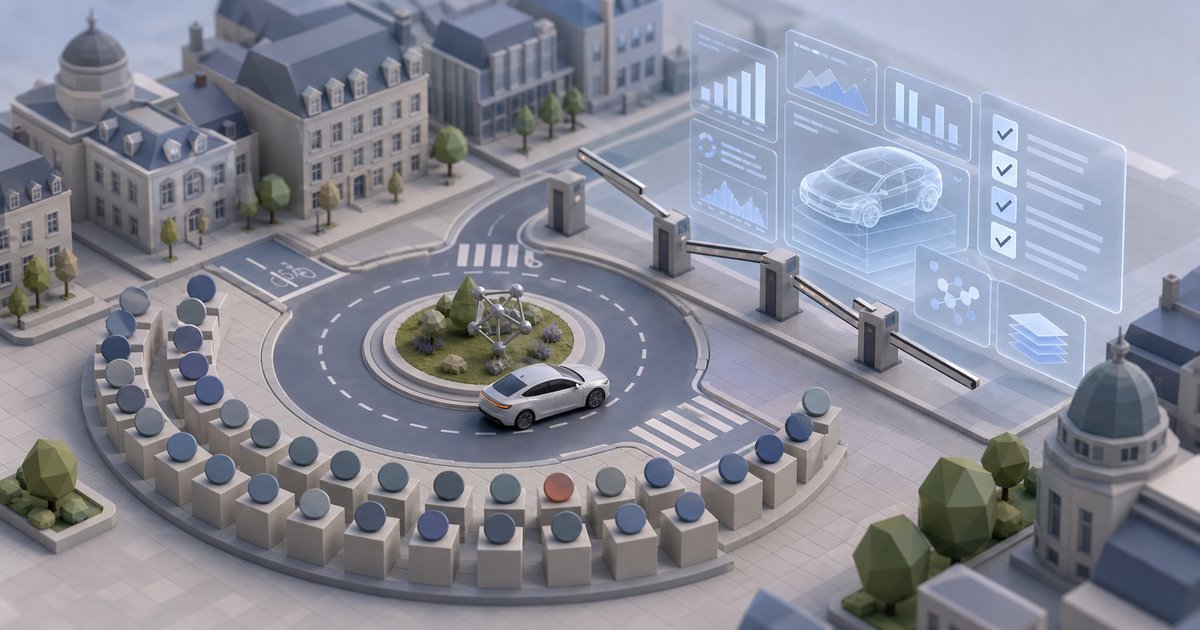
Tesla has published the evidence file behind its bid to get Full Self-Driving approved across the European Union. The Article 39 FSD (Supervised) Dashboard gathers eight studies the company has put to European authorities under Article 39 of Regulation (EU) 2018/858 — the derogation route that lets a member state approve a technology the existing type-approval rules do not yet cover.
The timing is the point. The Technical Committee on Motor Vehicles (TCMV) is expected to vote on 6 October 2026 on whether to extend the Dutch RDW's national approval to the whole bloc. Publishing five weeks out is a change of posture from a company that, as TeslAnt reported in August, had pressed the Dutch regulator to keep its FSD safety review confidential.
What the dashboard claims
| Measure | Tesla's figure |
|---|---|
| Cumulative global FSD distance | 10.5 billion km |
| Analysed in the submission | 3+ billion km |
| European engineering fleet | 1.28 million km across 8 countries, no attributed collisions |
| Scenario tests | 230,000+ across 6 European cities |
| Roundabouts / pedestrian crossings / cyclist yield | 98.9% / 99.7% / 99.9% success |
| Emergency braking events in Europe | 70–97% fewer than manual Tesla driving |
| Major collisions (North America) | 40–69% fewer than manual driving with assistance active |
| Driver fatigue episodes | 67% fewer |
| Speeding | 98% of cases at or below median traffic speed |
The eight studies cover road-type distribution, automatic emergency braking, major and minor collisions, lane changes, fatigue, the European engineering fleet, validation routes in six cities, and overspeed behaviour. These are Tesla's own measurements, presented by Tesla — not an independent audit.
Five derogations, and why they are contested
Tesla is not asking for a rubber stamp on the current rules. It wants exemptions covering unsupervised manoeuvres on and off motorways, lateral-acceleration thresholds, attention-monitoring requirements, and speed adjustment above detected limits. That last one is the sorest point: Sweden has already urged the EU to reject the application unless the speeding behaviour is removed.
The European Transport Safety Council wants the vote postponed outright. In a letter to Executive Vice-President Séjourné, it argued that hands-off driving should not become continent-wide policy "on the back of a single national approval" without public deliberation, noted that Europe has no equivalent of the US NTSB to scrutinise how such a system performs in service, and pointed to open American investigations into FSD.
Where Europe's votes actually are
Approval needs a double majority — at least 15 of 27 member states representing 65% of the EU population. Five countries have recognised the Dutch approval nationally: the Netherlands (10 April), Lithuania (20 May), Estonia (29 May), Denmark (9 June) and Belgium (10 June). Together they are about 8.9% of the EU population.
Eight more are reviewing: Germany, France, Italy, Spain, Greece, Sweden, Finland and Ireland. France has already declined to adopt the Dutch approval, holding out for an EU-wide decision. Twelve member states have not started a formal review at all.
If the vote carries, the Commission adopts an implementing act empowering the RDW to issue EU-wide type approval, and FSD (Supervised) becomes legal in every member state at once. If it fails, the patchwork of national reviews continues and harmonisation slips.
For European owners, 6 October is the date that decides whether the feature many have now sampled on a free trial becomes something they can legally use at home.
Update: 2026-09-02
On 1 September 2026, the Polish outlet Elektrowóz published a country-level reading of the same evidence file, working from Tesla's "Mileage Accumulated in European Countries" document. It separates two figures the dashboard summary does not: roughly 3.14 million kilometres of European road identified as candidate validation routes, against about 1.6 million kilometres actually used to validate how FSD handles the terrain. Poland's share of that second figure is a single thread of the A2 motorway towards Poznań, even though the country offers an extensive candidate network. The gap matters because of how Article 39 works: if the Technical Committee approves on 6 October, the authorisation reaches every member state's roads at once, including those Tesla has barely driven. Source: Tesla praktycznie nie testowała FSD (Supervised) w Polsce.