
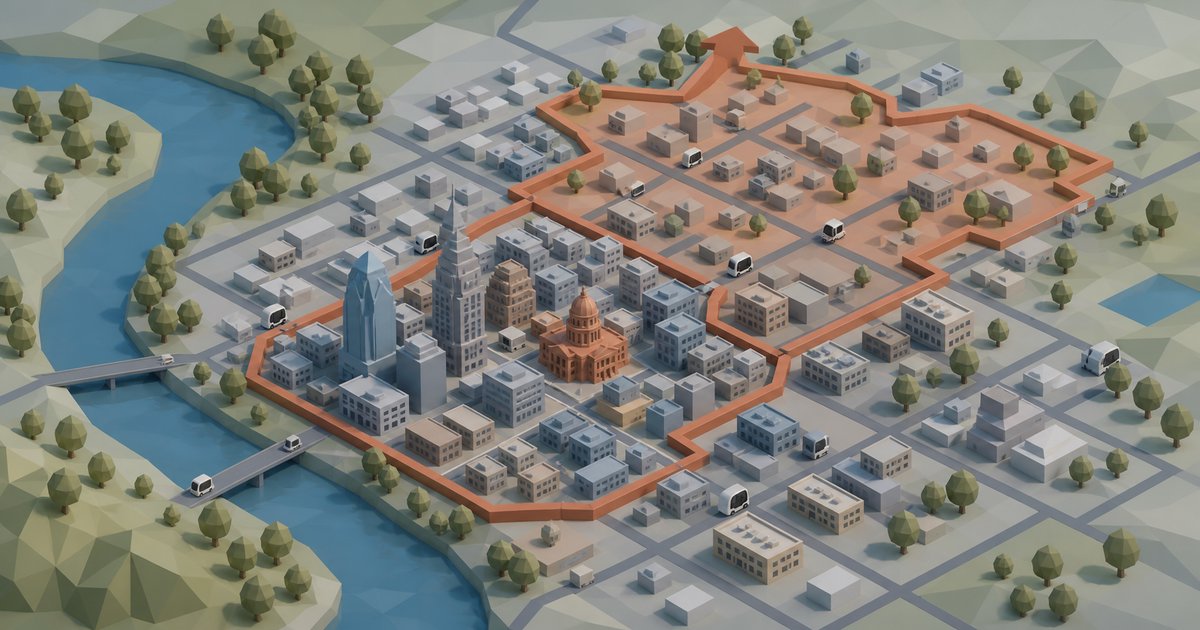
Tesla has made its Austin Robotaxi service area bigger for the first time in roughly ten months. The boundary now encloses about 288 square miles, Teslarati reports — some 24 square miles more than before, a rise of about 9%.
The new territory runs north along US 183 toward Pflugerville, taking in Mesa Park and the districts above The Domain. That is a deliberate choice of ground: affluent, low-density, heavy on office parks and retail, and the kind of area where trips are longer and traffic is more predictable than in the central grid.
The boundary had been frozen since October
What makes a 9% increase notable is how long the outline sat still. Tesla enlarged the Austin geofence four times during 2025, each step roughly doubling it, and the last of those came at the end of October, when TeslaNorth measured a jump of nearly 44% to about 243 square miles. Then it stopped.
Trackers trace these polygons by hand from the in-app map, so their figures differ by a few percent — Teslarati puts the pre-expansion area at about 264 square miles against TeslaNorth's 243 for the same period. The direction is not in doubt even if the decimal is.
One thing that did change in between was not the outline but what could happen inside it. In June 2026, Electrek reported that unsupervised vehicles were cleared for the whole Austin metro, having previously been confined to a slice of South Austin. That widened the driverless share of an existing map rather than the map itself.
A bigger map, a shorter day
The expansion is the second in a week. Days earlier Tesla enlarged the Dallas service area without publishing a figure, and both moves land three days before the Cybercab launch event scheduled for 3 September in Austin.
Set against that, the service has been contracting on a different axis. Robotaxi in Austin now stops at 10 PM, four hours earlier than a year ago — a cut, not an expansion, and one that arrived without announcement. Teslarati describes the unsupervised fleet in the city as "relatively small" and gives no number; Electrek counted about 20 unsupervised cars in June, down from a peak of 25 in late April.
A boundary is cheap to redraw. Twenty-odd cars covering 288 square miles is roughly fourteen square miles per vehicle, which is the figure that decides whether a rider waiting in Pflugerville actually sees a car. Coverage on a map and coverage in practice are different products, and only one of them was expanded here.
Why European readers should track the number anyway
Nothing about this reaches Europe directly. Tesla still has no robotaxi permission in any European country, and France has refused to approve FSD while it waits for an EU-wide sign-off. Waymo, meanwhile, has picked Munich for its first EU city with a driverless target of end-2027.
The reason to watch Austin is that it is the only place where Tesla's driverless operation is visible at all, and the shape of it is the argument Tesla will bring to European regulators. Ten months of a frozen boundary followed by a 9% step, with hours trimmed and a fleet in the low tens, is a different case than the one the launch cadence implies. Anyone assessing when a Tesla robotaxi might carry passengers in Berlin or Madrid should read the service area alongside the fleet count and the operating window, not on its own.