
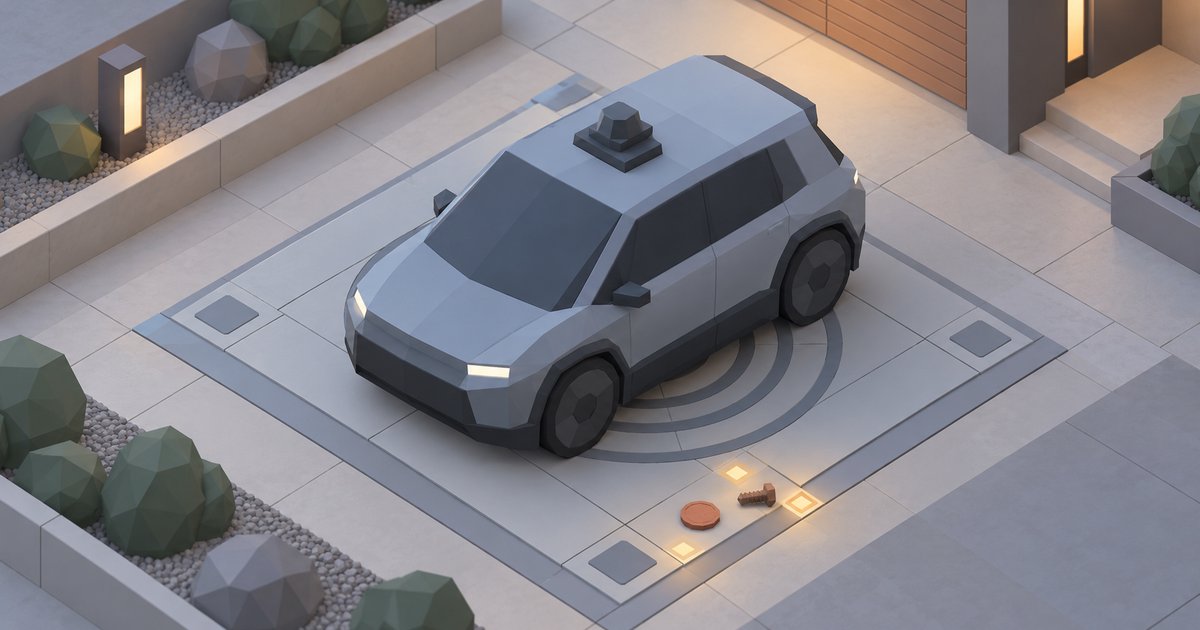
Tesla published two wireless charging patents on 1 October 2026, both filed in March. Neither describes a charging pad. Both describe the thing that stops one working: a piece of metal lying on it.
The problem being solved
Inductive charging moves energy through a magnetic field. Anything conductive sitting in that field absorbs some of it and heats up — a coin, a bottle cap, a dropped bolt. At the power levels a car needs rather than a phone, that is a fire risk, not an inconvenience. Every serious inductive system therefore needs foreign-object detection, and the hard part has never been spotting metal. It is spotting metal without stopping the charge every time the weather changes.
A pad in a driveway in Tromsø and the same pad in Seville behave differently. Heat alters the electrical characteristics the detector measures, so a system tuned to be sensitive enough to catch a coin will also cry wolf at a warm afternoon.
What the patents claim
The first approach embeds temperature sensors in the pad itself, watching for an object that is heating abnormally and cutting power before damage occurs.
The second is the more interesting one. It uses inductive coils arranged in resonant tanks, excited across a band of frequencies near their nominal resonance. A metal object makes a coil's resistance rise and its inductance fall. By reading how resonant frequencies and output magnitudes shift and distribute across that band, the detector separates changes caused by temperature from changes caused by an object — which is precisely the discrimination problem above.
Tesla has said Cybercab wireless charging runs at efficiency "well above 90%", and has already won FCC approval for the system.
Where this is going, and where it is not
The obvious application is the Cybercab, and the logic is not really about convenience. A robotaxi with no steering wheel and nobody aboard cannot plug itself in. Tesla has built the Cybercab without an onboard AC charger at all, and an automated charging dock is the alternative others are pursuing — an Austrian firm has already shipped one. Inductive charging removes the moving parts from that problem.
What none of this says is that a Model 3 or Model Y will get wireless charging. Tesla has not announced it for any customer car, no pad has a price, and a patent is a claim on an idea rather than a plan to sell it. Tesla patents a great deal it never builds.
It is also not first. Porsche put inductive charging in a customer car this September, at nearly €7,000 for the pad — which sets a useful expectation for what home hardware of this kind costs when it does arrive.
What a European owner should take from it
Very little, immediately. There is no product, no date and no market.
What is worth noting is the direction of travel. Two patents filed in the same month, on the single unglamorous problem that stands between inductive charging and a safety certificate, is not idle research — it is a company clearing a specific obstacle. The last time Tesla did that quietly in the charging stack, the result arrived in robotaxis before it reached anyone's garage.
If wireless charging does reach European customer cars, foreign-object detection is why it was allowed to. That is the part regulators ask about.