
A robotaxi that cannot plug itself in still needs a person, and that person is the last human in an otherwise driverless loop. An Austrian company has now shown a working answer before Tesla has shipped its own.
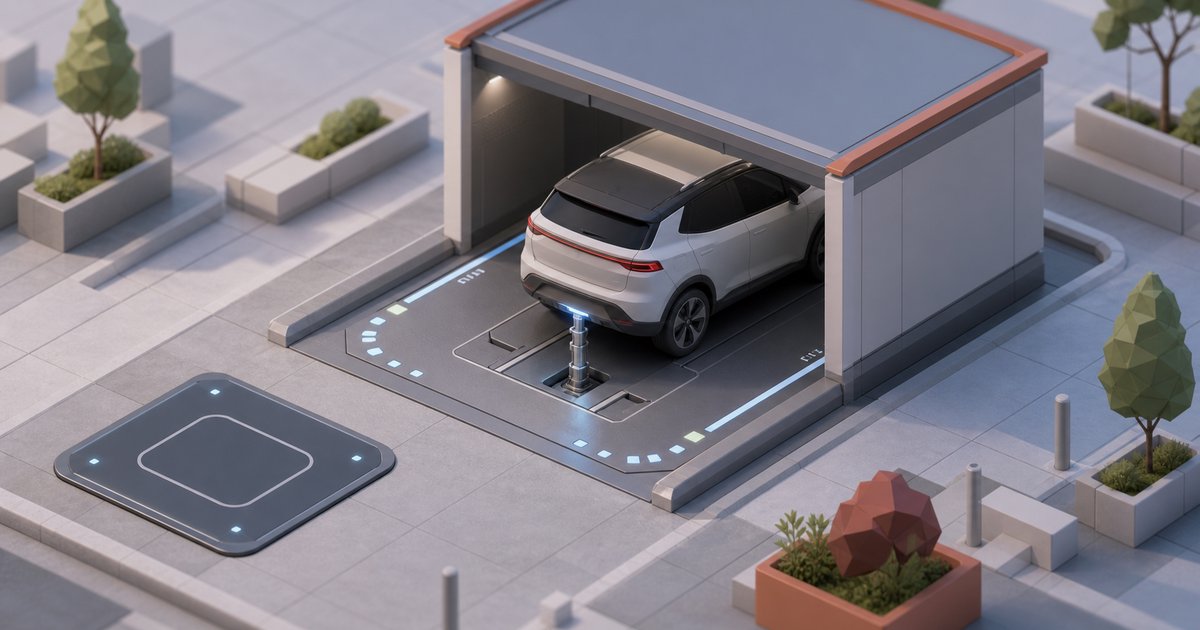
Volterio, an Austrian automated-charging specialist, has demonstrated a ground-mounted conductive dock that a vehicle reverses onto. Footage shared on X on 15 August 2026 shows a Model Y backing into a bay, with a probe rising from the floor unit to meet a port on the car and beginning a charge with nobody touching anything.
What the system does
| Element | Specification |
|---|---|
| Approach | Vehicle reverses onto a ground-mounted floor unit |
| Connection | Automated probe meets a vehicle-side port, no human involvement |
| Peak power | Up to 250 kW DC |
| Lateral misalignment tolerance | ±100 mm |
| Manual charging | Still available through the car's normal port |
NotATeslaApp reports that on the demonstrated Tesla the vehicle-side port sits where the rear tow hitch would be. Volterio's broader product line describes an underbody connector that a telescopic arm finds using ultrasonic positioning, seating in under 15 seconds, with its connector carrying the same lines as Type 2, CCS2 or NACS. The company also sells lower-power home units at 22 kW AC and up to 50 kW DC, and has previously worked with Continental on automated charging.
Tesla is not involved in any of this. Volterio built it independently.
Tesla went the other way
Tesla's answer to the same problem is inductive — a wireless pad the car parks over, with no physical connector at all. That work is real and it has cleared a regulatory step: in February 2026 Tesla obtained an FCC waiver covering the ultra-wideband radio the system uses to position the vehicle, with Bluetooth locating the pad at distance and UWB transceivers centring the car precisely before power transfer begins. Tesla has claimed efficiency "well above 90%".
What it has not done is release it. The Robotaxi charging hub Tesla is building opposite its St. Elmo service centre in Austin is planned at roughly 128 spaces, with a first phase of 48 Superchargers for the robotaxi fleet and wireless induction held for a possible second phase. In other words, the Cybercabs launching on 3 September are expected to be plugged in by hand.
Conductive versus inductive is a real trade
The two approaches are not equivalent, and the choice has consequences a fleet operator feels daily.
Conductive docking keeps the efficiency and power of a cable — 250 kW here, against inductive systems that generally sit far lower — and it can be retrofitted to cars that already exist. Its cost is a moving part exposed to grit, ice and kerbside abuse, and a vehicle-side fitting that has to be installed on every car.
Induction has no mechanism to jam and nothing for a passenger to trip over, which suits a vehicle designed with no charge port at all. It gives up efficiency and, so far, speed. Tesla's long-term vision points at a fleet with no NACS port at all — a bet that only pays off in a purpose-built car.
Why a European owner should care
Nothing here is a European product yet, and Volterio's dock is a demonstration rather than a deployment. What it establishes is that automated conductive charging works today at Supercharger-class power, on an existing Tesla, from a European supplier. If Tesla's inductive hardware slips, the fallback already exists — and it is being built 8,000 km from Austin.