
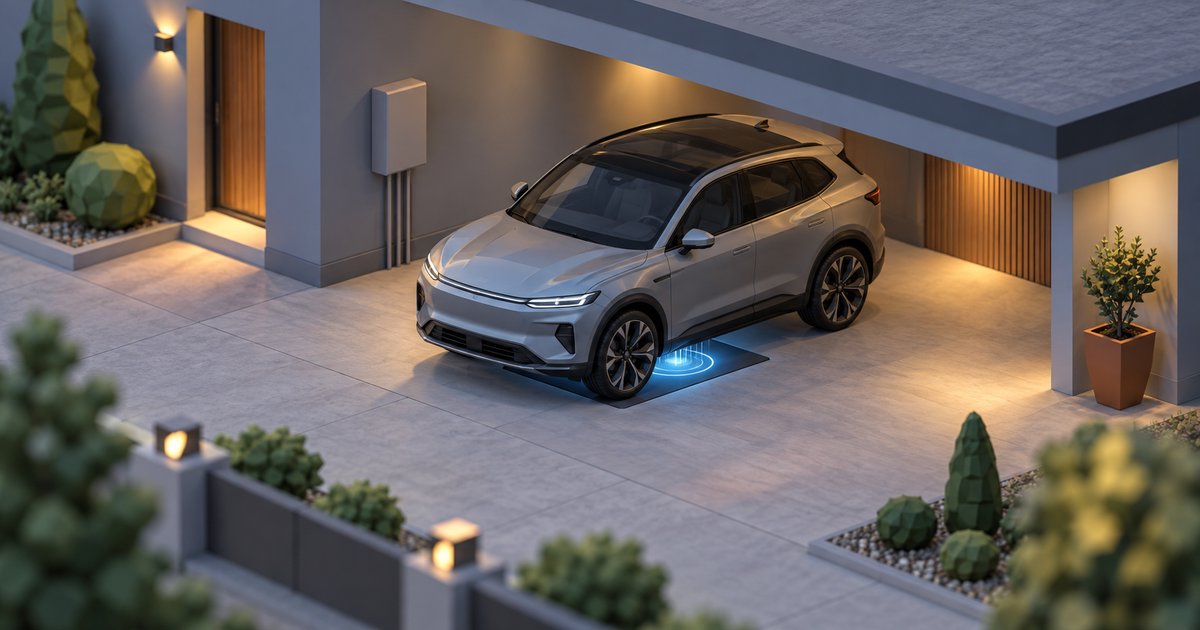
Porsche began taking European orders on 16 September 2026 for something no other carmaker sells as factory equipment: an inductive charging system that fills a production car's battery through a plate on the garage floor.
The Cayenne Electric is the first Porsche series model offered with it, and on Porsche's own account the first car of any brand to reach market with an 11 kW system built around a single-box base plate.
How it works
A charging pad sits in the vehicle floor. A base plate sits on the parking space and connects straight to the mains — no wallbox, no separate control unit, no cable. The car aligns itself using Park Assist, then charging starts on its own.
| Specification | Figure |
|---|---|
| Maximum power | 11 kW |
| Grid-to-battery efficiency | over 90% |
| Air gap between coils | 12-18 cm |
| Extra hardware needed | none beyond the floor plate |
Porsche says the system detects foreign objects such as keys and living objects such as animals beneath the plate, and stops charging when either is present. It also states the installation stays below every electromagnetic compatibility limit that applies to it.
What it costs
This is where the technology meets the invoice. German list prices:
| Item | Price |
|---|---|
| Vehicle-side pad, including pre-installation | 1,844.50 euros |
| Three-phase floor plate | 5,116.99 euros |
| Both together | 6,961.49 euros |
| Pre-installation only, no pad | 226.10 euros |
The Cayenne Electric itself starts at 105,200 euros, so wireless charging adds roughly 6.6% to the entry price of the car. A conventional 11 kW wallbox is a few hundred euros.
What you are actually buying
Not speed. Eleven kilowatts is exactly what a three-phase AC wallbox delivers, so the car charges no faster for the money. Not efficiency either — over 90% grid-to-battery is a genuine engineering result across a 12-18 cm air gap, but a cable does better, and Porsche does not claim otherwise.
What it buys is the elimination of the plug. Park, walk away, and the car is charged. For a daily driver on a home charger that is a small convenience bought at a large price, which is a reasonable description of a good deal of the Cayenne options list.
Tesla is building the same idea for a different car
The reason this matters beyond Zuffenhausen is where Tesla's version of the technology is pointed. Tesla's inductive charging work has surfaced in the context of driverless fleets, not private garages: the Austin robotaxi depot filing that asked for 48 Superchargers and 80 wireless chargers describes infrastructure for vehicles with nobody aboard to hold a cable. The same logic drives the Austrian automated charging dock built for robotaxis.
That is the sharper use case — a car with no driver cannot plug itself in — and it is why Tesla's effort is a depot technology rather than an options-list item. But the ordering is now on the record: a rival has delivered hands-free charging to private customers first, and priced it.
The European angle
The hardware can be ordered in Germany and other European markets now, and Porsche says it will reach all Porsche Connect markets except China. The Cayenne Electric has been in series production at the Volkswagen plant in Bratislava since February, which makes this a Slovak-built car carrying the first factory wireless charging on the continent.