
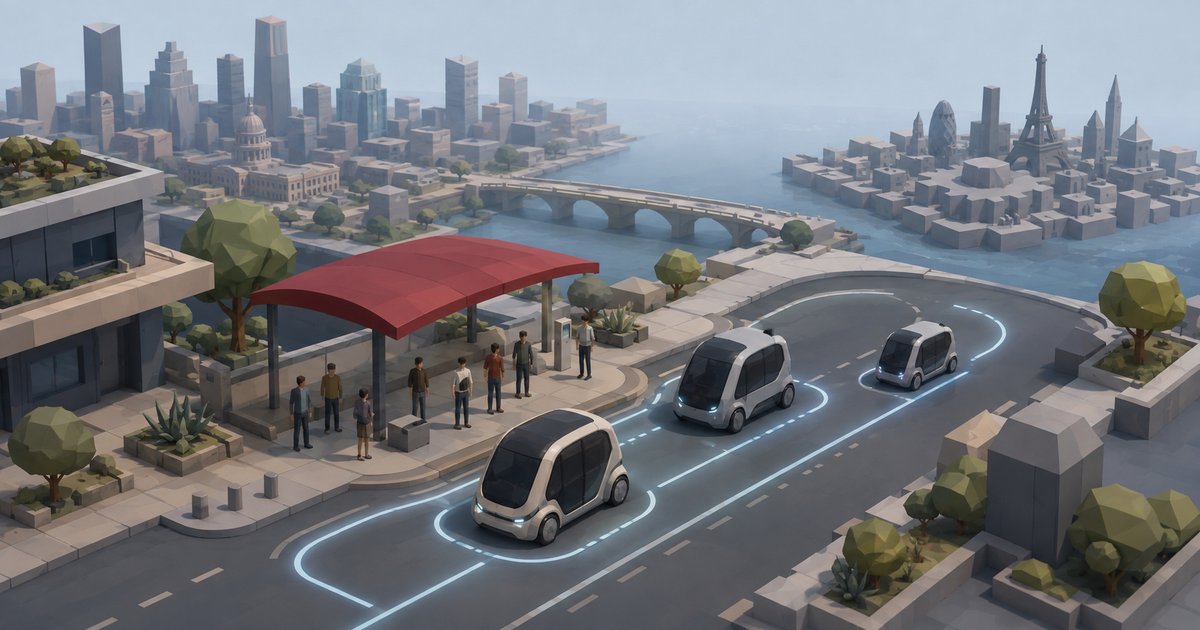
Tesla unveiled the production Cybercab at an invite-only event in downtown Austin on Thursday 3 September 2026, and did something the October 2024 reveal did not: it put the car into paying service. Cybercabs are now selectable in the Robotaxi app alongside the Model Ys that have been doing the driving in Austin since last year.
The event itself was tightly held. Tesla briefed almost nothing in advance, and Bloomberg called it "shrouded in mystery" hours before the doors opened. Invitations went to winners of a rider sweepstakes rather than to press.
What the car is
The Cybercab is the first Tesla built that a person cannot drive. There is no steering wheel and no pedals — two seats, a central screen, scissor doors, and a low floor meant to work with wheelchairs.
| Specification | Cybercab |
|---|---|
| Battery | 48 kWh |
| Motor | Single front motor, 219 hp (163 kW) |
| Range (EPA preliminary) | ~293 mi / 472 km |
| Curb weight | 3,113 lb / 1,412 kg |
| Seats | 2 |
Pilot production began at Gigafactory Texas in February 2026. Tesla has said it wants volume production before the end of this year and, eventually, two million units annually. Inductive charging was part of the design brief, which matters for a car with no driver to plug it in.
Tesla did not announce a retail price. Elon Musk has repeatedly pointed at a figure below $30,000, but that number has never been confirmed by the company and did not become official on Thursday.
The part that was actually new
Two things changed on 3 September that had not happened before.
The first is service. Riders in Austin can now choose the two-seat Cybercab or the four-seat Model Y when they hail, which is a commercial deployment rather than a demonstration — the app change TeslAnt covered as the Robotaxi app's new vehicle choice went live against real cars. The Austin fleet stands at roughly 45 Cybercabs.
The second is that Tesla opened a public interest form titled "Help Us Build Our Robotaxi Network", inviting companies to register to buy Cybercabs for their own fleets. That is the first official channel for commercial purchases of a vehicle Tesla has so far described as something it would operate itself. It is an interest form, not an order book, and no price, volume or delivery window came with it.
What it means for Europe
Nothing immediate, and the reason is worth stating precisely.
The obstacle is no longer the rulebook. As TeslAnt set out before the launch, the EU spent the first half of 2026 building a type-approval route for cars without steering wheels. The barrier is where Tesla stands in the queue.
Tesla is still seeking European approval for FSD Supervised — the version with a driver in it. That system is recognised in five EU countries, and the committee vote that could extend it bloc-wide is scheduled for 6 October, which is why Tesla published its Article 39 safety case days ago. A driverless two-seater sits several approval classes above the one Tesla has not yet cleared.
So the honest summary for a European reader is that the Cybercab is now a real product carrying real passengers, roughly 8,000 km away, and the first European ride is still gated behind a vote that has not happened.
Update: 2026-09-04
Fuller reporting on 4 September 2026 shows the interest form solicits more than vehicle buyers. Alongside "Cybercab fleet vehicle purchasing", it offers checkboxes for "mobility hubs and infrastructure" and "event collaboration", and asks which region a respondent would deploy in — so Tesla is recruiting depot and infrastructure partners for the network, not only customers for the car. The form also asks for a company name, and that is the exclusion Electrek highlights: individual owners, told for years they could earn passive income by adding their own cars to the fleet, still have no route in. TechCrunch reports the form collects only a name, email address, phone number and company name.
Update: 2026-09-04
Tesla Asia has since said where the car goes next, and no European city is on the list. Cybercab goes on display in Hong Kong from 9 September 2026 and in Beijing and Shanghai from 18 September, with Tokyo named but undated. These are static displays rather than a service expansion: Tesla has said it has no plans for sales or commercial operation in China, and neither announcement mentions test rides or a service area. For a European reader the point stands unchanged — the queue described above is still the only thing that decides when the car appears here. Sources: Teslarati, CnEVPost.
Update: 2026-09-05
On 4 September 2026 Tesla opened Cybercab bookings to the general public in Austin at 5 p.m. local time. That sharpens the account above: Thursday's rides carried invited sweepstakes winners, and city-wide public booking began a day later. Tesla has also priced the car below the rest of its own fleet. On an identical Austin trip, Not a Tesla App recorded $7.77 in a Cybercab against $12.10 in a Model Y robotaxi — roughly 35% less for the two-seater. Tesla has published no tariff, so those are observed fares on one route rather than a rate card, but the direction looks deliberate: the purpose-built car is the cheap seat and the Model Y is the premium one.