
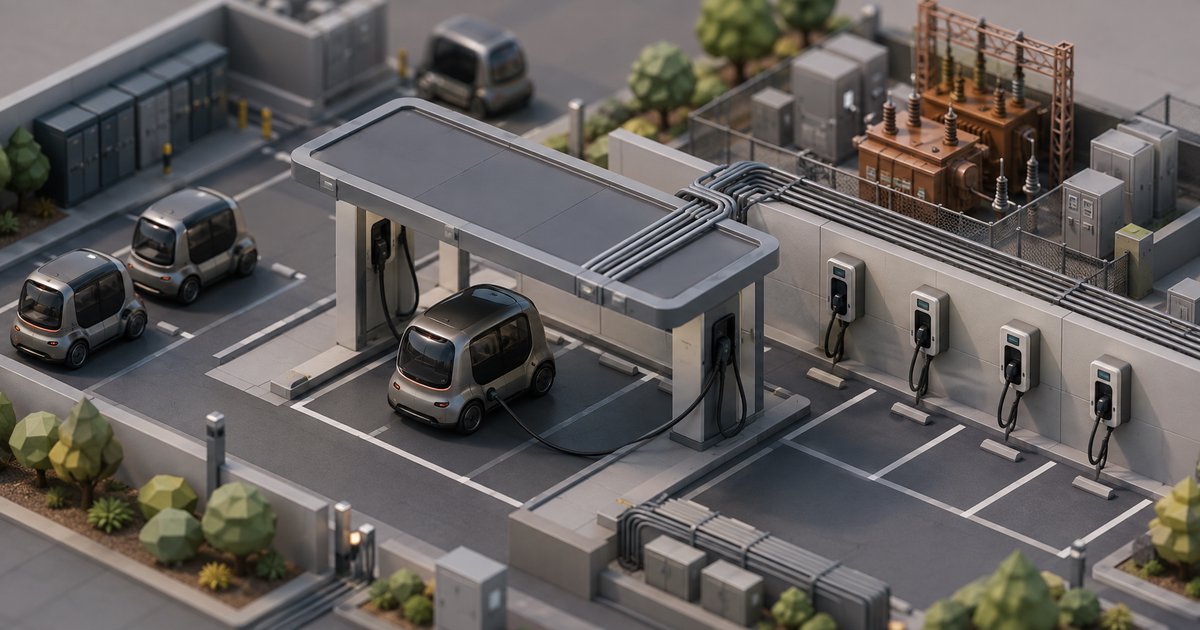
The production Cybercab cannot be charged from a wall socket, and not because of a software lock. Tesla left the onboard charger out of the car entirely.
Kyle Conner of Out of Spec Reviews, who went over the vehicle around Tesla's Austin launch, reported that the Cybercab "does not support AC charging" and that there is "no OBC" because the car is built for fleet use. Wired charging runs through a hidden NACS port and accepts direct current only.
What an onboard charger does, and what its absence costs
Public fast chargers deliver DC straight to the battery. Everything else - a home Wall Connector, a household socket, the AC posts on a street or in a car park - delivers AC, and the car has to rectify it. That job belongs to the onboard charger, a piece of hardware every other Tesla carries.
Take it out and the AC half of the charging world stops working.
| Charging method | Works on a Cybercab |
|---|---|
| DC fast charging (Supercharger, NACS) | Yes - the only wired route |
| Tesla Wall Connector (AC, Level 2) | No |
| Household socket (120 V / 230 V) | No |
| Destination and street AC posts | No |
Conner reads the omission as deliberate rather than unfinished: dropping the onboard charger is, in his words, good "for cost / durability optimization" in a car that will never be parked overnight on a driveway.
The depot is the answer Tesla has already filed for
That logic only holds if the fleet charges somewhere, and Tesla's plan is visible in its own paperwork. TeslAnt covered the Austin robotaxi depot permit that asks for 48 Superchargers now and 80 wireless bays later - DC today, inductive later, and no AC in either column.
Tesla has said it intends to bring wireless charging to the Robotaxi fleet, which is the part of the design that makes a driverless car workable at all: there is nobody to plug it in. Until that ships, the Cybercab is a DC-only vehicle, and an Austrian firm has already built the automated dock Tesla has not.
It sets the bill for the fleet buyers Tesla is recruiting
The timing matters. On 3 September Tesla opened an interest form inviting companies to buy Cybercabs for their own fleets, which TeslAnt covered as part of the Austin launch. Anyone filling that form in should read this specification next to it.
A conventional commercial EV fleet can be charged cheaply overnight on AC: a row of Level 2 posts, low power per bay, modest installation cost, energy bought at the night rate. A Cybercab fleet cannot. Every bay has to be DC, which means heavier grid capacity, more expensive hardware and a different planning conversation with the utility. The car is cheap to build partly because the depot is not.
The European version of the problem
Europe's public network leans harder on AC than America's. Street posts, car-park bays and apartment-block installations are overwhelmingly AC - France alone has wired 18,289 apartment blocks on that model, and AC chargers are only now getting Plug and Charge.
A DC-only vehicle ignores all of it. That is defensible for a car that lives in a depot and is not sold to individuals, which is what the Cybercab is today. It becomes a real constraint the moment anyone imagines a consumer version - and Tesla appears to know it, because the fallback floated for that case is a home wireless pad with the AC-to-DC conversion moved into the ground unit rather than into the car.
The Cybercab is in service in Austin and still gated out of Europe by an approval queue. Its charging architecture is one more thing that would have to be built here before it arrived.