
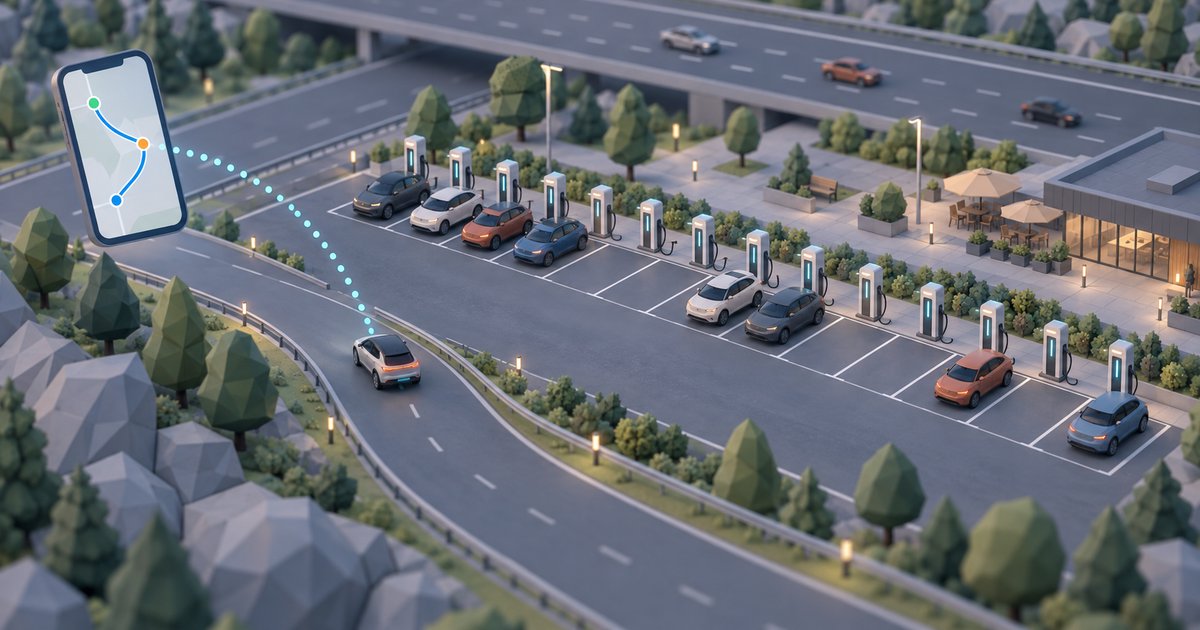
Tesla Charging said on 16 September 2026 that forecasted Supercharger availability is "now also available over Android Auto". It is a small sentence with a large addressable market behind it, and it is aimed at drivers who do not own a Tesla.
Forecast is not live
The distinction is the whole feature. Live availability tells you how many stalls are free at a site right now — useful when you are five minutes away, close to worthless when you are ninety. A forecast estimates how many will be free when you get there, which is the number a driver planning a stop actually needs.
Tesla builds that estimate from its own network telemetry and from the navigation data of drivers who opt in. That is the trade: you let the routing you have already entered feed the model, and in return the model gets better at predicting the site you are heading for. It is opt-in rather than assumed, which is the right default and worth saying out loud.
| Rollout | Reaches |
|---|---|
| June 2026 | EVs with Google Maps built into the car |
| 16 September 2026 | any car running Android Auto |
Why the second step matters more in Europe
Google Maps built into the dashboard is a manufacturer decision, shipped on a subset of recent models. Android Auto is a phone projected onto a screen, and it is fitted to a very large share of cars already on European roads, across brands and model years. Moving a feature from the first group to the second multiplies its reach without anyone buying a new car.
That matters here specifically because the audience is non-Tesla drivers. Superchargers have been open to other brands in European markets for long enough that the network is a general-purpose option, not a marque benefit — and a driver of another brand has no Tesla app, no in-car Tesla navigation, and until now no good way to see what they would find on arrival. Android Auto is where that driver already is.
What it does not fix
A forecast does not create stalls. The pressure it helps you route around is real — Tesla has been rebuilding sites to add capacity and holiday peaks still produce queues at the big corridor sites — and a better prediction only redistributes demand, it does not add supply. If everyone's app forecasts the same quiet site, the forecast stops being true.
It also does not change what you pay. European Supercharger pricing has moved repeatedly this year, down to 20 cents per kWh overnight in Germany, and non-Tesla drivers pay a different rate from members. Nor does it touch idle and congestion fees, which are charged on how long you stay after charging, not on how busy the site was when you arrived.
Neither caveat is a criticism of the feature. Knowing that four of twelve stalls will probably be free when you pull in is materially better than knowing nothing, and better than a live count taken an hour before you get there. It is simply a planning tool arriving on the screens of the drivers most likely to need it, which is a quietly sensible piece of network strategy from a company that now sells charging to everyone.