
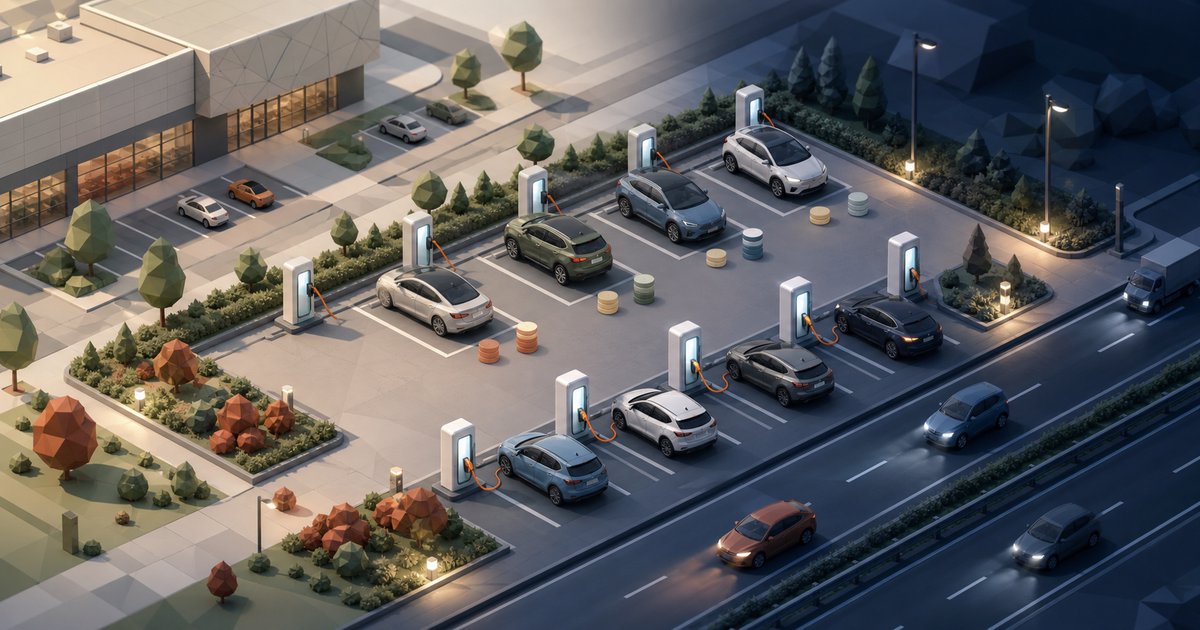
Tesla has opened another Polish Supercharger to cars from other brands. The Bytom site sits at the M1 shopping centre, less than two kilometres from the A1, and has eight stalls delivering up to 250 kW to a Tesla and around 200 kW to a 400-volt car from another manufacturer.
It is not the first. Rumia was opened to all brands in November 2025, and Stryków, Radom — expanded to twelve stalls on 16 July 2026 — Poznań and Warszawa Al. Krakowska have followed. Plenty of Polish sites are still Tesla-only, including Katowice, Białystok, Warszawa-Ząbki, Łućmierz and Poznań centrum, so "Superchargers are open in Poland" is still a site-by-site statement rather than a network-wide one.
Four variables set the price
The thing Polish owners actually ask about is the tariff, and it is not a single number. Four things move it.
| Variable | Effect |
|---|---|
| Brand | A Tesla always pays the lower rate |
| Membership | 50 zł/month, gives a non-Tesla the owner-level price |
| Time of day | Peak roughly 09:00–22:00, off-peak 22:00–09:00 |
| Site | Tariffs are set per location and change |
At the cheap end, a Tesla or a membership holder charging off-peak pays around 1.1 zł/kWh. At the expensive end, a non-Tesla with no membership charging at peak pays up to about 2.4 zł/kWh. Between those, a non-member from another brand is generally quoted near 1.9 zł/kWh overnight and 2.3 zł/kWh during the day, with the national average for non-Teslas without a subscription sitting around 2.2 zł/kWh and varying by site from roughly 1.5 to 2.9 zł/kWh.
That spread — better than double, end to end — is the whole point of the pricing model. Tesla is not opening the network at one price; it is opening it at a price that keeps its own drivers cheapest.
When the membership is worth 50 zł
For a non-Tesla driver, the subscription breaks even at roughly 83 kWh a month, which is about 400 to 500 km of driving for a typical EV. Below that, pay per session. Above it, and especially if you charge during the day, the membership is the difference between owner pricing and the top of the range.
For a Tesla owner the membership is irrelevant — you already have the lower rate.
What opening a site actually changes for a Tesla owner
Two things, pulling in opposite directions.
The unwelcome one is queues. A Supercharger opened to every brand is a Supercharger with more cars in it, and Tesla's own pricing is the tool it uses to manage that: the peak/off-peak gap exists to push discretionary charging into the night. Hungary showed the harder version of this problem when the grid forced power limits and Tesla briefly tried prices first.
The welcome one is competitive pressure. Polish fuel-station operators are responding — Moya is running a promotion at 1.99 zł/kWh until the end of August across fourteen sites with power up to 120 kW. When the Supercharger network sets a public price, every other operator in the country has to answer it, and Tesla owners benefit from that even when they never plug in anywhere else.
One practical note: Tesla adjusts these tariffs per site and without announcement, so treat every figure here as the current shape rather than a fixed price list. The app shows the live rate for the stall in front of you, and it is the only number that binds. If you want the background on what a V3 or V4 stall can actually deliver, our guide to the Supercharger generations covers it.