
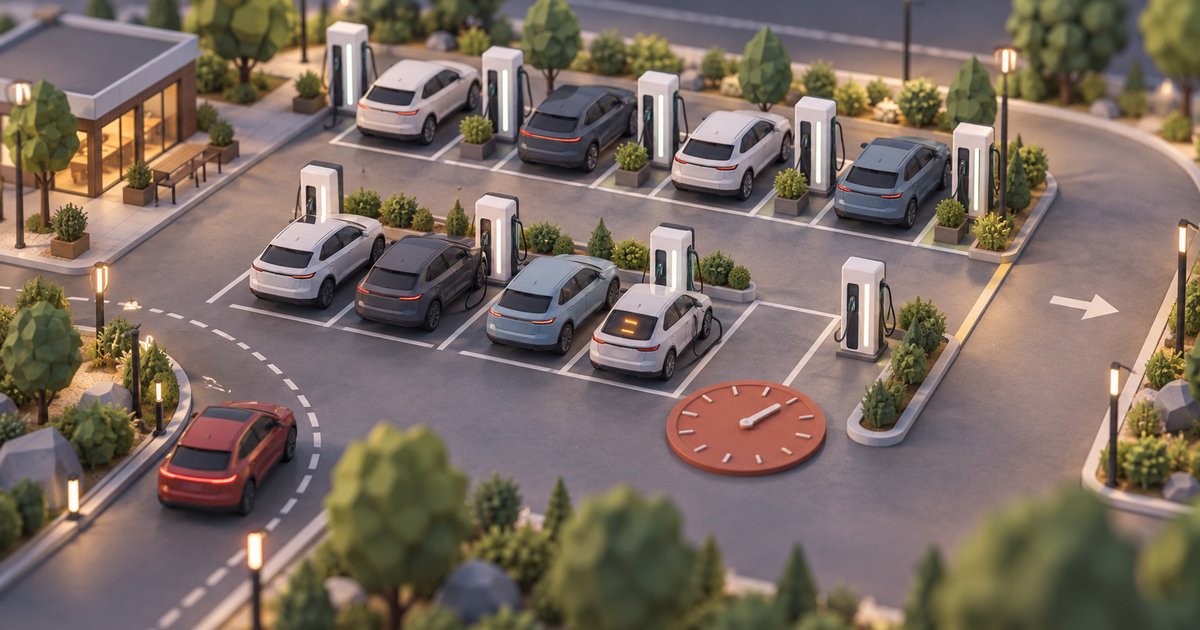
Two separate charges can appear on a Supercharger bill after the electricity stops being the expensive part. They have different triggers, they can both apply on the same visit, and both are avoidable once you know what starts the meter.
Idle fee versus congestion fee
An idle fee is charged when your car has finished charging and is still occupying the stall.
A congestion fee is charged when your car is still drawing power above 80% state of charge at a busy site. It starts at 80% whether the session is still running or not — the assumption being that the last 20% is slow, and the stall is worth more to the person waiting for it.
When the meter actually starts
Neither fee applies on its own. Both require two conditions at the same time:
- Your car is done charging, or has passed 80% state of charge, and
- At least half the stalls at that Supercharger are occupied.
At a quiet site you can sit at 100% indefinitely and pay nothing.
What it costs
The rate steps up with how full the site is, charged by the minute:
| Site occupancy | Rate per minute |
|---|---|
| Below 50% | €0.00 |
| 50% or more | €0.50 |
| 100% | €1.00 |
Tesla applies the same numeric structure across currencies — $0.50/$1.00, £0.50/£1.00, €0.50/€1.00 — rather than converting, so the euro figures are the ones a European owner pays. Rates can vary by location, so the in-app site detail is the authority for any given stall.
A full site at €1.00 a minute is €60 an hour. That is more than most people's entire charging session.
The five-minute rule
Any fee is waived if you move the vehicle within five minutes of it becoming chargeable. This is the single most useful thing to know: the grace period is generous enough that a fee almost always means nobody came back to the car, not that somebody was slightly slow.
The Tesla app sends a notification when charging completes and again when fees begin accruing. Turn those notifications on.
Tesla also typically waives a driver's first idle or congestion fee — but once per account, over its lifetime, not once per year.
How to avoid paying, in practice
- Set a charge limit below 80% on a road trip. You will leave before the congestion fee can start, and the 10–80% portion is where the charging speed is anyway.
- Treat the notification as the alarm. Five minutes is the whole margin.
- Check the site occupancy before you wander off. A half-empty Supercharger costs nothing to linger at; the same stall at a full site starts billing immediately.
- Do not plan to finish a meal at 100%. The fee exists precisely for that behaviour.
The European context
These fees are a smaller part of the bill than they were, because the energy price has been moving. Tesla cut prices at many German Superchargers, with off-peak rates from 20 cents per kWh, and in Poland the network keeps opening to other brands, where four separate factors decide what you pay. Cost is also the thing that dropped Tesla's network to fourth in J.D. Power's 2026 study, so the fee structure is worth understanding rather than assuming.
Tesla has also been known to charge these fees when it should not have. It ended up refunding idle fees billed to owners with free lifetime Supercharging — a reminder that the line item is worth reading rather than waving through.