
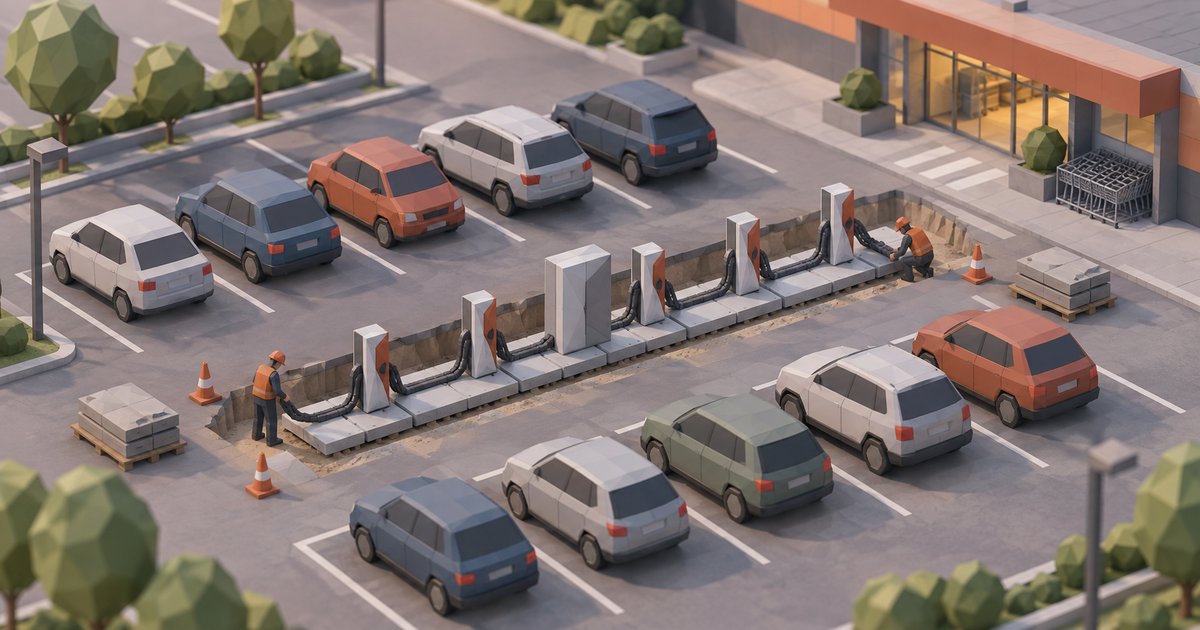
Tesla has added a second pre-assembled Supercharger to its catalogue, and this one is shaped for the place a charging site usually cannot go: the strip between two rows of parking spaces.
The Tesla Charging account unveiled the Accordion Supercharger on 15 September 2026 in a post and short video. The unit ships as a factory-built package — a central V4 cabinet with its posts already wired, mounted on pre-cast base slabs — that is lowered into an excavated trench and then drawn outward along the row, the cabling unfolding with it. Tesla's stated ambition is blunt: "Our goal is to pre-assemble all Superchargers in a factory."
What is actually new here
The geometry, and only the geometry. Tesla's existing folding Supercharger, which reached Europe in June, is built for the conventional layout — a line of posts behind a kerb, fed from a cabinet at one end. That works when a site has a kerb line to build against. Many car parks do not. The accordion design targets the leftover channel between facing parking bays, which is typically where a site's drainage and lighting already run and where a conventional install would mean trenching across live parking.
| Folding Supercharger | Accordion Supercharger | |
|---|---|---|
| Announced | March 2026 | 15 September 2026 |
| Fits | Behind a kerb line | Between facing parking rows |
| Assembly | Factory pre-assembled | Factory pre-assembled |
| Deployment | Unfolds into 8 units on site | Expands along a trench |
The numbers Tesla quoted are the ones it quoted in March
This is the part worth reading carefully. The figures attached to the accordion launch — 20% cheaper to install and 16 stalls per truck — are the same two figures Tesla published for the folding unit in March 2026, alongside a claim of half the deployment time and 33% more units per truck. Tesla has not published an accordion-specific install cost, deployment time, or power rating.
That does not make the figures wrong. Both products are the same idea — move the electrical work into a factory — so it would be surprising if the economics diverged much. But a reader should know that nothing in the 15 September announcement measured the accordion itself. It is the family's number, reprinted.
The same caution applies to the network figure doing the rounds with it. More than 80,000 Supercharger stalls are active worldwide; that is the size of the deployed network, not a count of pre-assembled units, of which Tesla has never published a total.
Why the form factor is the story
Supercharger growth is no longer limited by the hardware. It is limited by civil works, grid connections and permitting — the slow, local, expensive part. A pre-assembled unit attacks exactly one of those: it collapses weeks of on-site electrical labour into a crane lift and what Tesla calls "instant commissioning."
What it changes for European sites
This matters more in Europe than it does in North America, because European sites are more often retrofits into existing car parks with awkward shapes rather than greenfield builds beside a highway. A design that fits a parking aisle rather than requiring a kerb line widens the set of locations that can host a V4 site at all — supermarket and shopping-centre car parks most obviously, the category where Tesla has been adding urban capacity fastest.
It is also consistent with what Tesla has done on the truck side, where it shipped pre-assembled Megachargers for the Semi in June on the same reasoning.
What Tesla has not said is where the first accordion site will open, or when — and no European installation has been identified. For the wider hardware picture, our guide to the Supercharger generations tracks what each version actually delivers.