
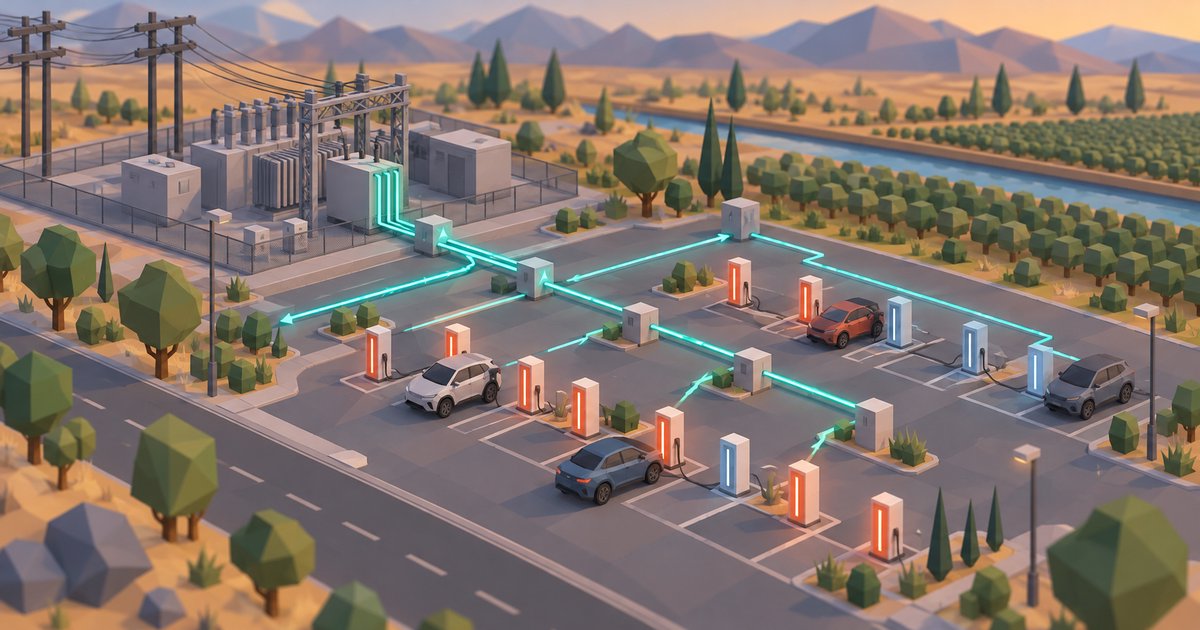
Tesla Charging published a short article on X on the evening of 12 October 2026, Pacific time, under the title "Opening Superchargers Years Sooner" (the post). The substance is a change in who controls a Supercharger's power. In Pacific Gas and Electric's territory in Northern California, the utility can now set a site's limit, hour by hour and a day ahead, and in exchange the site opens before the grid upgrade it would otherwise have waited for.
What Tesla said
"As of this month, our V4 Supercharger cabinets can talk directly to PG&E's systems using IEEE 2030.5," Tesla wrote, describing it as an open standard for utility communications that it recommends to utilities worldwide, as quoted by Tesla North. PG&E uses the link to send a power limit derived from its day-ahead forecasts. "The grid is built for its busiest hours, so it usually has spare capacity," the post says, and "sites typically run well below their maximum." When the local grid is constrained, the site is de-rated; the rest of the time it runs at full power.
Tesla says the arrangement has already accelerated some projects, with dozens more under way, that several pilot sites open in October, that a wider Northern California rollout follows, and, in the sentence that will travel: "We expect a typical project to be able to open more than 2 years sooner." The comparison it draws is with the Semi's Megacharger projects in Southern California, where the utility queue can run beyond three years, Drive Tesla Canada notes.
The programme is PG&E's, and it is two years old
Flex Connect is not a Tesla product. It is PG&E's flexible-interconnection programme, and Tesla has been in it from the start. Canary Media reported in December 2024 that the first two pilot connections were switched on in late October 2024: a Tesla fast-charging site in the Central Valley, which Tesla's post identifies as the 48-stall Santa Nella Supercharger, and an undisclosed battery system. PG&E's distributed energy resource management system, built with Schneider Electric and run on Microsoft's cloud, forecasts the limit at each substation and sends every participant an hourly schedule for the next day. Alex Portilla, PG&E's director of grid edge innovation, gave the example of 90% of capacity from 5 to 6 pm and 50% from 7 to 8 pm.
| Flex Connect | |
|---|---|
| Who sets the limit | PG&E's grid-management system, hourly, one day ahead |
| Normal operation | full power when the grid has room |
| Constrained hours | the site is de-rated to the utility's limit |
| Lost communication | the site falls back to a pre-set lower limit |
| Breaking the limit | can remove a participant from the programme |
| Link to the cabinet | IEEE 2030.5, as of October 2026 |
| First Tesla site | Santa Nella, 48 stalls, opened 2024 |
| Next | pilot sites in October 2026, then Northern California |
PG&E's system took more than a year to build, and the Santa Nella site's earlier connection agreement had capped it at 20% of its load in summer and 71% the rest of the year. What is new this month is the standard: the utility's signal now arrives at the V4 cabinet over IEEE 2030.5 rather than through a one-off integration, which is what makes "dozens more" sites a plausible number.
Why a European owner should care
Grid connection is the slow part of building a Supercharger here too. TeslAnt has written that Supercharger growth is now limited by civil works, grid connections and permitting rather than by hardware, that Tesla ran its Arlandastad site in Sweden entirely on Megapacks to avoid needing a grid connection during the electricians' blockade, and that Britain's £190 million motorway-grid scheme exists because the connection, not the charger, is what motorway services wait for. In the Netherlands, where grid congestion has put connection requests on waiting lists, the regulator ACM already lets grid operators sell non-firm transmission agreements at a discount to users who can cut back at peak hours.
What Tesla has not said is whether any European grid operator is on the other end of an IEEE 2030.5 link. The post addresses "utilities worldwide" as a recommendation, not a list. The European V4 cabinet is the same hardware, as the 500 kW site in Norway showed, so the missing piece is the utility's side of the conversation, not Tesla's.
What it means at the cable
For a driver, a Flex Connect site is one whose power can be cut back in hours the utility names in advance, which will usually be the early-evening peak. Tesla's argument is that new sites rarely run near their maximum, so most drivers will not notice. The honest caveat is that the de-rating happens in the busiest hours of the grid, which overlap with the busiest hours of a charging site on a holiday weekend. A site that opens two years early at reduced evening power is still a site that exists. That is the trade Tesla is making, and it is a better one for drivers in a town with no Supercharger than for drivers queuing at a full one.