
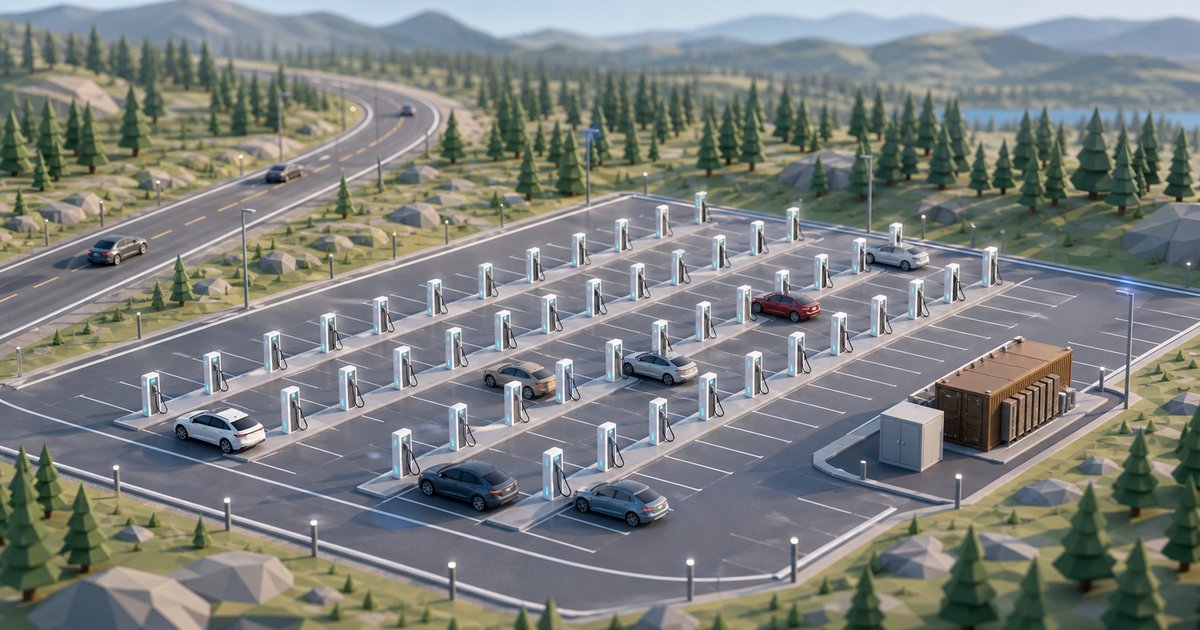
Tesla is commissioning 264 new Supercharger stalls across 20 locations in Sweden, the first large wave of Swedish charging capacity the company has been able to energise in nearly three years. It follows the end of the union action that had blocked new grid connections for Tesla's chargers — the dispute TeslAnt covered when IF Metall ended its 1,021-day strike.
The scale is significant for a single market. Sweden goes from roughly 1,350 charging points to more than 1,600 across over 100 sites, a jump of about 20% in one step.
Where the stalls are going
| Location | Stalls |
|---|---|
| Göteborg (Gamlestaden and Stigs Center) | 40 |
| Östersund | 20 |
| Ljungby | 20 |
| Arlandastad | 20 |
| Vansbro | 16 |
| Gävle väst | 12 |
| Bollnäs | 12 |
| Kläppen/Sälen | 12 |
| Lomma | 12 |
| Kungsbacka | 12 |
| Laxå | 12 |
The geography is not random. Kläppen/Sälen and Åre are ski-season destinations where charging demand spikes hard for a few months; Kiruna, Överkalix and Ytterhogdal are far-north sites that close gaps on routes where a missing charger does not slow you down so much as stop you. Ljungby and Laxå sit on the main north–south corridors. This is a network being filled in at its thin points rather than thickened where it was already strong.
Arlandastad is the entry with history attached. It is the site where Tesla built a Supercharger that runs entirely on on-site Megapack batteries rather than a grid connection — the workaround that let the company add capacity while electricians refused to connect its chargers. It now gets 20 stalls under normal conditions.
What the blockade actually did
The strike itself involved a comparatively small number of workers, but the sympathy actions were broad: dockworkers refused to unload Teslas at Swedish ports, unions in Denmark, Norway and Finland joined the port blockade, and electricians would not perform grid connections for Superchargers. That last piece is what froze charging expansion, and it is why 264 stalls are arriving at once instead of being spread over three years.
Tesla never signed a Swedish collective agreement. It bought out the remaining strikers — around 80 workers — and IF Metall suspended all industrial action from 19 August 2026.
Why this matters across Europe
For Swedish owners the effect is direct: more stalls on the routes where the network was weakest, in a market where the Model Y remains the best-selling used EV even as new Tesla sales have fallen.
For everyone else, two things stand out. Tesla confirmed that all new and existing Swedish stations are open to all electric car brands, continuing the pattern seen in markets like Poland — so this is 264 stalls of capacity for every EV driver in Europe who charges in Sweden, not just for Teslas. And it lands at a moment when the network's reputation is under pressure on price rather than coverage, after Tesla slipped to fourth in J.D. Power's 2026 charging study. Adding a fifth of a national network in one move is the kind of answer no other charging operator in Europe is currently in a position to give.
Update: 2026-09-19
The rollout described above has now started. Tesla opened the Ljungby station on 17 September 2026, the first of the 264 stalls to be energised, with 20 stalls as listed in the table. Auto Motor & Sport Sverige reports that the remaining sites across the 20 locations are due to come online over the following weeks rather than in a single switch-on, with Göteborg's 40 stalls among them. That makes Ljungby the first concrete evidence that the post-blockade grid connections are actually being completed, three weeks after the union action was lifted.