
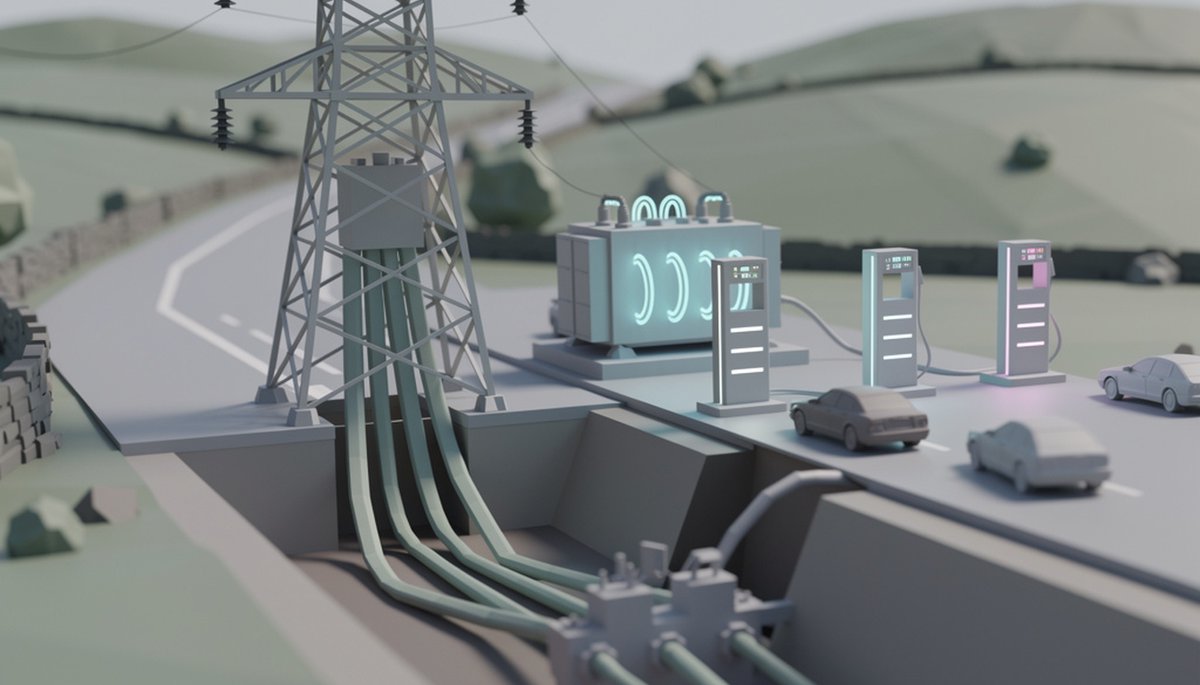
The UK government is trying to fix one of the least visible obstacles to fast EV charging: the electricity grid behind the plug. A newly opened consultation proposes a £190m Strategic Charging Infrastructure (SCI) scheme that would pay to upgrade grid capacity at motorway service areas where high connection costs have made private investment uneconomic.
How the scheme would work
Rather than handing money to charge point operators, the government would contract directly with electricity network connection providers to increase grid capacity at chosen sites. That extra capacity would then be offered to charging operators at heavily subsidised connection charges, letting them add high-power chargers without shouldering the full cost of a grid reinforcement. In effect, the state pays to remove the bottleneck and then rents the freed-up capacity to the market at a discount.
The £190m is an indicative allocation drawn from the £400m earmarked for EV charging infrastructure between 2026 and 2030 in the 2025 Spending Review. The Department for Transport is running the consultation. The logic is that a single high-power charging hub can demand as much electricity as a small town, and at some motorway sites the cost of reinforcing the local network to supply it runs into the millions — a bill no operator can recover from charging fees alone. By absorbing that upfront cost, the government hopes to turn commercially impossible sites into viable ones.
What it replaces
The SCI scheme is designed to succeed the £70m Rapid Charging Fund, a pilot launched in December 2023 that ultimately concluded without awarding any money. That earlier fund struggled to translate its budget into delivered upgrades, and the new approach — funding the network directly instead of reimbursing operators — is the government's attempt to avoid a repeat.
Where the money would go
Eligibility is deliberately narrow. Funding would apply only to existing motorway service areas in England where grid connection costs exceed commercially viable levels. Major A-road sites are excluded, on the basis that competition has already driven charging growth there — the number of A-road charging "cold spots" fell by around 75% between January 2024 and October 2025. The scheme targets the remaining hard cases where the grid, not demand, is the limiting factor.
Timeline and relevance to Tesla owners
The consultation is open until 28 July 2026, seeking views on site selection, connection pricing and how long reserved capacity should be held before release to the wider market. The Department for Transport says the goal is to ensure affected motorway services have enough electricity capacity by 2030 to meet projected charging demand through 2035 and beyond.
For Tesla drivers in Britain, the payoff is indirect but real. Many UK Supercharger sites and third-party rapid hubs share the same motorway-service grid connections, so cheaper, larger connections make it easier for every operator — Tesla included — to expand high-power charging on long-distance routes where queues are most likely.