
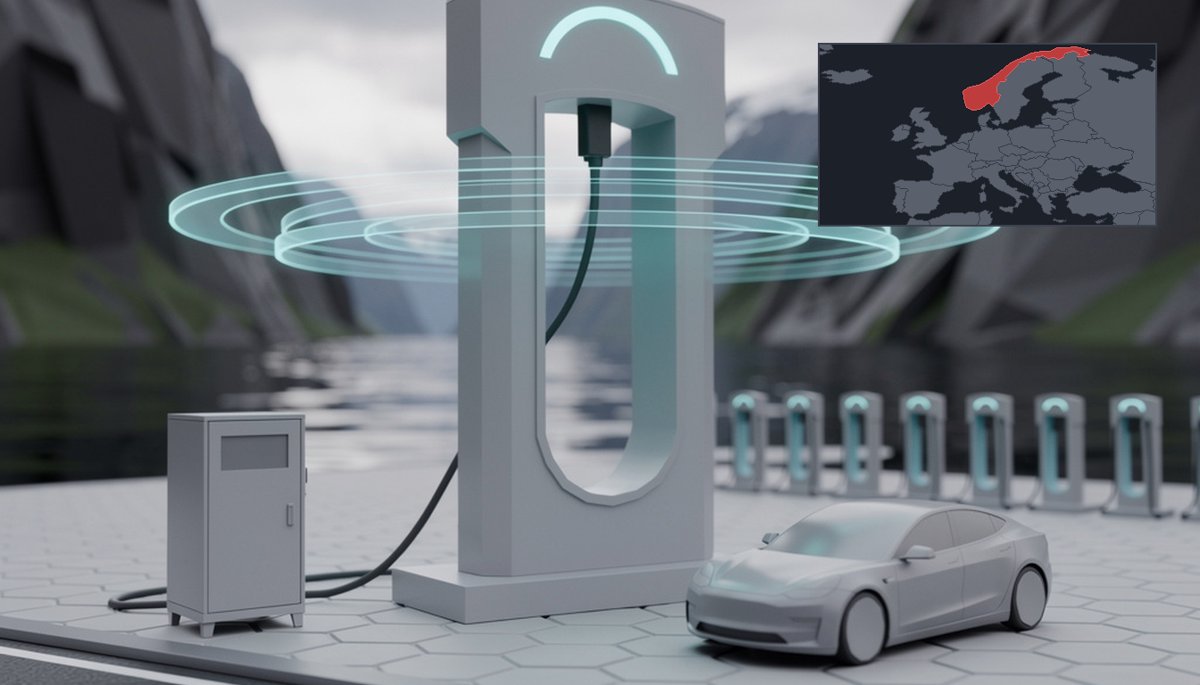
Europe has plugged into Tesla's V4 Supercharger posts for well over a year, but the cabinets feeding those stalls were still the older V3 generation, capping output at around 250 kW. That changes now. Tesla has energised the continent's first Supercharger backed by a full V4 power cabinet at Hellerudsletta, just outside Oslo, lifting the site's hardware ceiling to 500 kW per stall.
What actually changed
The distinction matters. The slim V4 posts already rolled out across Europe are mostly cosmetic upgrades wired to V3 cabinets behind the scenes — longer cables, a payment terminal, and a higher voltage architecture, but the same power limit. The new Norwegian site pairs those posts with the V4 cabinet they were designed for, and that is what unlocks the higher figure. The power electronics were built at Tesla's factory in Buffalo, New York, then shipped to Norway for the first European deployment.
Norway is a logical launch point. It is one of Tesla's strongest markets by share — the brand took 21.5% of new registrations there in May — and the country's grid and cold climate make it a useful proving ground for high-power charging.
Who benefits from 500 kW
It is worth being precise about the headline number. No Tesla on sale today charges anywhere near 500 kW. The refreshed Model Y and Model 3 peak at roughly 250 kW, and even the Cybertruck — not officially sold in Europe — tops out lower than the cabinet's ceiling. The 500 kW figure is about headroom, not a speed any current Tesla owner will see on the dash tomorrow.
The practical gains are more subtle. A higher-capacity cabinet sustains peak rates for more cars at once, so a busy site is less likely to throttle stalls when several vehicles arrive together. As Tesla continues opening its network to non-Tesla EVs across Europe, the extra power also future-proofs the site for vehicles built on 800-volt architectures that can pull more than today's Teslas.
The European angle
For European drivers, the significance is direction of travel. Tesla's network has long led on reliability and ease of use but lagged rivals such as Ionity and Alpitronic-equipped sites on raw peak power. A 500 kW cabinet closes that gap and signals that the continent's V4 rollout is moving from cosmetic posts to genuinely uprated infrastructure.
Tesla has not published a timeline for converting other European sites to full V4 cabinets, and the Hellerudsletta location remains a single installation for now. But the hardware is proven and in the field, which usually precedes a broader rollout. For owners, the message is simple: the slim posts appearing at motorway stops are finally starting to get the power supply they were always meant to have.