
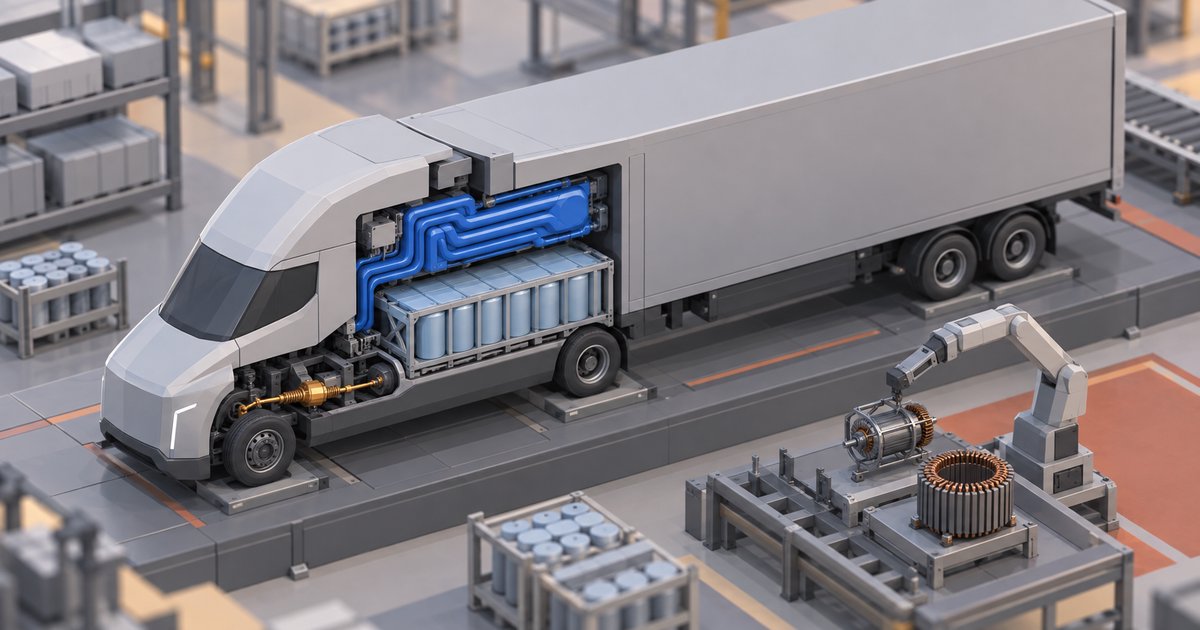
When Tesla handed over its first series Semis in Sparks, Nevada on the evening of 24 September 2026, the trucks looked like the ones it has been showing since 2017. Underneath, they are not the same vehicle. Over the days that followed, Lars Moravy and Dan Priestley set out what changed on the way to a production line, and most of it is subtraction.
The hydraulics are gone
The production Semi has fully electric power steering and no hydraulic assistance at all: no pump, no hoses, no fluid reservoir. Tesla says it is the first heavy-duty truck to delete hydraulic steering outright, and the architecture comes from the Cybertruck's 48-volt system.
The company's framing is the part worth noting. It calls the system lighter, quieter, more precise and redundant by design, and describes it as groundwork for future autonomy. A steering rack a computer commands directly, with no hydraulic path in between, is a precondition for running the truck without a person in it. Elon Musk said at the event that self-driving features would follow, and attached no date to it.
European operators should watch how that meets type approval. Steering equipment here is governed by UNECE Regulation No. 79, and a system with no hydraulic fallback is a different approval question from one that merely adds assistance to a mechanical rack.
One heat pump for the whole truck
The thermal system is called Megamanifold, and Tesla's Semi account describes it as running "cabin HVAC & all powertrain heating & cooling at once". A diesel truck throws its engine heat away. The Semi pulls waste heat out of the drive units and battery and uses it to warm the cab.
Not a Tesla App reports that engineering first tried fitting two Model 3 and Model Y heat pumps and found they could not carry a truck's thermal load, so the Megamanifold is a new unit, sharing its core architecture with Cybercab. It belongs to a family: Tesla has been consolidating coolant plumbing into single castings since the Model Y's Super Manifold.
For a European haulier this is the least glamorous change and possibly the most valuable. Cab heating through a Nordic winter is drawn from the same pack that moves the truck, and heating from waste rather than from the battery protects the range a route was planned around.
Cells, rotors and one kind of oil
| Component | Prototype | Production |
|---|---|---|
| Battery cells | 2170 | in-house 4680 |
| Rotor | carbon-fibre wrapped | steel caged |
| Stator | — | bar-wound, shared with Cybertruck |
| Steering | hydraulic | 48-volt electric |
The 4680 switch cuts pack weight and cost without giving up range, and it puts the Semi on the same cell Tesla is now building with lithium refined at its own Texas plant. The steel-caged rotor is cheaper than a carbon-fibre-wrapped one and holds its efficiency better across temperature and terrain. EV Wire adds that the drive axle now runs on one oil type where the prototype needed three, a maintenance detail that matters to a fleet and to nobody else.
Not a Tesla App puts the production truck at roughly 1.7 kWh per mile, and running costs at 20 to 25 cents a mile against 50 to 80 cents for diesel.
What reaches Europe
All of it, eventually, because the European Semi is a Nevada-built truck shipped here from 2027: one variant, up to 550 km at 40 tonnes, charging at 800 kW on MCS. The hardware described in Nevada is the hardware that will arrive. What Tesla still has not attached to it is a European allocation.