
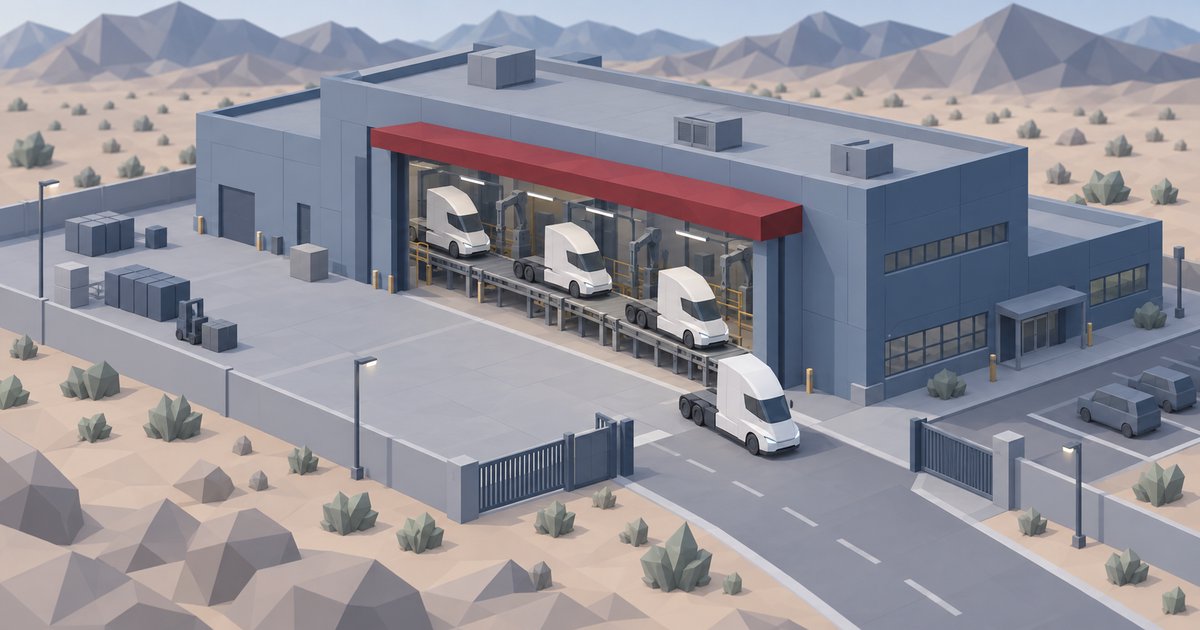
Tesla inaugurated its Semi factory in Sparks, Nevada on the evening of 24 September 2026 and handed series-production trucks to customers. Nine years after the Semi was unveiled, and nearly four after a handful of pre-production units went to PepsiCo, the trucks leaving this building came off a line rather than out of a workshop.
Who collected one
Drone footage the day before gave the guest list away: at least eleven Semis in customer livery parked outside the plant. The names on them included PepsiCo, US Foods, DHL, WattEV, ABF, Einride, IMC and OK Produce.
Tesla called the event the start of high-volume production and added the Semi to its homepage — the small administrative act that turns a prototype into something a fleet can order.
The three numbers Tesla did not give
When TeslAnt previewed this event in August we said the thing worth watching was not the ribbon but whether Tesla would attach a production rate, a delivery total or a European allocation to it. It attached none of the three.
That is the story. The plant has a nameplate capacity of 50,000 trucks a year and has been building trucks since 29 April. What it is building now remains undisclosed, and outside estimates for 2026 still sit between roughly 5,000 and 15,000 — somewhere between a tenth and a third of the line's design rate. An inauguration five months after production started was always going to be a ramp event rather than a start event, and it behaved like one.
What was announced
| Figure | |
|---|---|
| Range at 82,000 lb gross combination weight | 500 miles |
| Range at roughly half load | 600+ miles |
| Megacharging in North America by end of 2026 | 30+ stations, 200+ posts |
| Current production rate | not disclosed |
| European allocation | not disclosed |
What changes in Europe
Nothing this year. European deliveries remain set for 2027, built in Nevada and shipped; German production has been raised as a possibility and not committed to.
The European truck is a different vehicle on paper anyway. Tesla made its specification official on 11 September — one variant, up to 550 km at 40 tonnes, 800 kW on MCS — because the weight limits and the charging standard here are not the American ones. The 500-mile figure announced in Nevada does not transfer.
The infrastructure commitment is what a European haulier should actually watch, because a truck without chargers on its route stays in the yard. Tesla has announced a European network of more than 100 Megachargers alongside the 2027 start.
Demand is not the constraint
Tesla was the main supplier in a record 2,500-truck order placed through ZET SCALE on 22 September. Einride ordered 500 in August, none of them allocated to Europe, and a Swiss haulier placed the first European order at IAA Transportation this month. Elon Musk referred to a long waiting list at the event, and said self-driving features would follow "in the very near future" — a claim with no date attached.
The truck itself was already known in detail: Top Gear published the production specification on 18 September. What changed on 24 September is narrower than the staging implied, and still real. Tesla now has a truck factory that has delivered to paying customers. Whether it can fill a second continent's orders from it is the question the evening left open.