
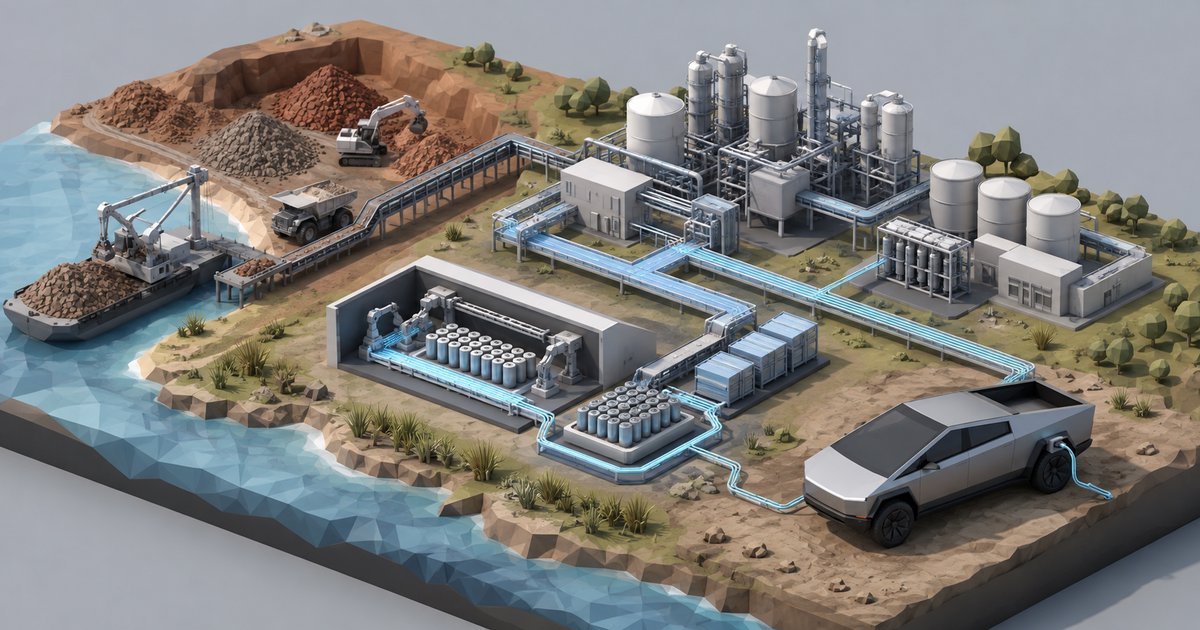
Tesla's Cybertruck account posted a photograph from Giga Texas late on Friday 4 September 2026 announcing that a truck had been built with 4680 cells containing lithium from the company's own Gulf Coast Lithium Refinery. Elon Musk quote-posted it minutes later with four words: "Lithium made in America."
The photograph is unremarkable. What it records is not. Until now, every Tesla ever delivered contained lithium that somebody else had refined.
What actually changed
Tesla has made its own cells since 2020 and its own cathode material since 2023. The step it had not taken was the one furthest upstream: turning spodumene — raw lithium-bearing rock — into the battery-grade lithium hydroxide a cathode needs. That conversion is the chokepoint of the entire battery industry, and it happens overwhelmingly in China.
The chain Tesla described on Friday runs spodumene into the refinery at Robstown, near Corpus Christi, out as lithium hydroxide, up the road to the 4680 cell lines at Giga Texas, and into a Cybertruck on the same site. No step in it leaves the state.
The plant
| Gulf Coast Lithium Refinery | |
|---|---|
| Location | Robstown, near Corpus Christi, Texas |
| Ground broken | May 2023 |
| Investment | More than $1 billion |
| Fully online | Early 2026 |
| Target output | 50 GWh of battery-grade lithium a year |
| Vehicles that supports | Roughly 1 million a year |
| Process | Alkaline, acid-free |
It is the first spodumene-to-hydroxide refinery in North America and now the largest facility of its kind on the continent. The refining route is the genuinely unusual part. Conventional plants roast the rock with sulfuric acid and are left with sodium sulfate, a hazardous waste that has to be disposed of. Tesla's alkaline process instead produces analcime, a benign sand-like mineral the company ships out for use in construction materials, and Tesla puts the emissions saving at about 30% against hard-rock refining.
That is a cost argument as much as an environmental one. A refinery that sells its byproduct rather than paying to bury it has a structurally different cost base, which is the whole reason to build one.
What Tesla did not say
Three things, and they matter more than the announcement.
It did not say how many Cybertrucks already carry Gulf Coast lithium — this may be one truck or a week's production. It did not say what share of Giga Texas cell output the refinery now feeds. And it did not say when another model follows.
What it means for Europe
Less than the headline suggests, though not for the obvious reason. European Teslas already run on Tesla's own 4680 cells: the Model Y Premium Long Range RWD swapped its LG pack for an in-house 4680 one in February 2026, and buyers noticed, because WLTP range fell from 661 km to 609 km. Cell manufacturing is not the missing piece here.
The missing piece is the step above it. Gulf Coast hydroxide feeds the 4680 lines in Austin, and the Cybertruck — a vehicle Europe cannot buy — is the only car Tesla has named. Nothing said on Friday tells a Berlin customer where the lithium in their pack was refined, and Tesla has offered no timeline for extending the chain.
What travels regardless is the economics. China began taxing lithium batteries on 1 September, at a rate set to double next year — a levy that reaches any manufacturer buying Chinese-refined material, which is most of them. A company that refines its own rock in Texas is one the levy cannot follow. Europe has spent two years writing the Critical Raw Materials Act against the same dependency and has no plant of this kind running.
So for now this is a milestone photographed at one factory, in one American state. Whether it ever reaches a European driveway depends on a chain Tesla has not yet described.