
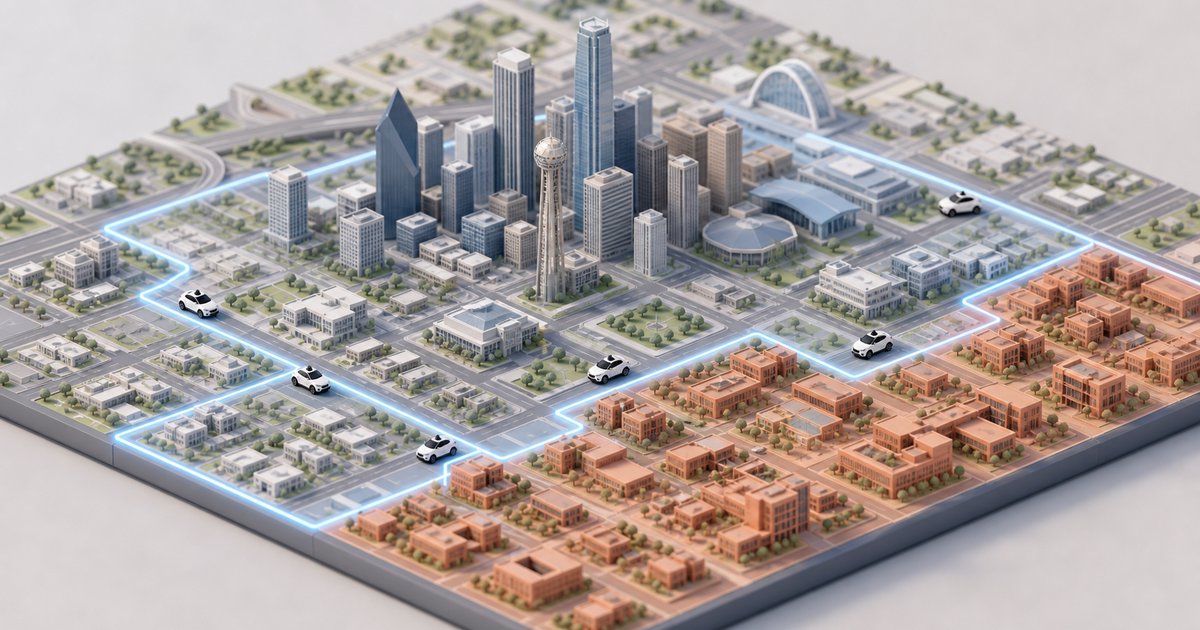
Tesla enlarged its Robotaxi service area in Dallas on 29 August 2026, posting a new coverage map to the service's account under the line "Bigger service area for Robotaxi in Dallas, TX." It did not say how many square miles were added, which neighbourhoods came inside the line, or when riders would notice.
That is the established pattern for this programme, and it is worth stating plainly rather than treating a map as a measurement.
What Dallas covered before
Robotaxi opened in Dallas on 18 April 2026, the same day as Houston. The area was small. Independent estimates put it at roughly 30 to 35 square miles centred on Highland Park and University Park, taking in downtown, parts of East Dallas and central Dallas as far north as Northwest Highway. Houston's opening geofence was estimated at about 25 square miles.
What the line excluded drew more local comment than what it enclosed: West Dallas, Far North Dallas and effectively all of southern Dallas — the city below I-30 — were left outside. Tesla published maps and, as Electrek noted at the time, almost no operational detail beyond them.
The trajectory is the story, not the announcement
Austin is the only useful yardstick. It opened in June 2025 at about 20 square miles and now covers roughly 245 after a year of incremental enlargements. Measured against that curve, one Dallas expansion four months after launch is ordinary progress rather than a step change.
| City | Opened | Opening area | Now |
|---|---|---|---|
| Austin | June 2025 | ~20 sq mi | ~245 sq mi |
| Dallas | 18 April 2026 | ~30-35 sq mi | enlarged, size undisclosed |
| Houston | 18 April 2026 | ~25 sq mi | not updated |
The expansion also follows a week in which the service moved the other way on time. Tesla said on 26 August that Robotaxi runs 06:00 to 22:00 seven days a week, with a larger unsupervised fleet and better vehicle distribution and routing so riders wait less. That reads as growth until it is compared with the schedule a year earlier, when the service ran until 02:00. More map, fewer hours.
The fleet itself is also less uniform than the announcements suggest. Tesla has never published how many Dallas vehicles operate with no one aboard, and in Austin the unsupervised share was a minority of the fleet for most of the first year.
Why this matters from Europe
None of it is available here, and none of it is close. Tesla sells FSD Supervised in Europe; the driverless service exists in no European market, and Waymo's Munich plan remains the first concrete date for a driverless European city.
What Dallas measures is something more useful than another launch: the rate at which Tesla can widen an autonomous service area once it already has one, in a jurisdiction that puts almost nothing in its way. That rate — roughly a twelvefold expansion in Austin's first year, and now a first enlargement in Dallas — is the number worth carrying forward to any European timeline, where approval, not capability, sets the pace.
It also lands days before the Cybercab launch event on 3 September in Austin, where the purpose-built two-seater is due to join a fleet that is, everywhere it currently runs, a fleet of Model Ys.
Update: 2026-08-31
On 31 August 2026, NotATeslaApp put numbers on the expansion this article could only describe: the Dallas service area went from about 31 to about 81 square miles, more than doubling rather than taking the incremental step the Austin curve implied. NotATeslaApp reports the new ground runs west toward Irving and takes in wider sections of downtown Dallas, and that the enlarged area is served by fully unsupervised rides. Read against the same day's Austin change of roughly 9%, the figure Tesla withheld describes the larger of the two moves by a wide margin — which is the opposite of what the silence suggested.