
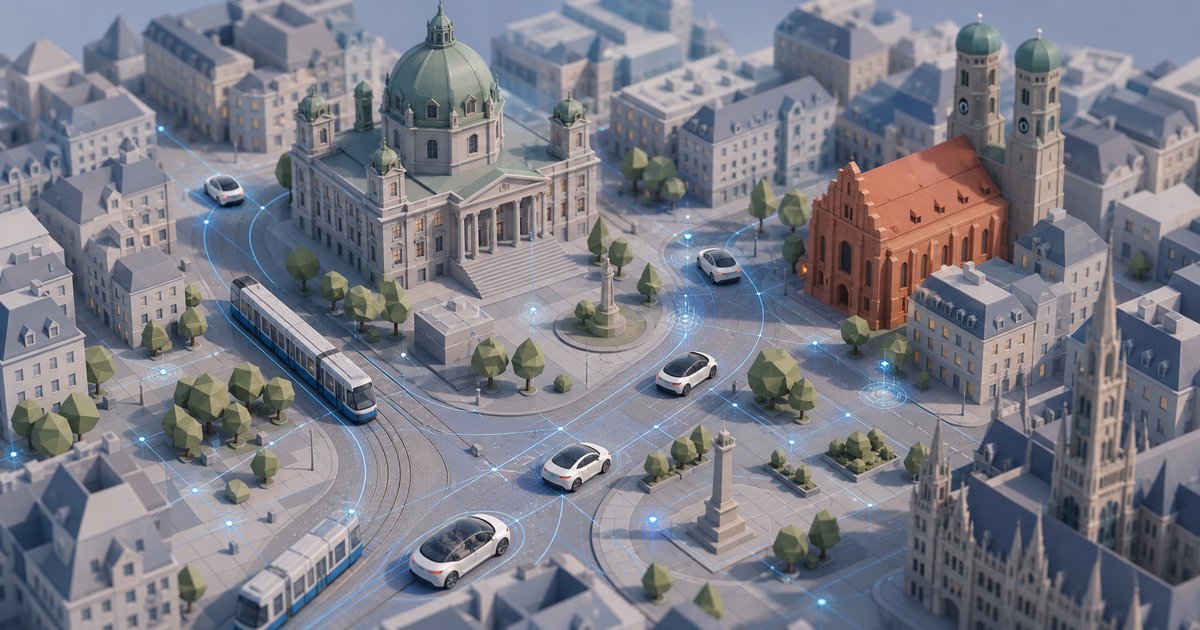
Waymo has named Munich as the city where it will launch its first robotaxi service in the European Union, with driverless commercial rides targeted for the end of 2027. Manual driving and high-definition mapping start in the coming weeks.
That is a firmer commitment than anything the company was willing to say a fortnight ago, and it is the part worth registering.
What changed since the middle of August
A fortnight ago the evidence was circumstantial: a subsidiary registered in Munich in May, fleet operator Transdev recruiting test drivers, a job posting for an operations manager. Waymo was actively playing it down — a spokesperson told Automobilwoche that a Federal Transport Ministry claim about imminent passenger service was unzutreffend, inaccurate. As our earlier read of the hiring signals put it, that looked less like a denial of the programme than a correction of its schedule.
It was. The city is now named, the date is public, and Bavarian and federal officials appeared alongside the announcement. Co-CEO Tekedra Mawakana called Munich "a world-class hub for mobility and engineering".
The phase that starts now
Nothing drives itself in Munich yet. Trained specialists will drive the cars manually while the company builds HD maps of the city and tunes its software to local traffic. Safety drivers come out only after that, and Waymo's pattern elsewhere is to carry employees and invited guests before opening a service to the public. Certification runs through the KBA, Germany's federal motor transport authority.
Munich follows London and Tokyo as international markets where Waymo is already testing. It is the first inside the EU.
Why Germany went first
Germany passed its autonomous-driving law in 2021, becoming the first EU member state to create a legal route for Level 4 vehicles on public roads. Five years later that statute is why a US operator can attach a date to a European city at all. Waymo has since registered entities in France, Spain, the Netherlands and Switzerland, so Munich is a beachhead rather than an experiment.
The numbers Waymo brought with it
| Waymo's published record | |
|---|---|
| Trips completed | 20 million+ |
| Fully autonomous distance | 350 million+ km |
| Serious-injury crashes vs human drivers | 16x fewer |
| Pedestrian crashes vs human drivers | 14x fewer |
| Cyclist crashes vs human drivers | 6x fewer |
These are the company's own figures, drawn from US operation, describing a geofenced fleet Waymo controls end to end. Read them as a claim with a good paper trail, not an independent audit.
What it means for Tesla owners in Europe
Tesla's European product is a different category of thing. FSD (Supervised) is a Level 2 system: the driver stays legally in control, hands and attention included. It has national customer approval in five countries — the Netherlands, Lithuania, Estonia, Denmark and Belgium — and the Dutch RDW said in July that there is no internal timeline for EU-wide type approval, calling the process exceptional and complex. Germany is not on that list, though the summer update did bring FSD features to European cars.
So the plausible shape of late 2027 in Munich is a driver-optional Waymo carrying a stranger across town while a Model Y owner in the same traffic supervises every metre of their own drive, having paid for the software.
That is not a verdict on which system is better engineered. Waymo solves a mapped, bounded problem with a fleet it owns; Tesla is selling a system meant to work anywhere a customer points it, harder both technically and legally. But the calendar is the calendar, and on current dates the first driverless ride in Germany will not be in a Tesla.