
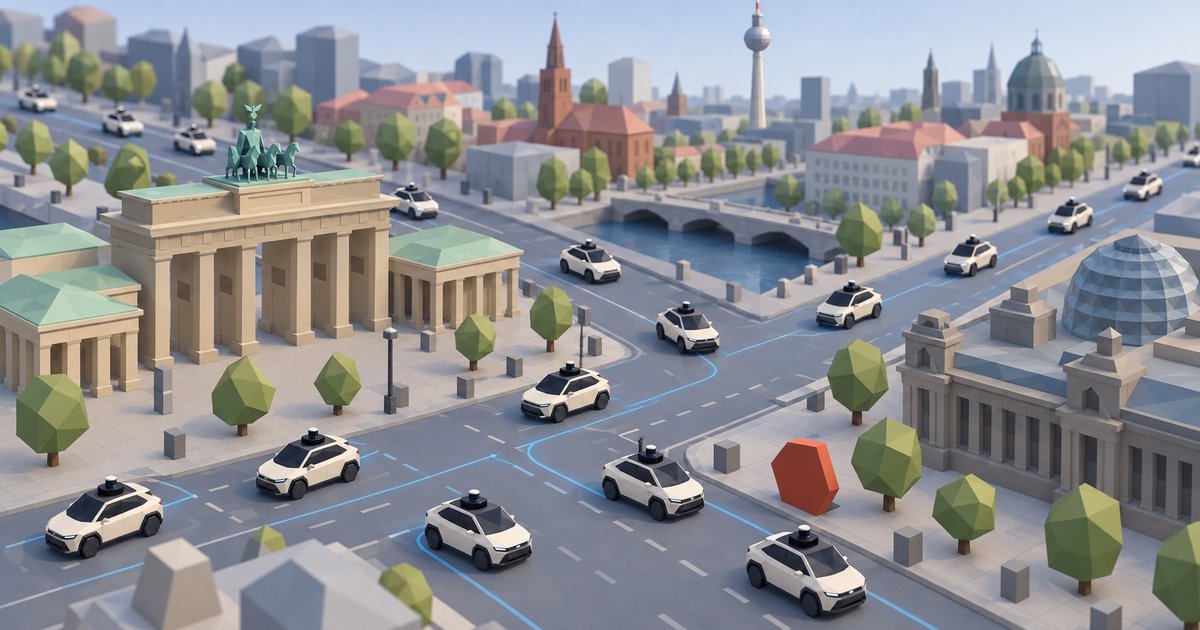
Waymo is preparing to put robotaxis on Berlin's streets, a second German city alongside Munich, according to internal Senate administration documents obtained by Manager Magazin and Der Spiegel. The company itself has not confirmed it.
What the documents say
The plan described in the Berlin papers is a mapping-and-testing phase before the end of 2026: up to 50 vehicles running in test mode, building the high-definition map of the city that Waymo's system drives against, with commercial service following in 2027.
Berlin's Senate Department for Transport is not hiding its interest. "We are technology-neutral and have a genuine interest in testing such robotaxis on Berlin's roads," a spokesperson said. According to the reporting, Waymo was the first company to approach the administration with a concrete plan for scaling a fleet and a business case to go with it, rather than a research proposal.
Waymo will say only that it would "very much like to bring the service to more locations across Germany". It has neither confirmed nor denied Berlin.
Four permissions, and nobody holds the important one
Testing is not the hard part. Germany's 2021 autonomous driving law gives Level 4 vehicles a legal route, but the route runs through the Kraftfahrt-Bundesamt, and an operator needs all of the following:
- a KBA testing permit for Level 4 operation
- a KBA operating licence for the vehicle type
- approval from the responsible state authority for a defined operating area
- a commercial passenger licence under the Passenger Transport Act
The KBA has never issued that operating licence to anyone. Every driverless project running in Germany today runs on a test permit, which is why "commercial service in 2027" is a target rather than a schedule.
It lands where Tesla builds cars
Waymo picked Munich in August as its first EU robotaxi city, with human safety drivers first and driverless operation targeted for the end of 2027. Berlin would make two German cities in a country where Tesla's FSD is still Supervised: a driver-assistance feature with a driver responsible for it, not an autonomous service.
Tesla's European plant is about 30 km from the city boundary. Giga Berlin in Grünheide builds the Model Y for Europe, and Brandenburg's transport ministry has discussed driverless shuttles with Tesla for areas the scheduled bus network does not reach. Those conversations have produced no vehicles on the road. Waymo's Berlin plan, if the documents are accurate, proposes 50 of them before January.
Neither company got there first. Pony.ai and Verne began carrying passengers with no safety operator in Zagreb on 10 September, which remains Europe's only genuinely driverless public service.
What to watch in Europe
A KBA test permit issued to Waymo would be the first hard signal that Berlin is real. Until one appears, this is a set of internal documents and a spokesperson's enthusiasm. That is still more than Tesla has to show in Germany, and considerably less than a running service.
Update: 2026-09-16
This article said the KBA had never issued a Level 4 operating licence to anyone. That needs correcting. On 15 September 2026, Einride and Lidl began running a cab-less Level 4 truck on a public road in Edermünde, Hesse, under a KBA permit granted on 14 August 2026 and valid to at least 28 February 2027 — described by both companies as the first of its kind in Germany. Neither has published which instrument under the autonomous-driving rules it is. The four-permission list above still stands for a robotaxi, and the gap it describes is real: freight needs no licence under the Passenger Transport Act, which is why a pallet carrier cleared the route before any passenger service did. Nobody has yet been licensed to carry people. See Germany's first driverless truck.