
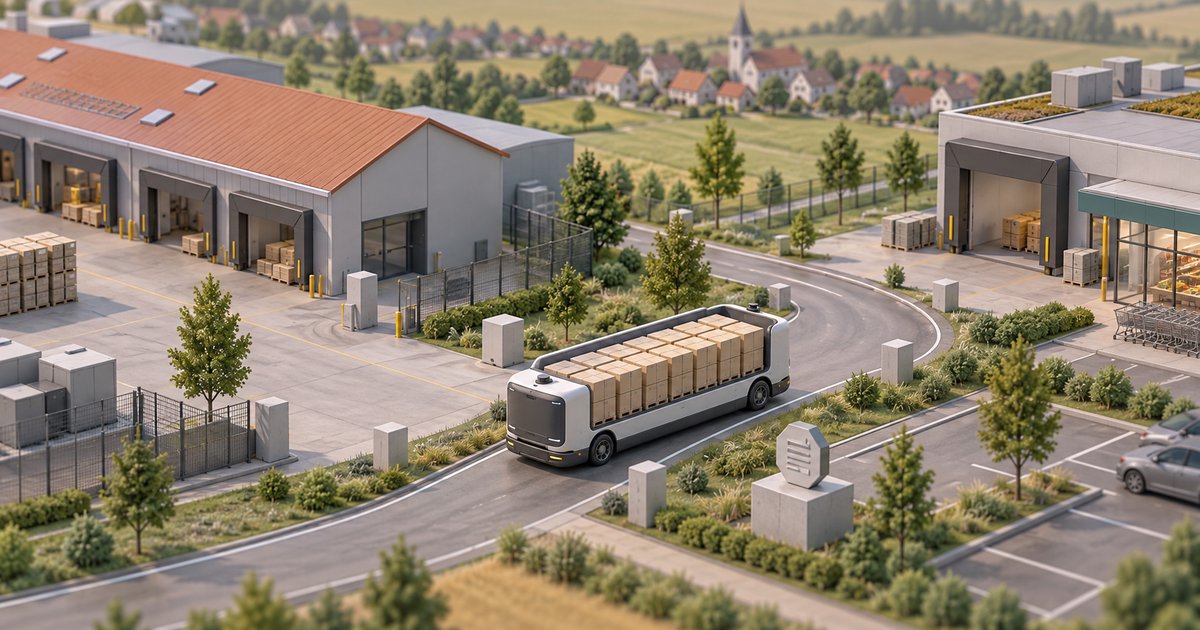
On 15 September 2026, Einride and Lidl began running a truck with no cab, no driver and nobody aboard at all between a distribution centre and a shop in Edermünde, in Hesse near Kassel. It is the first vehicle of its kind cleared for German public roads.
The clearance itself is older than the announcement. Germany's Federal Motor Transport Authority, the KBA, granted the permit on 14 August 2026, and it runs until at least 28 February 2027.
What actually runs
| Operator | Einride, for Lidl Germany |
| Location | Edermünde, Hesse |
| Route | Distribution centre to a nearby Lidl store |
| Vehicle | Einride's second-generation rigid pod, no cab |
| Capacity | 15 Euro pallets |
| Maximum permitted speed | 25 km/h |
| Autonomy level | SAE Level 4, no safety operator on board |
| Permit granted | 14 August 2026, valid to at least 28 February 2027 |
Einride and Lidl plan to extend the route into a multi-stop milk run, and further deployments across Schwarz Group companies are under discussion.
The permission Waymo still does not have
This needs a correction to something TeslAnt published the day before. Our report that Waymo wants 50 test robotaxis in Berlin said the KBA had never issued a Level 4 operating licence to anyone. On the evidence now public, the KBA had already issued one — a month earlier, to a freight operator.
The distinction that survives is the useful one. Germany's 2021 road-traffic amendment created a national approval route for autonomous driving functions: an operating permit from the KBA, plus approval of a defined operating area by the state authority, plus a technical supervisor able to intervene remotely. A robotaxi needs all of that and a commercial licence under the Passenger Transport Act. Carrying pallets does not. Einride reached the road first because the freight side of the same law has one fewer gate, not because its technology outran Waymo's.
Einride's chief executive, Roozbeh Charli, framed the approval as the point: "Germany's approval process is among the toughest in the world, and obtaining clearance there gives us a foundation to scale with confidence."
Why this reaches a Tesla owner
Because of who Einride is. This is the same company that ordered 500 Tesla Semis in August — the largest public commitment anyone has made to the truck, and not one of those Semis is bound for Europe. So the split is now explicit: Einride runs its Tesla trucks in America and its driverless trucks in Germany, and the two halves do not meet.
It also marks where European autonomy approval has actually got to. Tesla's offering here remains FSD Supervised, a driver-assistance feature with a human responsible for it, recognised in six member states and facing a Technical Committee vote on 6 October. A German regulator has now signed off on a vehicle with no human in it — for freight, at walking-pace speeds, on one short route.
What it does not prove
Almost everything that makes autonomous trucking commercially interesting is missing here. The truck is capped at 25 km/h. The run is short enough that InsideEVs put it under a mile. It is one vehicle, on one route, under a permit that expires in February. Neither company has published the route length, the number of daily runs, or how the remote supervision is staffed.
What it does establish is that the paperwork can be completed in Germany. Until 15 September, that was an open question.