
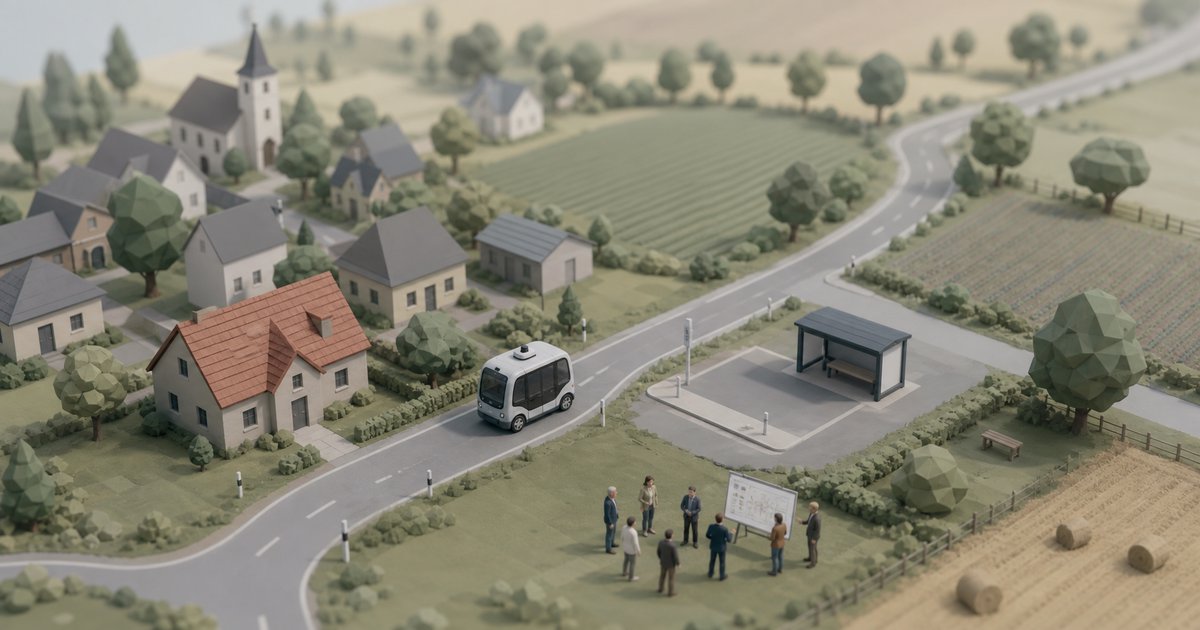
Brandenburg's transport ministry is in talks with Tesla about putting driverless shuttles into rural areas where scheduled buses barely run. The minister confirmed it himself. There is no agreement, no route and no date.
What was said
Robert Crumbach — Brandenburg's deputy minister-president and finance minister since December 2024, and transport minister since March 2026 — told regional broadcaster rbb that the ministry is examining autonomous shuttles for thinly served parts of the state.
His framing was conditional but not vague: "Wo ein normaler Bus aufgrund mangelnder Nachfrage nicht oder nur sporadisch fährt, könnte ein fahrerloses Shuttle eine sinnvolle Alternative darstellen" — where a normal bus does not run for lack of demand, or runs only sporadically, a driverless shuttle could be a sensible alternative. On scale he went further, saying that once the legal approvals and permits are in place, he can very well imagine area-wide use across rural Brandenburg.
Tesla was named as one of the companies the ministry is speaking to.
The problem it is meant to solve
Brandenburg already operates a Rufbus — an on-demand service run with scheduled buses, minibuses and taxis, booked rather than timetabled. Its constraints are practical rather than technical: rigid standby windows, and an acute shortage of drivers. A vehicle that does not need a driver removes both at once.
That is why the ministry is describing this as an extension of the Rufbus rather than a robotaxi service. It is not a proposal to run Tesla robotaxis against taxis in Berlin. It is a proposal to fill gaps in a network that cannot afford to send an empty bus to a village twice a day.
Germany has the law. Tesla does not have the approval.
The legal groundwork is done. The Road Traffic Act was amended in 2021 to permit SAE Level 4 vehicles, and the AFGBV ordinance of May 2022 set the technical and procedural requirements. Approval is granted by the KBA, applies to a defined geofenced operating area, and requires the operator to submit a safety case.
The gap is Tesla-shaped.
| Company | Status in Germany |
|---|---|
| Tesla | FSD not approved; KBA review ongoing |
| Momenta | Germany-wide Level 4 testing approval, July 2026 |
| Waymo | Munich named first EU city; mapping now, driverless targeted end of 2027 |
| ZF | Germany-wide Level 4 test authorisation |
Tesla is the only name there without a permit of any kind. Its driver-assistance system remains under review by the KBA, where Autobahn speeds have been the reported sticking point, while Momenta cleared nationwide Level 4 testing in July and Waymo picked Munich for its first EU robotaxi city days ago.
A ministry can hold talks with a company whose system is not yet street-legal in its country. It cannot sign a service contract with one.
Why Brandenburg, and what it means for Europe
Grünheide. Tesla's only European factory sits inside this state, which gives the ministry a counterpart with a local address and gives Tesla a home-market argument it has nowhere else in Europe.
The wider signal is who is being invited. European robotaxi plans so far have been commercial ventures seeking permission — Waymo in Munich, Momenta on test plates. This is a public authority naming Tesla as a possible operator of subsidised rural transport, a role that carries procurement rules and service obligations. If it ever happens, it will not look like Austin.
What to hold lightly
Talks are not a pilot, and a pilot is not a service. No route, operator model, vehicle type or timeline has been named, and Tesla has not commented publicly. Crumbach's condition — once the legal approvals and permits are in place — carries the weight of the sentence, and for Tesla in Germany it is not close to being met.