
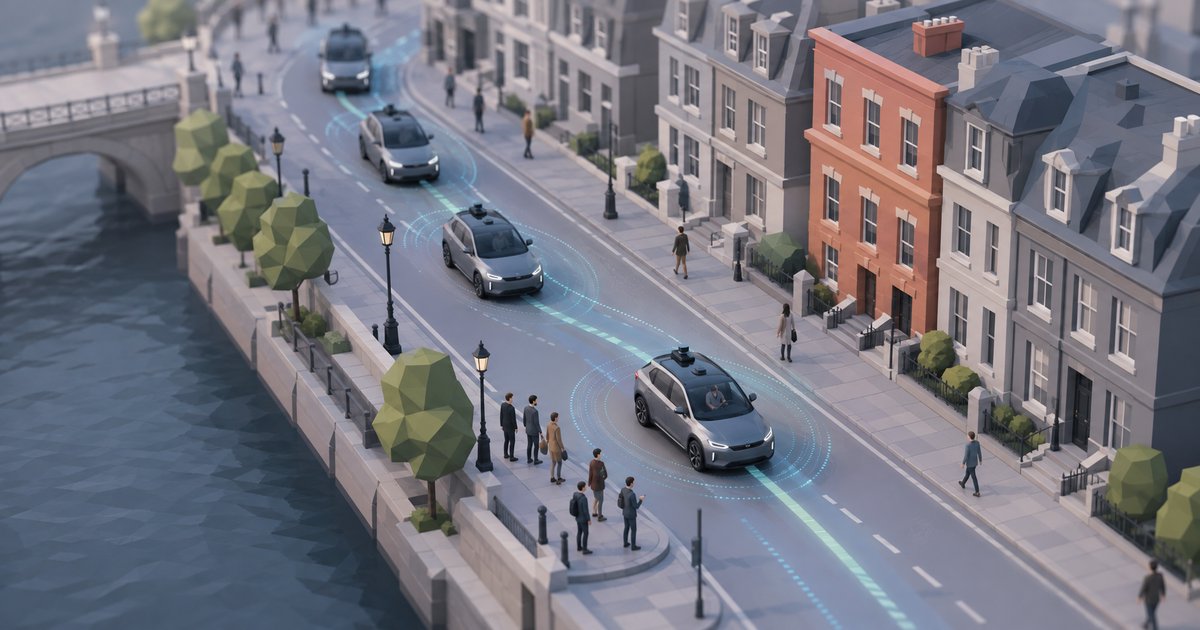
Uber and Wayve started carrying passengers in self-driving cars in London on 3 September 2026. It is Britain's first public robotaxi service, and it beat both Waymo and Baidu to the city.
What a ride looks like
The cars are Ford Mustang Mach-Es running Wayve's AI Driver — the same 15 vehicles Transport for London licensed in August. A trained, TfL-licensed private hire driver sits behind the wheel on every trip and can take over at any point.
Riders cannot ask for one. The Uber app matches them, and they can accept or decline; declining returns a conventional car. Fares are unchanged: a robotaxi trip costs what the equivalent standard, Electric or Comfort Uber ride costs, with no autonomy surcharge. Uber says more than 140,000 Londoners have registered interest for priority matching, up from around 100,000 when the licences were granted.
Deliberately small
Both companies describe the fleet as dozens of cars to start, expanding in phases. Under the UK's pilot framework, removing the safety driver requires a separate approval that neither company holds — so for now, every London robotaxi ride has a human being paid to watch it.
The same bet Tesla is making
Wayve's system is end-to-end learned driving with cameras and radar and no high-definition maps: the car generalises from experience rather than following a pre-surveyed route. That is architecturally Tesla's wager, and the opposite of the mapped, lidar-heavy approach behind Waymo's record.
So the first learned-driving system to carry paying passengers in Europe is not Tesla's. But it is Tesla's architecture, and a European regulator let it happen.
Three routes in, three different bars
| Operator | Route onto European roads | Where it stands |
|---|---|---|
| Wayve + Uber | Per-vehicle private hire licensing, one city | Carrying passengers in London since 3 September, safety driver aboard |
| Tesla | EU type approval via an Article 39 derogation | TCMV vote on 6 October 2026 |
| Waymo | City by city; Munich first in the EU | Driverless targeted by end of 2027 |
These are not comparable asks. Licensing 15 supervised taxis in one city is far lighter than certifying software for hundreds of thousands of privately owned cars across 27 member states, and Wayve's launch says nothing about when Tesla clears its own bar.
What it means for European owners
What it does say is that European regulators will move when the liability question has an obvious human answer. Wayve's cars drive themselves with a licensed professional legally responsible for the trip. Tesla is asking 27 governments to let ordinary owners supervise the same class of system on any road they like.
That request now has a date, and the arithmetic behind it just shifted: France has moved from refusing FSD to supporting its homologation ahead of the October vote. If it carries, the gap closes quickly — a Tesla owner in Lyon or Leipzig would get supervised autonomy in their own car, instead of waiting to be matched with someone else's.