
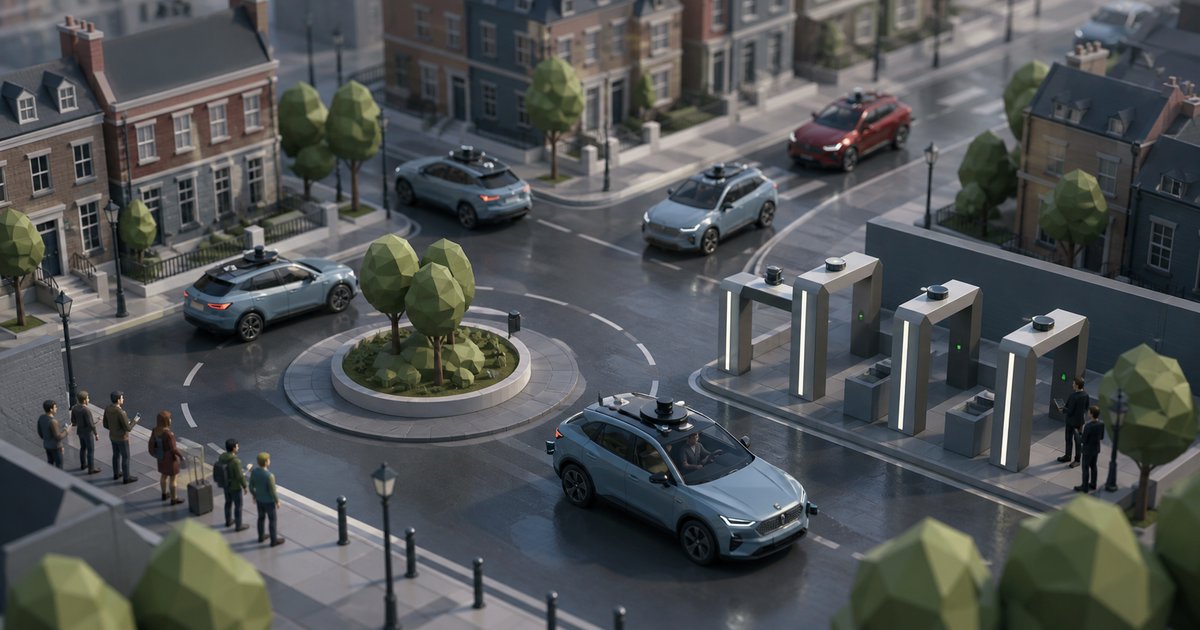
Transport for London issued private hire vehicle licences on 5 August 2026 to a fleet of autonomous cars running British software — 15 electric Ford Mustang Mach-E vehicles fitted with Wayve's AI Driver. It is the closest any European operation has come to putting a learned-driving system into paid passenger service.
What the licence actually unlocks
London does not have a bespoke robotaxi permit. It has a private hire regime with a requirement the industry calls the triple lock: for a legal private-hire trip, the operator, the driver and the vehicle must each hold a licence from the same licensing authority.
Uber already held the operator licence. The safety drivers already held driver licences. The vehicles were the missing third lock, and TfL has now closed it after inspecting the cars to confirm they meet its policy and safety standards. The fleet runs Wayve's software with surround cameras and radar.
Supervised, not driverless
This is the part the headlines tend to lose. A trained, TfL-licensed private hire driver remains on board for every trip — to supervise, to help passengers, and to take the steering wheel if needed. The car drives itself; a human is responsible for it.
That framing is what made the licence achievable. TfL is not certifying that a computer can be a driver. It is licensing vehicles that happen to drive themselves, with a licensed human still legally in the seat.
What happens next
Uber has an interest list of around 100,000 Londoners. Selected passengers from that list will receive booking invitations later this summer. The vehicle licence is one gate among several, and other approvals for robotaxi operation in London are still outstanding — so a launch date is not the same thing as a licence.
Why the approach matters
Wayve's technical bet is end-to-end learned driving without high-definition maps — the car generalises from experience rather than following a pre-surveyed route. That is architecturally the same wager Tesla makes with FSD, and the opposite of the heavily mapped approach Waymo has built its record on.
So this is the first time a regulator in Europe has licensed vehicles running the mapless, learned-behaviour approach for commercial passenger work. For anyone tracking whether that architecture can pass a European safety authority, it is a real data point rather than a demo.
What it means for Tesla in Europe
The contrast with Tesla's position is sharp, and it is mostly about which door each company is trying to walk through.
Tesla is pursuing consumer self-driving via type approval, and that route has stalled: France declined to back the Dutch approval EU-wide and Germany's KBA review remains open, with unrestricted Autobahn speeds the sticking point. Wayve went through per-vehicle private-hire licensing in one city, with a paid professional supervising, and Momenta took a third route again with its German Level 4 testing approval.
Those are not comparable bars. Licensing 15 supervised taxis in London is a far lighter ask than certifying software for hundreds of thousands of privately owned cars across 27 member states. Wayve clearing its hurdle tells us little about when Tesla clears its own — but it does show European regulators will move when the liability question has an obvious human answer.