
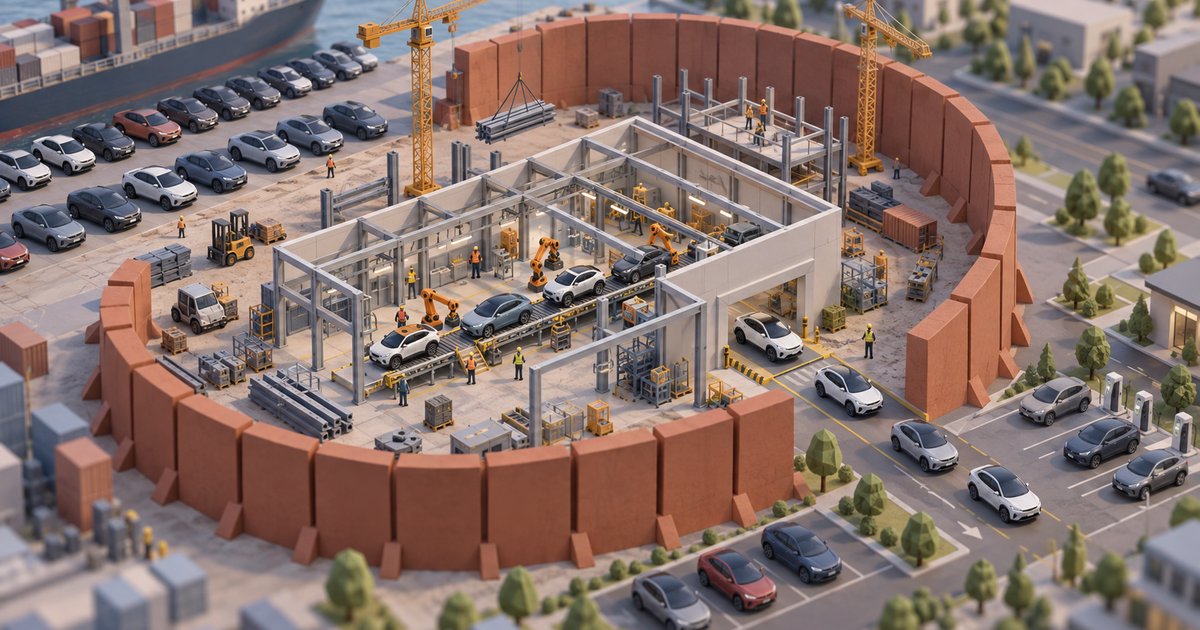
Asked on Fox News whether Chinese carmakers might ever sell in the United States, President Trump drew a line between importing and building. "If China wanted to come in and open a plant to build their cars here, I'd be OK with that," he said on The Ingraham Angle on 11 September 2026. "The big thing is they hire our people." He offered Japan as the precedent: "Japan does it."
What he ruled out in the same breath
He did not open the border. In the same interview he rejected the idea that Chinese vehicles might enter under a broader trade deal — "We don't allow his cars into the United States, and we never did" — and said the American market would be "overrun" without restrictions. The remarks came ahead of a planned meeting with Xi Jinping.
The barrier he described is intact. The United States holds tariffs above 100% on Chinese electric vehicles, and separately restricts connected-vehicle hardware and software originating in countries it treats as national-security risks. That second rule is the harder one for a factory to solve, because it attaches to the software rather than to the assembly line — which is why InsideEVs reads current law as making Chinese production difficult even with an American plant and American workers.
Detroit is already legislating against it
Ford, General Motors and the United Auto Workers back a measure that would place additional limits on vehicles from automakers with significant Chinese ownership — aimed squarely at the arrangement the president says he would accept.
Europe did not have to imagine this
Europe ran the experiment the remark describes. Tariffs went up, and Chinese brands responded by moving production inside the wall rather than leaving the market. They have already outsold their entire 2025 in Europe, and could build 1.5 million cars a year here — which is why Brussels now argues about European parts content rather than about imports.
Local assembly has not been frictionless. Hungary withdrew environmental exemptions and stopped three battery plants, and Beijing has told its own carmakers to stop price-warring abroad. The direction held anyway: a tariff changes where a car is built, not whether it is sold.
Why a Tesla buyer should care
The United States is the one large market where Tesla does not meet BYD. In Europe it does, and the difference shows up in the registration tables every month — Germany's August figures had BYD growing nearly five-fold in the same month Tesla doubled.
A Chinese plant on American soil would end that asymmetry in Tesla's home market. Nothing has been proposed, no company has applied, and the tariffs and connected-vehicle rules that keep the idea hypothetical are all still law. What changed on 11 September is that the president said yes to a version of it out loud.