
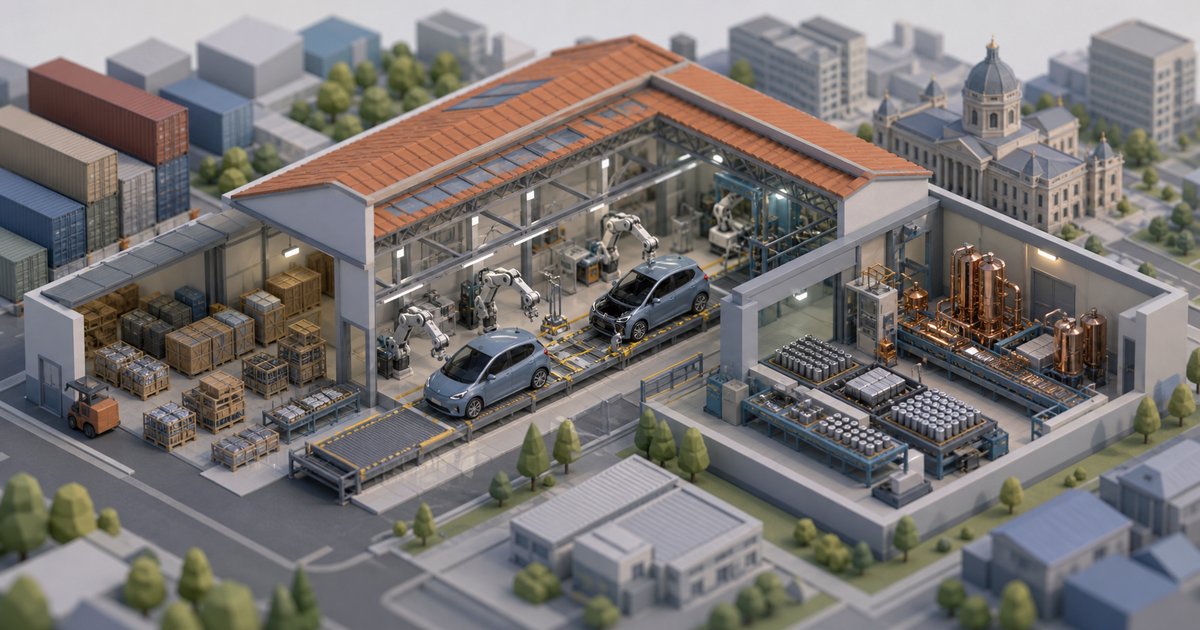
Chinese carmakers are no longer shipping cars into Europe so much as moving in. S&P Global Mobility puts Chinese-brand assembly on the continent at roughly 90,000 vehicles this year, one million a year by 2030 and 1.5 million a year by 2035. European lawmakers have noticed, and are drafting rules to decide what those cars are actually made of.
Where the plants are
| Brand | Site | Status |
|---|---|---|
| BYD | Szeged, Hungary | Ramping up; Spanish expansion planned |
| Leapmotor | Zaragoza, Spain (Stellantis plant) | EV production starting |
| Chery | Barcelona, Spain | Building Omoda and Jaecoo models |
| Geely | Almussafes, Valencia (Ford plant) | Production via Ford partnership |
Spain is the centre of it. The pattern is not greenfield construction either: the most striking part of the current wave is Chinese manufacturers taking over the spare capacity that European carmakers are trying to shed. A half-empty Ford or Stellantis plant is cheaper and faster than a new one, and it comes with a trained workforce and a permit.
The motive is tariffs. Building inside the customs union sidesteps the EU's import duties on Chinese-made electric cars entirely, which is why the investment accelerated the moment those duties became real.
What the Industrial Accelerator Act would change
The draft Industrial Accelerator Act would introduce quotas for European-made parts in vehicles assembled on the continent. Details are still being finalised — no threshold and no start date have been published — but the intent is explicit: tie public support and "Made in Europe" status to genuine local value-add rather than to the location of the final screwdriver.
Sander Tordoir, chief economist at the Centre for European Reform, framed the concern directly: the main risk, he said, is that China opens pure assembly plants for Chinese components inside the EU, with minimal economic added value for Europeans. Analysts at the Rhodium Group make the same point more concretely — a meaningful "Made in Europe" designation would have to cover large parts of the vehicle's components, the battery included.
The battery is where this stops being a paperwork exercise. It is the single most valuable component in an electric car, and it is the one Chinese manufacturers are most vertically integrated in. A rule that counts cells is a rule that reshapes investment plans; a rule that counts only assembly is one that BYD can satisfy by unpacking crates.
Where Tesla's European plant sits in this
Tesla is one of the few volume manufacturers that already builds electric cars in Europe, and Grünheide's output competes directly with what these plants will produce — Chinese brands and Tesla together took a record 13.3% of Western Europe in Q2.
But a battery-inclusive local-content test is not an automatic win for Tesla either. Model Y packs built at Grünheide have run on LFP cells from CATL in China and NCM cells from LG Energy Solution, and newer packs use Tesla's own 4680 cells shipped from Texas. On a cell-counting rule, the Model Y's European credentials are weaker than its assembly address suggests.
Tesla's answer predates the draft. The company plans to start cell production at Grünheide from 2027, expanding to a target of 18 GWh a year — a roughly $250 million commitment that would put cells and cars on one site. If the Act lands with real thresholds, that timing looks less like coincidence and more like the point of the policy.
What is not decided
No percentage, no date, and no confirmation of whether the quotas attach only to subsidised purchases or to market access more broadly. Until Brussels publishes numbers, this is a direction of travel rather than a rule.