
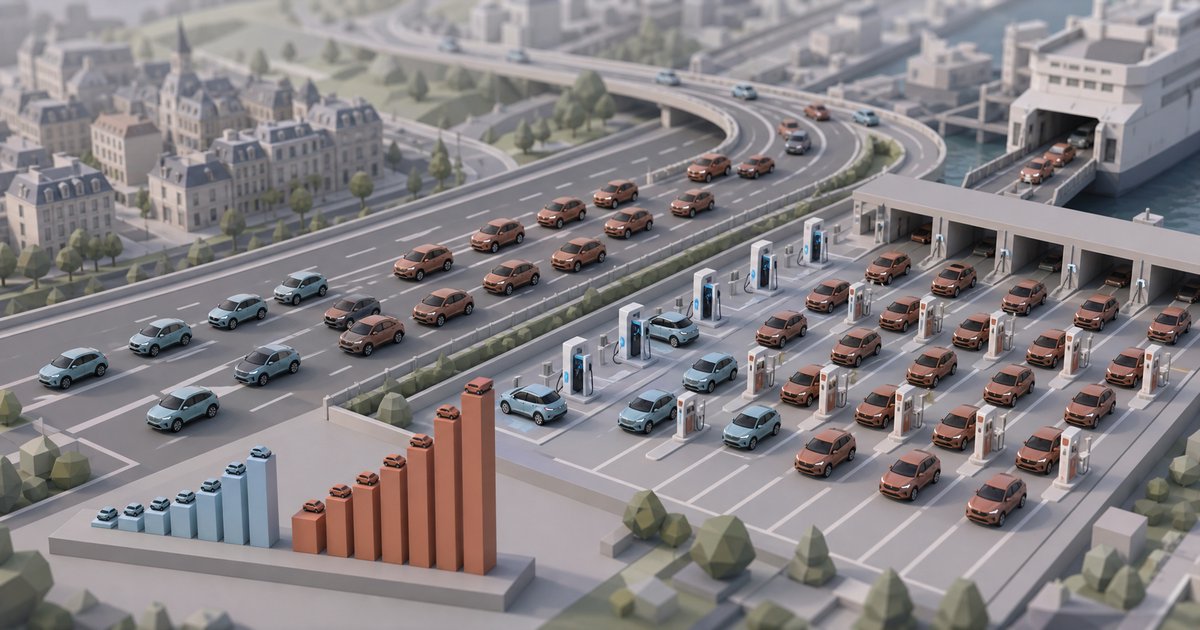
Chinese carmakers have sold more cars in Europe in seven months of 2026 than they did in the whole of 2025. Registrations from January to July reached 813,096, just past the 812,452 they took across all twelve months of last year, and July alone gave them a record 11.2% of the market.
The figures come from Dataforce, which tracks about 98% of new registrations across the EU, the UK, Iceland, Norway and Switzerland. Portugal and Croatia are outside the sample.
Three brands, separated by rounding
The striking thing about the year-to-date table is how close the top three are.
| Brand | Jan–Jul 2026 | July 2026 |
|---|---|---|
| MG (SAIC) | 208,009 | 27,745 |
| BYD | 205,451 | 32,470 |
| Chery (Omoda/Jaecoo) | 201,544 | 31,816 |
Fewer than 7,000 cars separate first from third over seven months. MG holds the cumulative lead on the strength of a decade in Europe, but the monthly column shows the order already reversing — BYD and Chery both outsold it in July, and Chery has only been delivering in Europe since June 2026.
The growth is not electric, and that is the point
This is the part that gets lost when the story is filed as "Chinese EVs". Plug-in hybrids made up 33.6% of Chinese-brand sales in July, up from 23% a year earlier, with conventional hybrids adding another 19%. Chinese badges now account for roughly 34% of Europe's entire plug-in hybrid segment.
The reason is structural. The EU's anti-subsidy duties introduced in late 2024 push tariffs on Chinese-built battery-electric cars as high as about 45% — and they apply to battery-electric cars only. A plug-in hybrid shipped from the same factory pays the standard 10% rate. Brands that were told to stop exporting EVs cheaply have responded by exporting something the measure does not cover.
So the tariff worked exactly as written and not at all as intended. It slowed one drivetrain and redirected volume into another, and the market-share line kept climbing.
Where Tesla sits in the same data
The wider July picture was strong for electric cars generally: European EV registrations rose 51% year on year to take 25% of the market, against 4.1% growth for the market as a whole.
Tesla's position in that is split by timeframe. Over January to July the Model Y remains Europe's best-selling electric car at 115,759 registrations, up 55%, with the Model 3 third on 57,086. In the single month of July, though, the best-selling EV in Europe was a Škoda and the Model Y left the top ten.
That is the useful comparison. Tesla is defending a lead built on two models in the €35–45k bracket, while the Chinese cohort is expanding through a segment Tesla does not sell into at all. Tesla builds no plug-in hybrid and never will, so a third of the fastest-growing group's European volume is competition it cannot answer on price or product.
What it means for a European buyer
For anyone shopping, the direct effect is on the used and mid-market end rather than on the Tesla configurator. More PHEVs at €30,000 pulls buyers who might otherwise have stretched to a base Model 3, and it puts pressure on residuals across the segment.
The number worth watching is not the 11.2%. It is whether the EU extends its duties to cover hybrids — Brussels has been asked to, and if it does, the volume now flowing through the tariff gap has to go somewhere, most likely back into the battery-electric column where Tesla actually competes.