
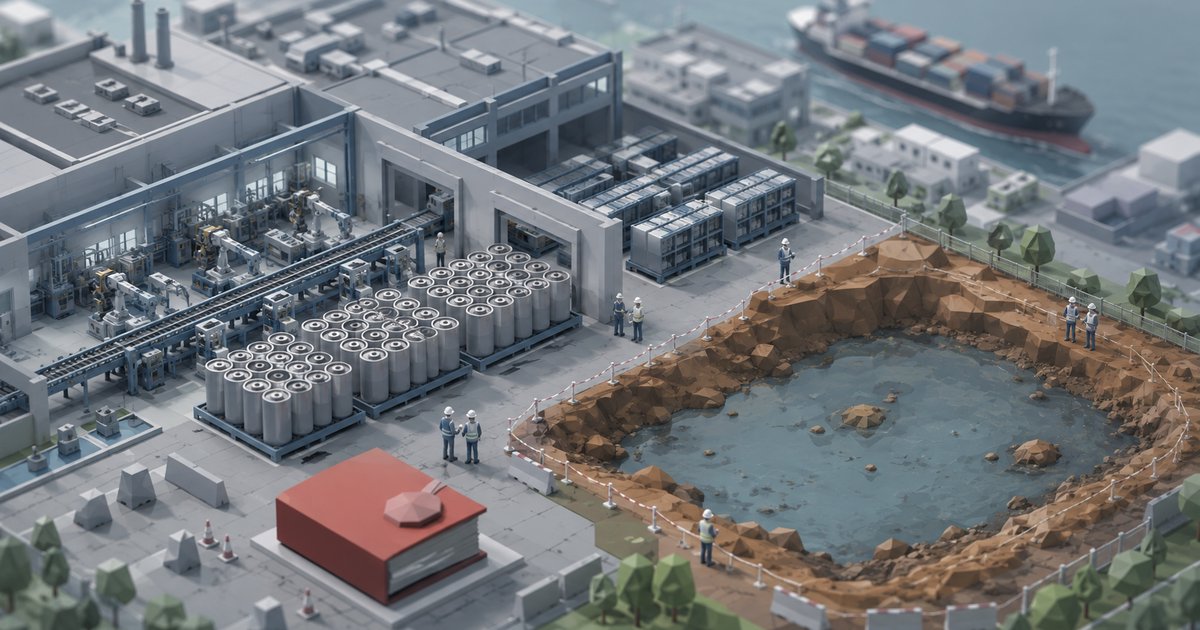
The reason Chinese battery makers built in Hungary was never only geography. It was that Hungary exempted "key investment projects" from the environmental, nature-protection and urban-planning rules everyone else had to follow. On 16 August 2026 the country's Ministry of Transport and Investment withdrew that exemption.
The change followed April 2026, when the opposition defeated Viktor Orbán's long-governing coalition, and the new administration began reviewing the major investment agreements signed under its predecessor. The revision to the building law now carries a specific penalty: a project found in breach of environmental standards can have its building permit suspended for at least six months.
Three plants have already stopped or slipped.
CATL Debrecen: still not making cells
TeslAnt reported in August that Hungary's occupational safety authority had banned work in three areas of CATL's Debrecen cell building after nine workers showed elevated nickel levels. What has changed since is the scope of the restriction rather than the incident.
The local authority stated on 31 August that CATL must complete every rectification before production can officially begin. Until then the company is permitted to conduct equipment debugging and experimental production only. A licence application for the plant's second phase was refused on 19 August over inaccurate site-planning documents.
| CATL Debrecen | |
|---|---|
| Investment | €7.34 billion |
| Design target | 100 GWh |
| Module assembly | began May 2026, 5 GWh/year, from imported cells |
| Cell production | not started; currently debugging only |
BYD Szeged: a year late
BYD's Hungarian car plant was to start production in Q4 2025. It is now scheduled for Q4 2026 — a full year's slip, with trial production having run since early 2026 and equipment installation still under way. Bloomberg reported in May that Hungarian police were investigating the movement of contaminated soil from the Szeged construction site to land outside it; the company was fined 10 million forints (about $31,000). BYD has rejected the claim that it broke Hungary's environmental rules.
Semcorp: suspended since June
Semcorp, which makes the separator film that sits between a lithium-ion cell's electrodes, had operations suspended in June after metallic elements were detected in local groundwater. Samsung SDI's Göd plant and SK On's Iváncsa site are also named among the projects now subject to the ordinary permitting regime.
What it means for a Tesla buyer in Europe
Tesla is not a Debrecen customer, and no car anyone has ordered is delayed by any of this. The relevance is structural, and it is the same point the nickel suspension raised in sharper form.
CATL supplies around 40% of the world's EV batteries, including the LFP cells in a large share of Model 3s and Model Ys. Debrecen was the test of whether a Chinese cell maker could move genuine cell production into Europe rather than shipping finished cells in. A year ago the answer looked like a permitting formality. It now looks like a plant that assembles modules from imported cells while its cell building waits on a compliance sign-off.
Every month that slips is another month in which European-built electric cars — Tesla's Berlin output included — depend on cells that arrive by sea, with the cost and tariff exposure that carries. The plants were sited in Hungary partly because the rules were lighter there. That premise no longer holds, and the localisation timetable was written on the assumption that it would.