
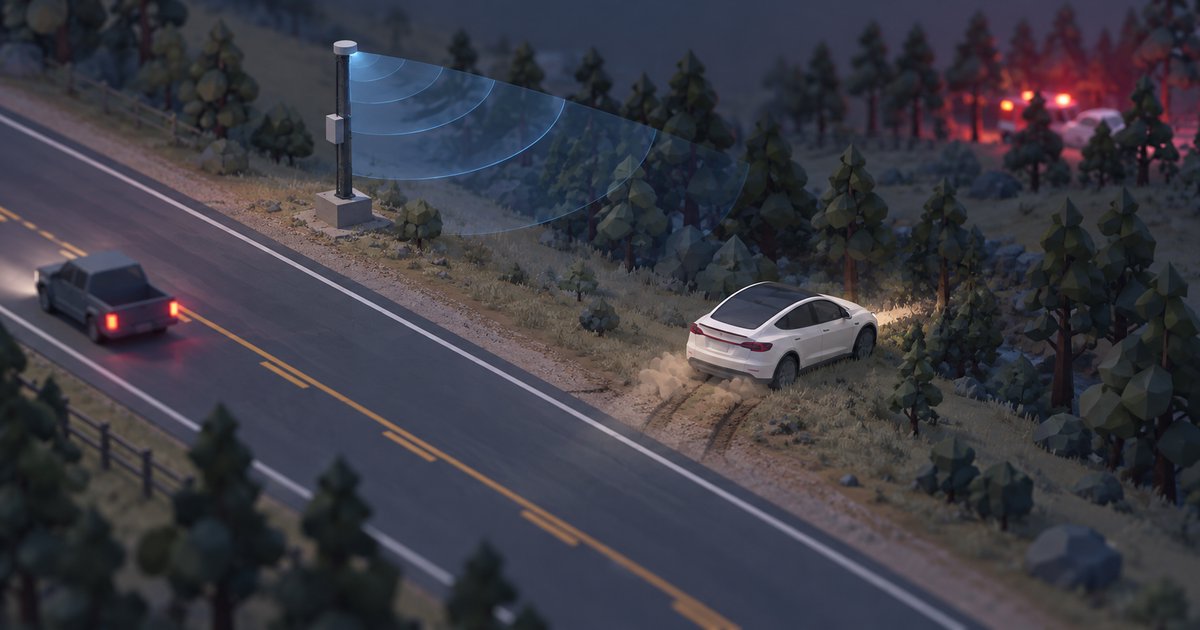
On 7 December 2025, a 2021 Tesla Model Y Long Range left Alabama Highway 157 in Morgan County, about a mile north of Battleground and close to the Cullman County line. It struck two trees and caught fire. The driver, 29-year-old Kayleigh Page of Waterloo, Alabama, was pronounced dead at the scene. Her seven-month-old daughter was pulled from the burning car by a passer-by who saw it happen, and was taken to hospital in stable condition.
State troopers recorded a single-vehicle wreck. Their report does not mention driver assistance, and there is no indication they knew to.
Tesla's own submission to the US regulator says the system was on.
What the filing says
Under NHTSA's Standing General Order, manufacturers must report crashes involving advanced driver assistance. In the entry matching this crash, Tesla recorded the automation status as Verified Engaged — its telemetry confirms the system was running, rather than a driver having claimed it afterwards.
| Field | What Tesla filed |
|---|---|
| Automation status | Verified Engaged |
| Pre-crash speed | 55 mph (89 km/h) |
| Fatalities | 1 |
| Data held by Tesla | Event data recorder and telematics |
| Narrative | Redacted |
| Software version | Redacted |
| Within approved operating area | Redacted |
Three fields are withheld as confidential business information. The last of them is the one that would answer the obvious question — whether Autopilot or FSD was supposed to be usable on that stretch of road at all — and it is precisely the field the public cannot see.
Why this one is different
TeslAnt has covered four of these matches in the past ten days: a Model 3 on a stopped-vehicle freeway crash, a Model Y left turn in Batavia, a Model X that killed a motorcyclist in Moraine, and a stop sign rolled at 4 mph in Buena Vista.
Those four were intersection or traffic-conflict cases: the system was in company, and misjudged another road user. This one is not. It is a road departure at highway speed with nothing else involved — the car simply left the carriageway. That is a different failure mode, and it is the mode that lane-keeping is supposed to make impossible.
It is also the case where the gap between the two records is widest. In the intersection crashes, the local report at least described a collision that invited questions. Here the trooper file reads as an ordinary run-off-road wreck, and the fact that a Level 2 system was steering at 55 mph exists only inside a redacted federal spreadsheet.
What a European owner should take from it
Nothing here says the system caused the crash. A verified-engaged flag records that software was active, not that it was at fault; a driver can be inattentive, asleep or unwell with the system on, and the redacted narrative is exactly where that would be explained.
What it does show is that crash statistics as published locally do not capture driver assistance, and that the reconciliation is being done by journalists matching redacted federal filings to police reports one at a time. Europe's own framework is being weighed in the 6 October vote on FSD approval. Whatever regulators decide, the reporting question this case raises — who records that the software was on — has not been answered here either.
The matching work is Electrek's ongoing investigation, and it is worth reading in full.