
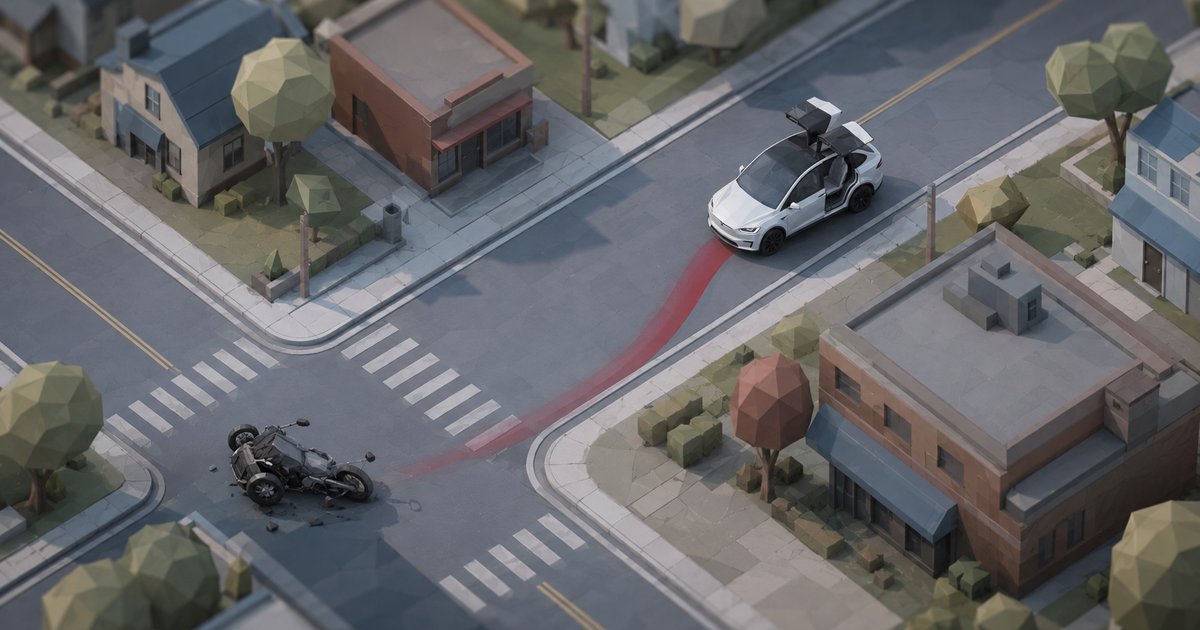
A fatal crash that drew almost no attention when it happened has turned out to be one of the clearest examples of how little the public can learn about Tesla's driver-assistance record. On 23 July 2025, at around 8:15 p.m., a 2024 Model X struck a three-wheeled motorcycle at the intersection of Germantown Pike and Hemple Road in Moraine, Ohio. The rider, 55-year-old Leonidas Davis, was thrown from the machine and died at the scene. Local coverage at the time described the striking vehicle as a sedan and gave no cause.
Tesla's own report to the National Highway Traffic Safety Administration says something different.
What the filing says
Under the standing general order that requires carmakers to report crashes involving automated driving systems, Tesla filed a record for this crash listing a 2024 Model X, a pre-crash speed of 49 mph, and an outcome of fatality. The field that matters most is "Engagement Status", and Tesla marked it Verified Engaged — the company's own telemetry confirms a driver-assistance system was running when the car hit the motorcycle.
The filing also states that Tesla holds the event data recorder, vehicle telematics, video, and the police report.
What Tesla withheld
What the filing does not say is which system was engaged. Tesla redacts the distinction between Autopilot and Full Self-Driving in its NHTSA submissions, so a reader cannot tell whether the car was running basic lane-keeping and cruise control or the far more ambitious city-streets software. Tesla also redacted the crash narrative, the software version and the operating-area status, claiming all three as confidential business information.
The practical effect is that a death is on the public record with the single most important technical fact removed.
How the crash was identified
Electrek matched the filing to the Moraine crash as part of an ongoing investigation that cross-references Tesla's redacted NHTSA data against reported collisions. Enough fields survive redaction to make the match: the location, the vehicle model, the involvement of a motorcycle, the fatality, and the month. Tesla logged the incident at 00:09 UTC, which converts to roughly 8:09 p.m. local time and lines up with the timing in the police report. The outlet has filed a public records request with the Moraine Police Division.
This is the fourth such reconstruction TeslAnt has covered, after a Model 3 crash in Clute where Tesla's filing verified the system was engaged, two Model 3s found stopped in live freeway lanes, and a passenger killed during a 24 mph left turn in Batavia.
Why European readers should care
Tesla is currently asking European regulators to let FSD onto public roads, and last week published an Article 39 safety case ahead of the EU vote. That case rests on Tesla's own crash statistics. The Moraine filing shows what those statistics look like at the level of an individual death: the engagement is confirmed, and everything that would let an outside engineer or regulator judge the system's behaviour is redacted.
Approving a system on the strength of data the manufacturer controls, and can withhold at its own discretion, is the question in front of the EU now.