
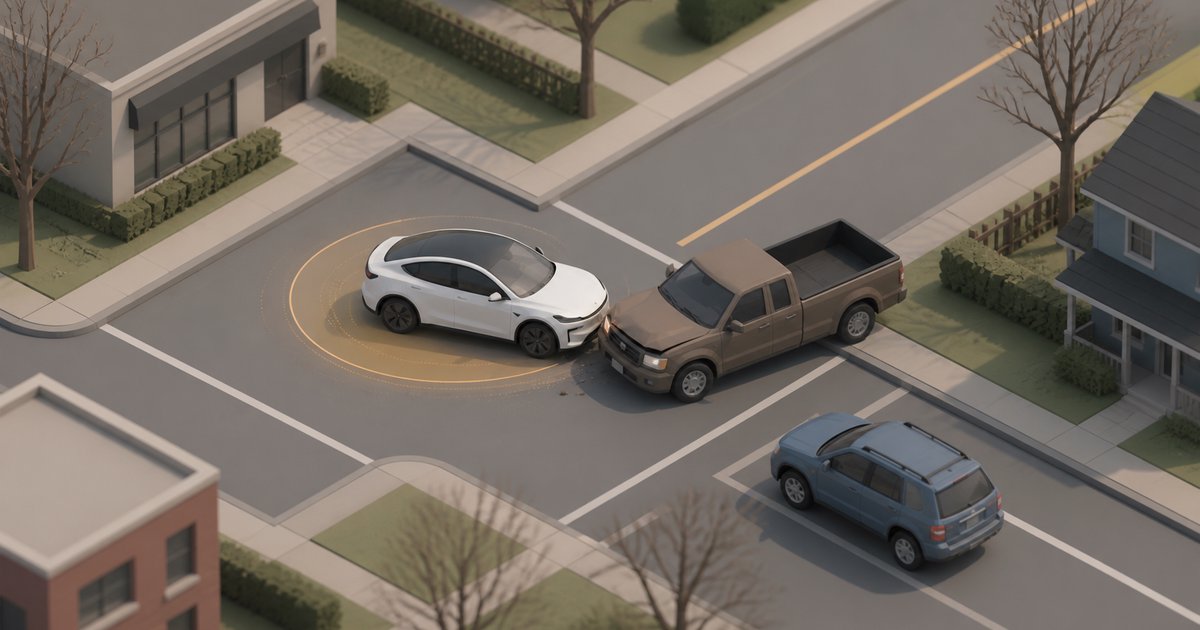
On 25 March 2026, at about 4:19 pm, a 2026 Tesla Model Y heading south on Randall Road in Batavia, Illinois turned left across the path of a Dodge pickup that had right of way. The Tesla struck the front of the pickup. A Nissan SUV was caught up in the crash. Maggie Espinosa, 37, a kindergarten teacher and mother of five, was in the Tesla's front passenger seat. She died.
It was reported at the time as an ordinary intersection collision. No police statement and no news account mentioned driver assistance.
Tesla's own report to the United States National Highway Traffic Safety Administration says otherwise. In it, the company marks the automation "Engagement Status" as "Verified Engaged", and records the pre-crash movement as "Making Left Turn" at 24 mph. Electrek matched the redacted federal entry to the named crash more than five months after it happened.
Why this one reads differently
This is the fourth case TeslAnt has covered from the same running investigation, and it is the first that is not about speed. The Clute, Texas crash happened at 104 mph. The two freeway cases involved Model 3s sitting stationary in live lanes. Each of those is unusual enough that a reader could file it as an edge case.
An unprotected left turn at 24 mph is not an edge case. It is one of the most common manoeuvres in driving, it is the manoeuvre both Autopilot and FSD are explicitly built to handle in city driving, and judging an oncoming vehicle's gap is the core competence the system claims.
That is what makes the redactions matter here more than usual. Tesla withheld the crash narrative, the specific software version, and whether the road was inside the system's approved operating area. Without the software version there is no way to know whether the build in that car was FSD attempting the turn or Autopilot being steered through it by a driver, and no way to know whether whatever went wrong was fixed in a later release.
Tesla has confirmed it holds the event data recorder, the telematics and the video from the car. None of it is public.
What "verified engaged" does and does not settle
The label is narrow. Under the Standing General Order, carmakers must report crashes where a Level 2 system was engaged within 30 seconds of impact and someone was killed or injured. "Verified Engaged" means Tesla checked its own telematics and confirmed the system was on — stronger than the "reported" or "unknown" values the form allows.
It does not establish that the system caused the crash. A driver can override, accelerate, or fail to intervene while the system is nominally engaged, and the filing does not distinguish those. What it establishes is narrower and still significant: the public record of this crash was incomplete, and only Tesla could have known.
European regulators are weighing exactly this question. Tesla has published FSD safety evidence ahead of the Article 39 vote on 6 October. Cases like Batavia are the reason the argument is about disclosure as much as capability.