
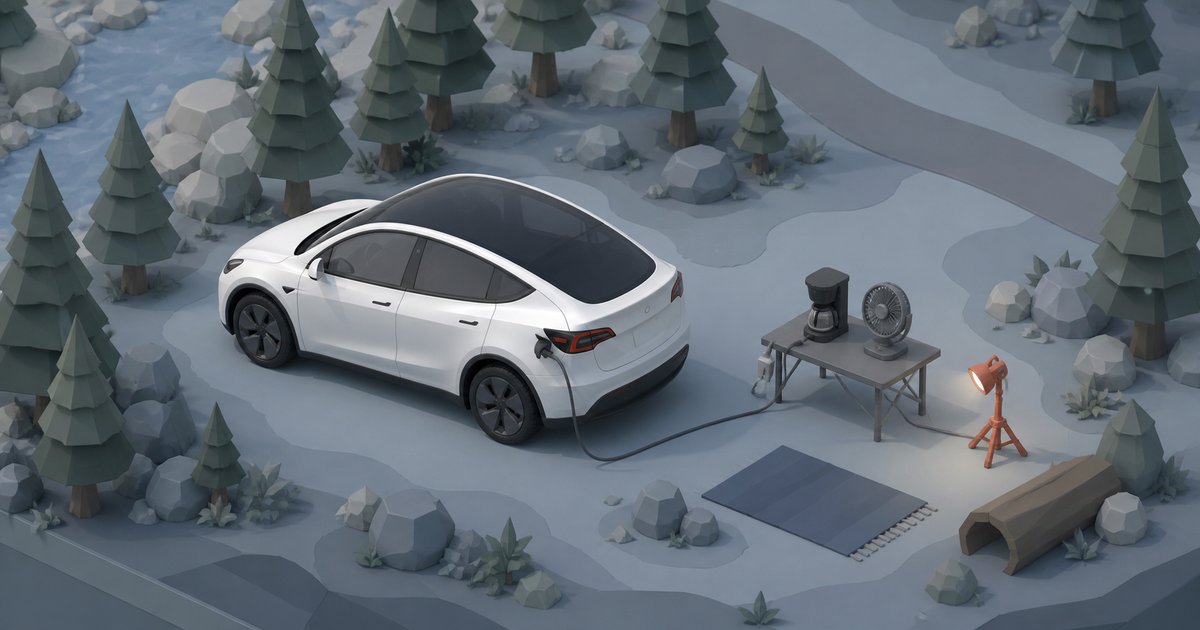
Tesla has switched on Vehicle-to-Load (V2L) for Model Y Premium trims in the United States, extending a feature that until now belonged to the Cybertruck, the Model Y L and the Model Y Performance. The change applies to cars already on the road, not only to new orders.
What owners actually get
V2L turns the car into a mobile power source. On the Model Y it supplies a continuous 2.4 kW at 120 volts and 20 amps through Tesla's Outlet Adapter, an $80 accessory that plugs into the Gen 3 Mobile Connector and ends in a standard household socket.
That is a deliberately modest output. It runs power tools, a laptop, a string of lights, or a fridge through a short outage. It is not whole-home backup — that remains the Powerwall's job, and Tesla began leasing pairs of Powerwalls in Texas this week at a net $35 a month.
| Tesla | V2L | Status |
|---|---|---|
| Cybertruck | Yes | Native, since launch |
| Model Y Performance | Yes | Via PowerShare Outlet Adapter |
| Model Y L | Yes | Via PowerShare Outlet Adapter |
| Model Y Premium | Yes | New, United States only |
The detail that matters is the retrofit
The significant part is not the feature — rivals have offered V2L for years — but that Tesla has not gated it to new inventory. Teslarati reports the capability covers any Model Y Premium, including cars bought before the adapter existed.
That makes this an unlock of hardware owners already paid for rather than a reason to buy a new car. Tesla has spent much of 2026 being criticised for the opposite pattern, most visibly over Hardware 3 cars promised Full Self-Driving. A capability arriving for free on existing cars is the more welcome direction.
Where this leaves Europe
Europe is not the afterthought it first appears. The Model Y Performance launched in Europe ahead of other markets at around €62,990, and it carries V2L through the same PowerShare adapter family. What Europe has not been given is this week's extension to the Premium trim.
There is a hardware reason the two markets cannot simply be switched over together. An adapter specified at 120 volts, 20 amps and a NEMA socket describes a North American domestic supply. European owners live in a 230-volt, Type 2 world, so a European rollout needs its own adapter rather than a configuration change. Tesla has announced no European date, price or part number, and until it does this remains a US feature.
The rules are the other half of the problem
Bidirectional charging in Europe is a regulatory question as much as an engineering one. Germany only recently redrew its grid rules for bidirectional charging and charging hubs, and other markets are further behind.
V2L is the easiest case — the car powers a device directly and never pushes energy back into the grid — which is precisely why it tends to arrive first. Vehicle-to-home and vehicle-to-grid are where the metering, safety and tariff arguments live. Competitors have already begun packaging the whole stack: Hyundai and Kia put bidirectional charging behind a single brand earlier this month.
Bottom line
A useful, free capability for US Model Y Premium owners, and a reminder that Tesla's European cars are on a separate hardware track for anything involving a mains socket. European Model Y Premium owners have no adapter to buy yet.
Update: 2026-08-15
On 15 August 2026 Not a Tesla App established what actually gates this feature, and it narrows the claim above that the change "applies to cars already on the road". Eligibility is decided by the car's Power Conversion System: only a PCS that supports bidirectional flow through the charge port can drive the adapter, and Tesla appears to have changed the part mid-2026. Model Y Premium cars built as recently as May 2026 are reported incompatible, June-built cars give mixed results, and later cars work. Tesla checks eligibility against the VIN at the point of purchase, so the practical test is to open the Tesla Shop in the app and search for the Outlet Adapter — the product page states whether your specific car qualifies. The adapter itself is confirmed as two 110-volt outlets at up to 20 amps, about 2,400 watts, for $80. Source: Not a Tesla App.
Update: 2026-08-16
On 16 August 2026 Teslarati reported what an incompatible car would cost to fix, a figure absent from the eligibility guidance above. The dividing line is the Power Conversion System: the adapter works with the newer two-piece PCS, and not with the older 48-amp single-phase unit still fitted to some 2026 builds. Retrofitting the newer PCS is quoted at $1,750 for parts alone, before labour — several times the $80 the adapter itself costs, and enough to make the upgrade uneconomic for the sake of a 2.4 kW socket. Owners reporting the problem include cars delivered as late as February 2026. Source: Teslarati.
Update: 2026-08-17
On 17 August 2026 Not a Tesla App reported that Tesla has now published the retrofit procedure itself — a draft PCS1-to-PCS2 Lite document running to 344 steps. It also shows the $1,750 noted above buys only the new PCS (part 2100145-N0-E): the job additionally requires a 12-volt DC harness, an AC filter harness and revised coolant hoses, and the document states no total labour time. Most importantly, Tesla has still not announced a customer retrofit programme, nor said Service Centres will perform the upgrade simply to add V2L. A procedure that exists for technicians is not the same as a service an owner can book. Source: Not a Tesla App.