
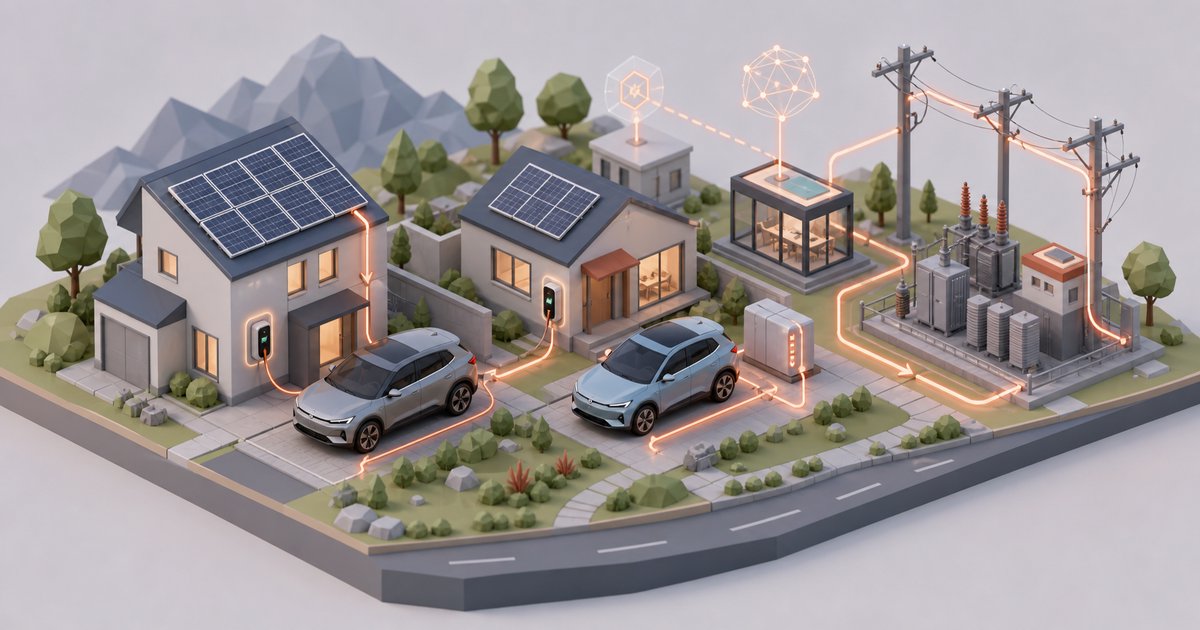
Hyundai Motor Group has spent several years running vehicle-to-everything services as separate regional experiments. On 24 July it gave them a single name — AllDayEnergy — and a plan to ship them as a product rather than a pilot.
The brand covers three things that are usually discussed together and delivered separately:
- V1G smart charging — shifting when the car draws power in response to electricity prices and grid conditions
- Vehicle-to-grid (V2G) — sending energy back to the grid
- Vehicle-to-home (V2H) — powering a house, including as emergency backup
The order matters. Smart charging ships first, with V2G and V2H following. That is the correct sequence commercially as well as technically: V1G needs only a tariff integration and a scheduler, while V2G needs a bidirectional charger, a grid connection agreement and a regulator that has decided how to treat a car exporting power.
The UK goes first
AllDayEnergy launches in the UK through the Kia app, with continental Europe, the United States and South Korea following. Announcement materials have described the UK timing as both Q2 and H2 2026, so treat the exact date as unsettled — what is firm is the market and the delivery channel.
Britain first is a reasonable read of where the pieces are in place. The UK has an established market in half-hourly and dynamic domestic electricity tariffs, which is what makes smart charging worth anything to a customer, and it has done more regulatory groundwork on domestic export than most European markets.
Built on real deployments
This is a rebrand of running services rather than an announcement of intent. The Group is piloting V2G in South Korea's Jeju province. In the United States it has deployed V2H as emergency household backup, including during major wildfires. And in the Netherlands it already offers V2G and smart charging that respond to dynamic electricity prices — the closest existing analogue to what UK customers will get.
The Dutch deployment is the one to watch, because it is the proof that the continental European rollout has somewhere to start from.
Why the timing works
Bidirectional charging in Europe has been held back less by cars than by rules — what a vehicle is allowed to do when it acts as a grid asset, who pays network charges on exported energy, and how a domestic connection is certified. That is now moving: Germany has been redrawing exactly these provisions, rewriting its grid rules for charging hubs and bidirectional charging.
An OEM putting a single consumer-facing brand across smart charging, V2G and V2H is a bet that those rules settle in the next few years. It also sets a competitive marker. Tesla has the hardware and the energy business to do all of this and has moved cautiously on domestic bidirectional charging in Europe. Hyundai and Kia have now claimed the label first — which is not the same as shipping the capability, but it is a start on making V2X something a buyer can ask for by name.