
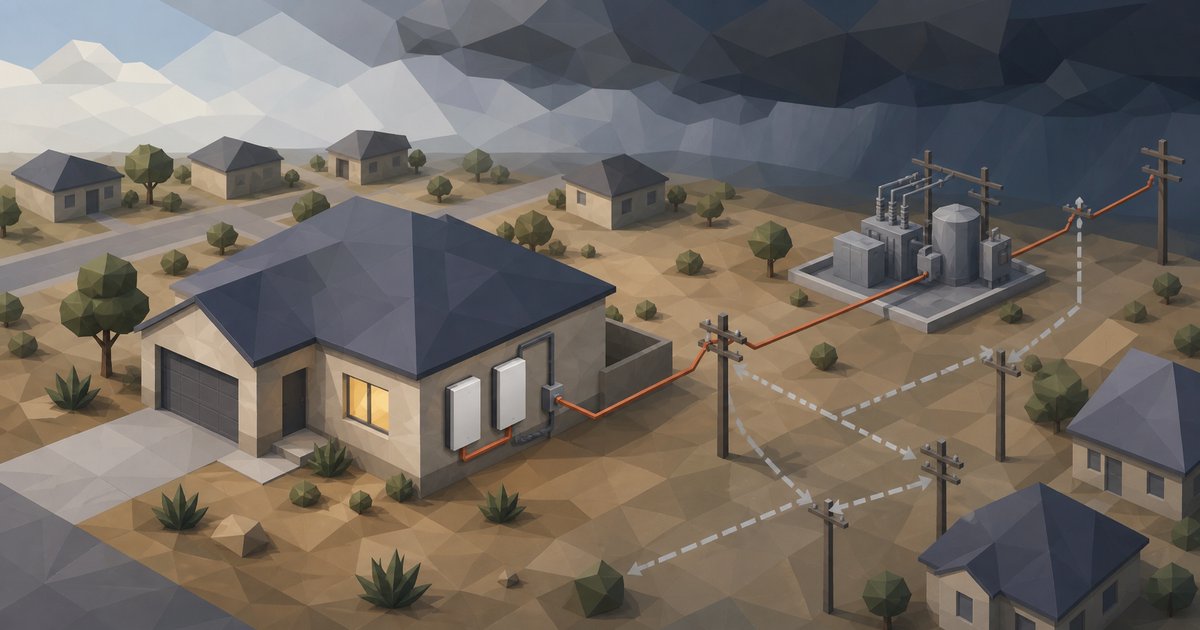
Tesla Energy has started leasing Powerwalls instead of only selling them. The Powerwall Lease went live in parts of Texas on 13 August 2026, and the headline number is $35 a month for whole-home backup. That number is real, but it is the product of an arrangement worth reading carefully before signing.
What the deal actually is
| Item | Amount |
|---|---|
| Powerwalls required | 2 (exactly) |
| One-time order fee | $100 |
| Installation | $0 |
| Base lease payment, year one | ~$122/month |
| Tesla Electric credit | −$87/month |
| Net cost, year one | ~$35/month |
| Annual escalator on the base payment | 3% |
The package includes Storm Watch, which pre-charges the batteries when severe weather is forecast, and everything is managed from the Tesla app.
Two constraints narrow it sharply. You must lease exactly two units — this is not a one-Powerwall product — and solar panels are not eligible, so this is backup and grid arbitrage rather than self-consumption of your own generation.
The credit is the whole product
Strip out the $87 and the lease costs $122 a month, which is not a bargain. The credit only appears once the system is installed, granted permission to operate, and enrolled in a qualifying Tesla Electric plan — either the Backup plan or the Virtual Power Plant plan — and it only continues while that enrolment does.
That is the trade. Tesla is not discounting hardware; it is buying access to a battery. Enrolled Powerwalls are dispatched into the ERCOT grid when demand and prices spike, and that revenue is what funds the credit. The customer gets cheap backup, Tesla gets a distributed fleet it did not have to buy.
The consequence is a switching cost that grows over time. Leave Tesla Electric for a cheaper electricity supplier and the $87 stops while the lease payment continues — and by then the base payment has been escalating at 3% a year. Availability is already limited to Texas locations with retail electricity choice, which is precisely where a household might otherwise shop around.
Why it matters beyond Texas, and what Europe should watch
The interesting part is not the price, it is the shape. Tesla has spent years selling Powerwalls as capital equipment, with virtual power plant enrolment as a voluntary extra that paid a bit back. This inverts that: the VPP is the business model and the hardware is the customer acquisition cost.
If it works, it is a template that travels better than most Tesla Energy products, because it needs a liberalised retail electricity market and a grid with volatile evening peaks rather than any particular subsidy regime. Europe has plenty of both. Several European markets already show the peak-shaving problem this product is built around — Hungary's networks are currently rationing charger power during evening peaks precisely because there is not enough flexible storage on the system.
What has not been announced is any European version. The lease depends on Tesla acting as the electricity retailer as well as the hardware vendor, and on the specific credit economics of the ERCOT market. Treat the $35 as a Texas number, and the structure — hardware subsidised by grid services, locked to a supply contract — as the thing to watch for elsewhere.
Bottom line
Good value if you want backup, live in the right part of Texas, and would have stayed with Tesla Electric anyway. A long-dated commitment dressed as a low monthly payment if you would not.