
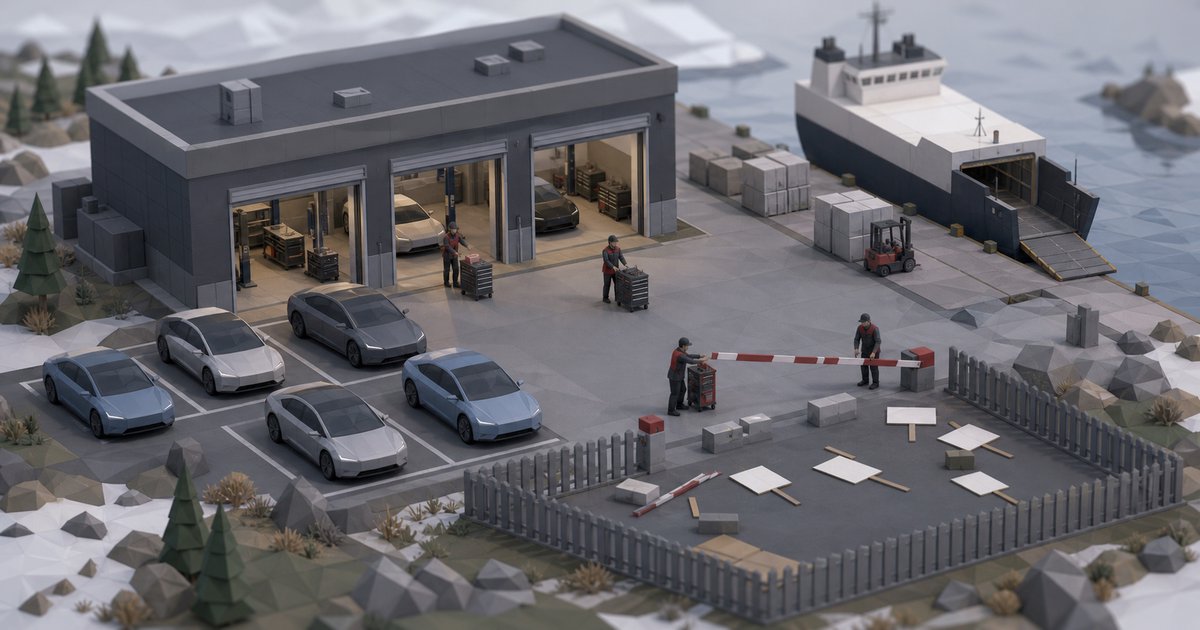
Sweden's largest industrial union has ended the longest strike in the country's modern history without obtaining the one thing it struck for. On Thursday 13 August, IF Metall announced it is withdrawing all industrial action against Tesla, with the blockades formally lifting at 00:01 on 19 August 2026. Tesla has still not signed a Swedish collective agreement.
How it ends
The dispute began on 27 October 2023, when roughly 120 Tesla mechanics across seven Swedish service centres walked out to demand a kollektivavtal — the sector-wide collective agreement that underpins the Swedish labour model and covers the overwhelming majority of employees in the country. It ran for 1,021 days.
The union's account of the ending is unusually blunt about what defeated it. Rather than negotiate, Tesla bought out the remaining striking members individually until the bargaining unit had emptied out and there was no one left on the picket line.
"There seems to be no limits to the length Tesla would go to keep unions out of their operations. Unfortunately, they have managed to pay their way out in Sweden."
IF Metall chair Marie Nilsson called the strikers "union heroes who have fought for collective agreements." Veli-Pekka Säikkälä, agreement secretary at the LO confederation, put the outcome down to arithmetic: "Tesla has gigantic economic resources and has used them." Contract secretary Simon Petersson said the company "would rather buy out union members than offer secure conditions."
The blockade that nearly worked
What made this dispute internationally notable was not its length but its breadth. Swedish law permits sympathy action, and it arrived from every direction at once:
- Dockworkers refused to unload Teslas at Swedish ports — and unions in Denmark, Norway and Finland extended that blockade across the Nordics.
- PostNord stopped delivering Tesla licence plates, briefly leaving newly sold cars unregisterable.
- Electricians declined to service Tesla charging equipment.
- Cleaners stopped cleaning Tesla showrooms.
For a period, a company selling cars in one of Europe's most EV-dense markets could not reliably land them, plate them or clean the room it sold them in. Tesla routed around each obstacle rather than sign.
Timeline
| Date | Event |
|---|---|
| 27 October 2023 | ~120 mechanics at seven workshops strike over a collective agreement |
| Late 2023 – early 2024 | Dockworkers, electricians, cleaners and PostNord join the sympathy action; Nordic unions extend the port blockade |
| 13 August 2026 | IF Metall announces the end of all industrial action |
| 19 August 2026 | Blockades formally lift, 1,021 days after the walkout |
What it means for Europe
For Swedish owners the practical effect is immediate and positive: parts, plates, service and charger maintenance stop being contested territory after nearly three years of friction.
The wider signal is about Tesla's European labour posture. The company has now demonstrated, in the market with arguably the strongest union framework in Europe, that it will absorb almost three years of blockade rather than accept sectoral bargaining. Works councils at Grünheide and unions in other European markets will read the Swedish outcome the same way IF Metall did — as a template that money can outlast solidarity — and plan accordingly.
What has not changed is the underlying position. Tesla's Swedish mechanics still have no collective agreement. There are simply no longer any striking members to represent.
Update: 2026-08-21
The first concrete consequence of the blockade lifting is charging capacity. Tesla is commissioning 264 Supercharger stalls across 20 Swedish sites, according to Auto Motor & Sport — the largest wave it has been able to energise since the dispute began, because the electricians' refusal to perform grid connections was precisely what had frozen expansion. Sweden's network grows from roughly 1,350 charging points to more than 1,600, about 20% in a single step, with the new sites concentrated at the network's thin points: ski destinations such as Kläppen/Sälen, far-north locations including Kiruna and Överkalix, and the north–south corridors at Ljungby and Laxå. Arlandastad — the station Tesla ran entirely on on-site Megapacks to avoid needing a grid connection at all — now gets 20 stalls under normal conditions. Tesla says all Swedish stations, new and existing, stay open to every electric brand.