
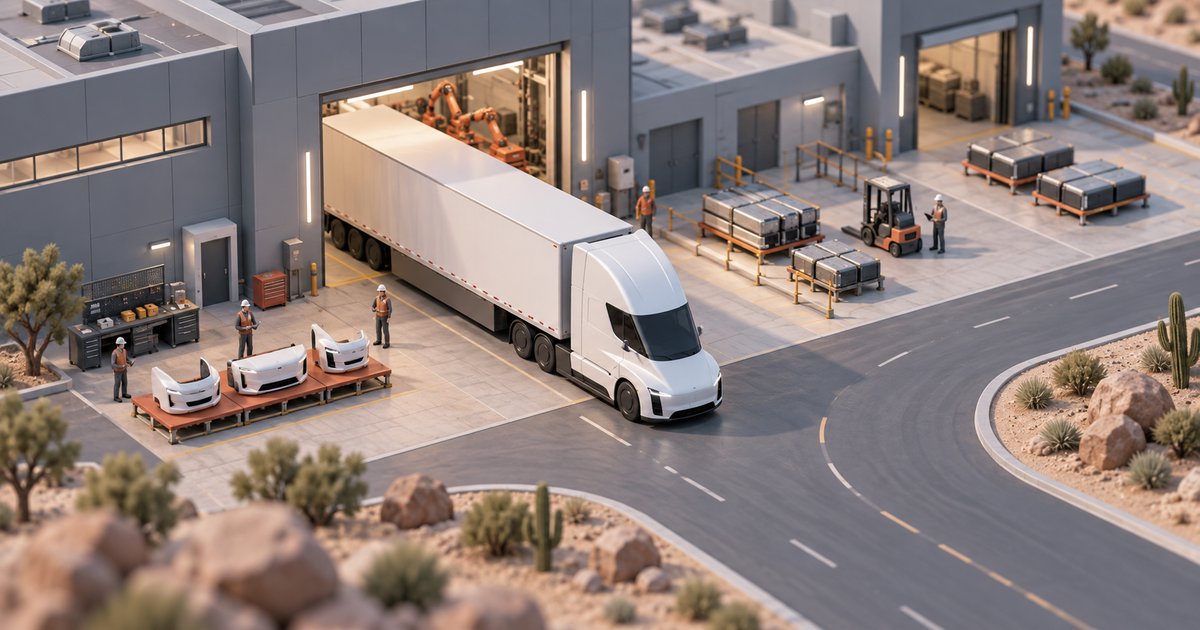
Almost everything published about the Tesla Semi for nine years described a prototype. Tesla has now let Top Gear into the Nevada factory where the production truck is being built, and the details that came out are the first specification of the thing customers will actually receive.
What it does
| Production Semi | |
|---|---|
| 0–60 mph, no trailer | 12.5 seconds |
| 0–60 mph, fully loaded | 24 seconds |
| 0–60 mph, loaded diesel tractor | about 60 seconds |
| Standard Range battery | 548 kWh |
| Efficiency vs earlier prototypes | ~3% better |
The loaded acceleration figure is the one that changes a haulier's day. Twenty-four seconds to motorway speed against roughly sixty for a diesel is not a performance statistic — it is the difference between merging into traffic and waiting for a gap in it, repeated at every junction on every shift.
Tesla also claims the truck is only around seven times less efficient than a Model Y despite the weight and frontal area, and that its aerodynamics beat a Bugatti Chiron's. The second claim is a drag-coefficient comparison rather than a like-for-like one, and it is Tesla's own number, but the shape is genuinely the reason the energy figures work at all.
What changed to make it buildable
The more revealing details are the manufacturing ones, because they show a truck being redesigned for cost rather than for spectacle.
The Semi is powder coated rather than painted — the process Tesla already uses on Megapack, cheaper and more durable than a paint shop, and initially white only, with more colours promised for fleet customers. The front bumper is now three pieces instead of one, so a low-speed scrape replaces a section rather than the whole assembly, and it gained an opening to improve airflow. The battery pack has been squared off, which Tesla says holds heat better in cold weather — a straightforwardly useful change for a truck expected to work northern European winters.
Inside, the central driving position survives from the prototype, the seats are heated and ventilated cloth, and there is enough headroom for someone six foot six to stand up.
How this reads from Europe
None of these figures are European. Tesla made the European Semi's numbers official on 11 September — one variant, up to 550 km at 40 tonnes, 800 kW on MCS — and published no battery capacity for it. The 548 kWh quoted here is the North American Standard Range pack, so it does not settle what the European truck carries, though it narrows the range of plausible answers given the 9,100 kg European curb weight.
What does travel is the engineering. Powder coating, a segmented bumper and a warmer pack are decisions about repair cost and cold-weather range, and both of those are what European fleet buyers will be doing sums on when deliveries begin at the start of 2027. It also puts some substance behind the Nevada factory Tesla inaugurated in August: the line is running, and the truck coming off it is not the one from the 2017 reveal.