
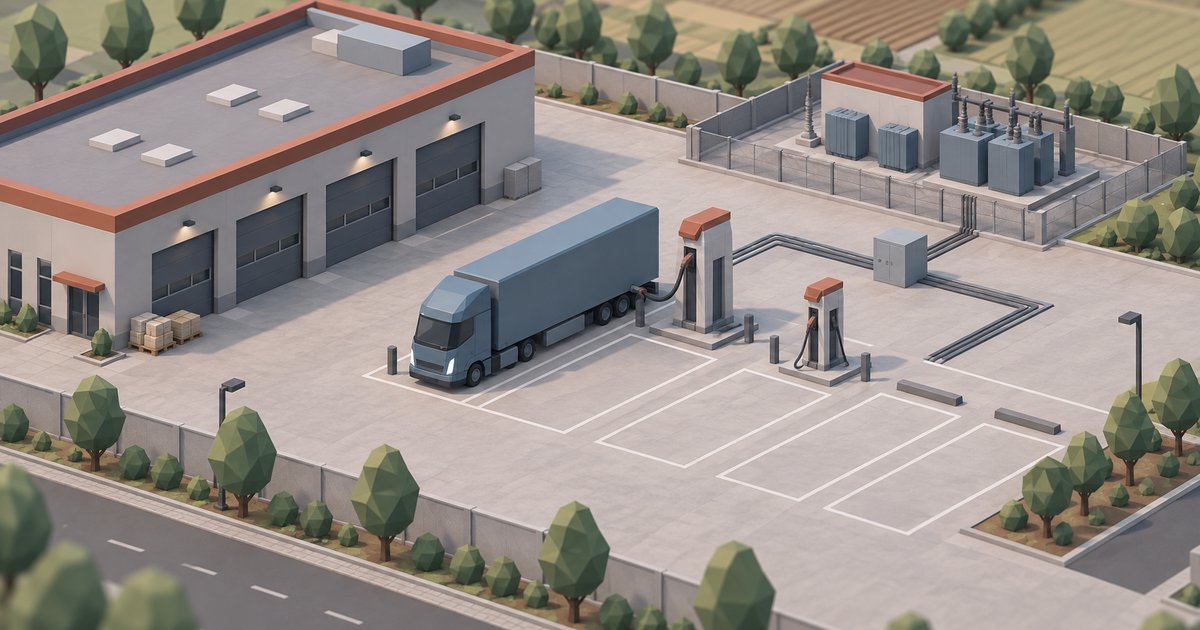
Tesla has started selling the chargers before it sells the trucks. On 14 September 2026, the press day of IAA Transportation in Hannover, it opened Semi Charging for Business in Germany, the Netherlands, Belgium, France and the United Kingdom — the same day the European-specification Semi went on public display.
What a fleet can actually order
| Product | Rated power | Intended use |
|---|---|---|
| Megacharger | up to 1.2 MW | Short stops, turnarounds |
| Basecharger | 125 kW | Overnight and long dwell at a depot |
Each of the five markets gets its own order page. Tesla has published no European prices for either unit, and has not said who performs the installation or what grid connection a buyer is expected to bring.
One number deserves care. The 1.2 MW headline is the Megacharger's own ceiling and matches the North American Semi's peak; Tesla's regional pages show 800 kW for charging here. That is consistent with the European truck's official specification, which lists up to 550 km at 40 tonnes and up to 800 kW on the Megawatt Charging System rather than Tesla's proprietary connector. A European operator buying a Megacharger is buying hardware rated above what the truck in their yard will draw.
Selling infrastructure first is the point
The programme is not new — Tesla launched it in North America earlier this year — but the sequencing in Europe is deliberate. Tesla's framing invites operators to "become part of our Semi charging network" by buying and installing chargers at their own sites, which is to say the network is built out of customer-owned hardware on customer-owned land rather than out of Tesla's capital.
That is the same structure behind EVgo selling Tesla's V4 Superchargers under its own brand: Tesla supplies the equipment, somebody else owns and operates it. For heavy trucks the logic is stronger, because depot charging is where electric haulage actually happens. A tractor unit that runs a fixed route returns to the same yard every night, and the charger that matters most is the one it parks next to — which is why a 125 kW Basecharger sits in the catalogue beside a megawatt unit.
What it does not settle for European fleets
It does not settle price, and for a fleet buyer the charger is a substantial fraction of the total cost of going electric. It does not settle timing either: Tesla has placed European Semi deliveries at the beginning of 2027, so anyone ordering hardware now is provisioning a depot for trucks that do not yet exist in their market.
There is also a competitive point hiding in the connector. By building on MCS, Tesla is selling into a standard that Milence, Scania, Volvo and others are already deploying across European corridors — so a Tesla Megacharger is not a Tesla-only asset, and a Semi is not confined to Tesla hardware. That openness is a real difference from how the Supercharger network began, and it is the pragmatic choice in a market where megawatt truck charging is still thin on the ground.
For now the most telling detail is the order of operations. The clearest measure of Tesla's European freight ambition remains Einride's 500-truck order — placed by a European company, with not one of those trucks bound for Europe. Selling depot chargers in five countries is how that changes, or how Tesla intends it to.