
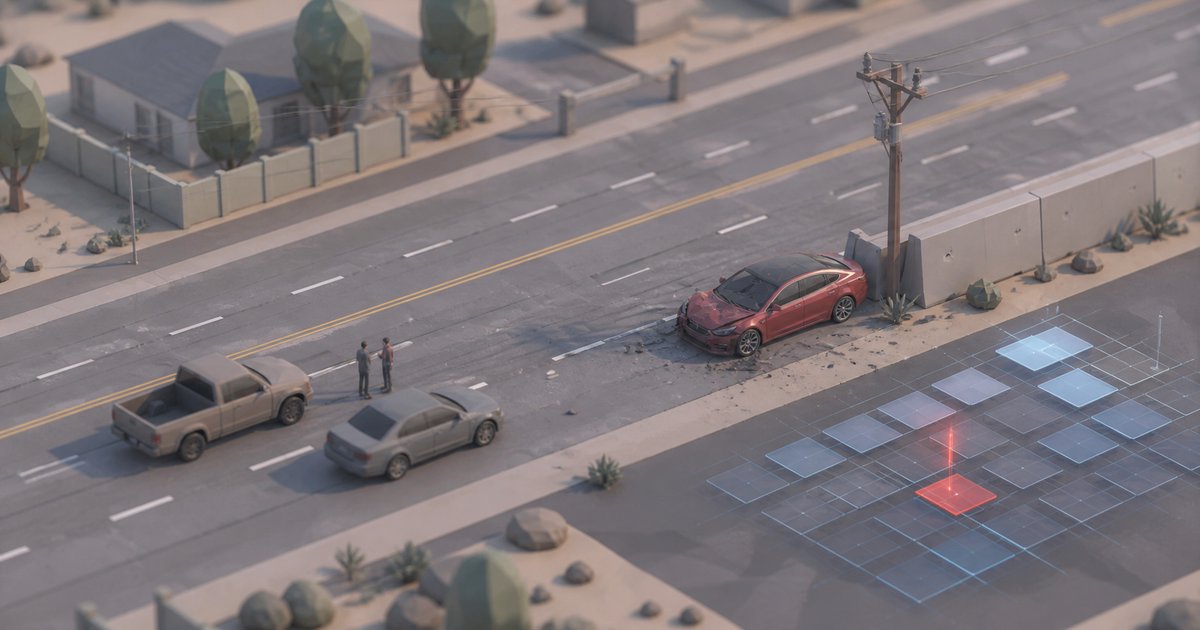
A 2025 Tesla Model 3 left Brazoswood Drive in Clute, Texas, at 104 mph on 20 May 2026 and came to rest in Clute Municipal Park. The driver, 23-year-old Steven Alvarez, an IT technician at Lake Jackson Intermediate School, was killed.
Clute police said their preliminary theory was that Alvarez had suffered a medical episode. No police statement and no news report mentioned driver assistance, and none mentioned the speed. Both facts exist in one place only: Tesla's own filing to the United States National Highway Traffic Safety Administration, where the company marked the automation "Engagement Status" as "Verified Engaged". Electrek found the entry more than three months after the crash.
What "verified engaged" does and does not mean
The label is narrow and worth reading precisely. Under the Standing General Order, carmakers must report any crash in which a Level 2 driver-assist system was engaged within 30 seconds of impact and someone was killed or injured or the car was towed. "Verified Engaged" means Tesla checked its telematics and confirmed the system was on — a stronger statement than the "reported" or "unknown" values the form also allows.
It does not establish that Autopilot or FSD caused the crash. A medical episode and an engaged driver-assist system are not alternatives; they can be the same event, and a system that holds a lane while its driver is incapacitated behaves as designed right up to the point where the road stops being straight. What the entry does establish is that the public account of this crash was incomplete in a way no one outside Tesla could have known.
The speed carries its own question. Both systems drive to a set speed, and 104 mph on a suburban street is not ordinary behaviour for either. Whether the system was accelerating, coasting, or being overridden by a driver's foot is exactly the detail the report would answer — and exactly the detail Tesla withheld.
The redactions are the pattern
Tesla removed the crash narrative, the specific software version and the operating-area field, claiming confidential business information. That is not unusual for the company: Electrek reports Tesla applies redactions to 99.9% of its crash reports, across a database that now holds nearly 4,000 Tesla driver-assist crashes.
So the public record of the largest driver-assist fleet on the road consists of a checkbox and a date. Which build was running cannot be determined, which means no one outside Tesla can tell whether a given failure mode was fixed two releases ago or is still shipping.
This is a recognisable habit rather than a one-off. In July, NHTSA had to demand Tesla's internal "radar saves us" document as part of its FSD investigation. In Europe, Tesla pressed the Dutch regulator to keep its FSD safety review confidential.
Why this matters for European approval
Europe has no equivalent of the Standing General Order. There is no continent-wide register of driver-assist crashes, no obligation to file one within days, and no public database an owner or journalist can search. The imperfect, heavily redacted American record is the most complete public source of Tesla driver-assist crash data that exists — and European regulators weighing FSD approval are working from it too.
That matters because the safety case runs the other way. Tesla says European FSD is 5.2 times safer than manual driving across 65 million kilometres, a figure computed from data only Tesla holds, and France has refused approval while waiting for an EU-wide decision.
A regulator asked to accept a manufacturer's own safety statistics has a reasonable interest in the crashes behind them. A filing that says a system was verified engaged in a fatal crash, then redacts the software version and the narrative, is a poor advertisement for that arrangement — whatever ultimately caused this crash.