
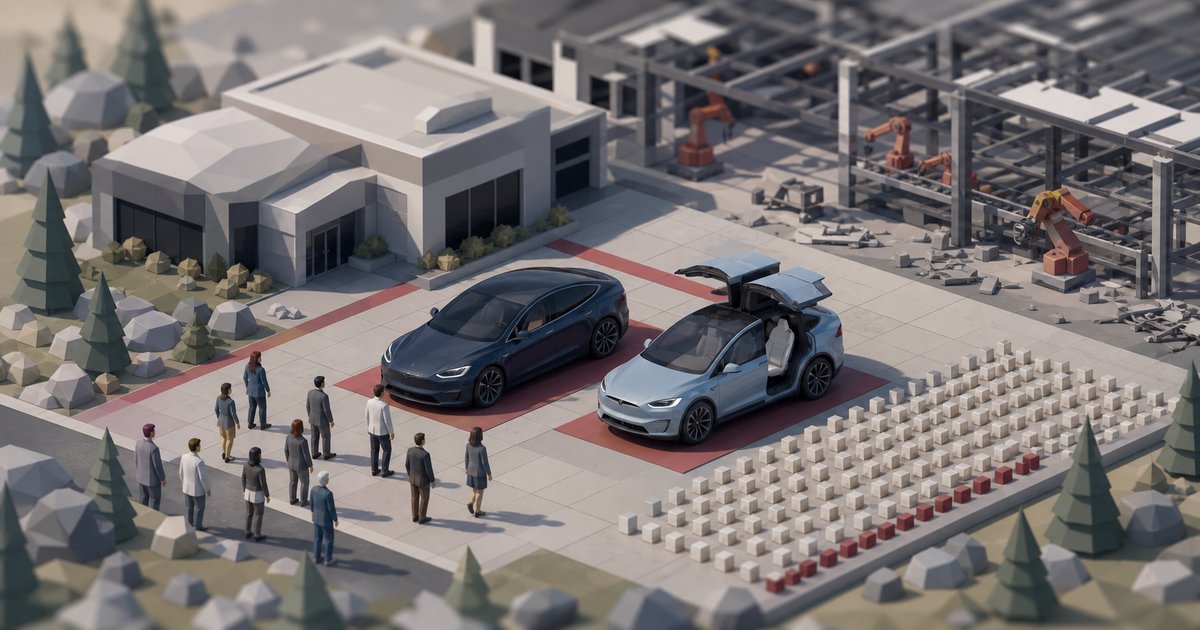
Tesla's two flagships had their strongest US half-year in years, in the six months immediately before the company stopped building them.
S&P Global Mobility registration data, reported by Drive Tesla Canada, puts the Model S at 6,876 US registrations in the first half of 2026, up 64% from 4,187 in the same period of 2025. The Model X climbed 62%, from 6,521 to 10,575. Both cars left production in early May, when Tesla tore out the Fremont line that had built them for nearly two decades and began converting it for Optimus.
A run on the last ones
| Model | H1 2025 | H1 2026 | Change |
|---|---|---|---|
| Model S | 4,187 | 6,876 | +64% |
| Model X | 6,521 | 10,575 | +62% |
Discontinuation announcements usually depress demand — nobody wants an orphan. These did the opposite, and the reason is straightforward: a buyer who specifically wanted a Model S or a Model X had a deadline. Once the line was gone, the only route to a new one was remaining inventory. That converts an open-ended purchase into a now-or-never one, and it shows up as a spike.
It is worth reading the percentages with the base in mind. A 64% rise on 4,187 cars is a rise of 2,689 cars. These were already low-volume products; the surge made them briefly less low-volume, not mainstream.
The rest of the range went the other way
Model 3 and Cybertruck registrations both fell over the same period. Tesla's total US registrations were down 1.3% year on year — a decline the flagship rush and the Model Y between them very nearly erased.
The Model Y alone accounted for close to 70% of everything Tesla registered in the US in the first half. That concentration is arguably the more important number in the data set: Tesla's American business is now, to a first approximation, one car.
What a discontinued flagship does next
The used market is where the consequences land. Used Model S prices have collapsed while the batteries mostly haven't — a gap between reputation and measured condition that gets wider once a model stops being built. Tesla has meanwhile been auctioning its leftover Model S and X parts by the pallet, which is a useful signal about how the company sees the long tail of servicing these cars.
What it means in Europe
European buyers never saw volume like this. Both flagships were imported from Fremont rather than built at Giga Berlin, and both were niche here even in good years — which is precisely why the end of the Fremont line caps how many will ever reach European roads.
The one European echo of the American rush was the Model S Signature Edition, whose orders opened to European buyers in June. If you are shopping for either car now, treat remaining stock as finite, confirm availability in writing before committing, and price in a service and parts picture that is being actively wound down rather than built out.