
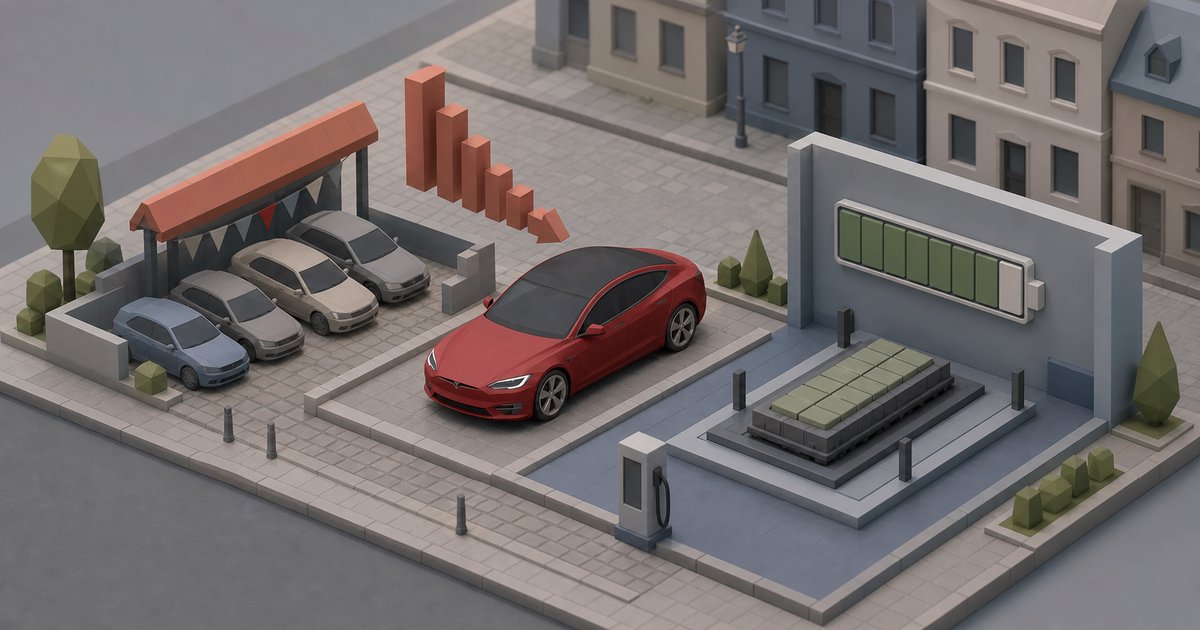
The used Tesla Model S has become one of the cheapest ways into a large electric car in Europe, and the reason it is cheap has little to do with the part buyers worry about most.
InsideEVs published a feature on 14 August 2026 tracking ageing, high-mileage Model S sedans. The pattern matches what independent degradation data has shown for years: prices have fallen far faster than the batteries have.
What the packs actually do
| Age or mileage | Typical capacity retained |
|---|---|
| Per year, average | 2-2.5% lost |
| ~200,000 miles (320,000 km) | 10-12% lost |
| 10+ years, ~200,000 miles | 85-90% retained |
An early 85 kWh car holding 85-90% of its pack is still a 200-mile (320 km) real-world car. That is less than it was, and considerably more than most buyers expect from a decade-old battery.
The outliers go further. A UK Model S used as an airport taxi has covered roughly 430,000 miles (690,000 km) on its original battery and drive units, fast-charged constantly, and lost only about 65 miles from its original rated range.
The prices
Depreciation has been severe. A five-year-old Model S has typically lost around 69% of its value, and one- to two-year-old cars are expected to slide a further 8-12% across 2026.
At the bottom of the market that produces genuinely odd pricing. One European listing with free lifetime Supercharging was found at EUR 14,000, with a seller-claimed 88% battery health. Early 60, 70 and 85 kWh cars now sell for less than many far smaller used EVs, and early P85D and P90D models, six-figure performance cars when new, sit under $20,000 in the United States.
What it looks like in Europe
Two things pushed the floor down. Model S production ended at Fremont in May 2026, which removes the new-car price that used values anchor to. And European used-EV pricing has softened generally: Dutch used-EV prices fell in July for the first time since March.
That combination puts a large, long-range saloon inside the price of a small used hatchback in several European markets. The catch here is not the battery but the car around it: parts and specialist labour for a decade-old Model S are not evenly spread across the continent, and a cheap car far from anyone who can work on it is a different proposition.
What to check before buying one
The battery is not the risk it is assumed to be, but it is not free either. Tesla now lists a remanufactured Model 3 and Model Y pack at about $8,000 against roughly $14,500 new. That is not a Model S part and not a European price, but it is a useful sense of scale for what a pack is worth today.
Three practical points:
- Seller-claimed battery health is a claim, not data. An 88% figure in a listing means someone typed 88. Get a health readout you trust, from the car, before you pay.
- Free lifetime Supercharging is per-car, and it does not always survive a sale. Confirm it against the specific VIN with Tesla rather than against the advert.
- The pack is the part that lasts. On a car this old the money tends to go elsewhere, so budget for the rest of the vehicle rather than for the battery.
The Model S is now a used car like any other used car, priced by supply and sentiment. What the degradation data says is that the thing buyers discount it for is largely not what is wrong with it.