
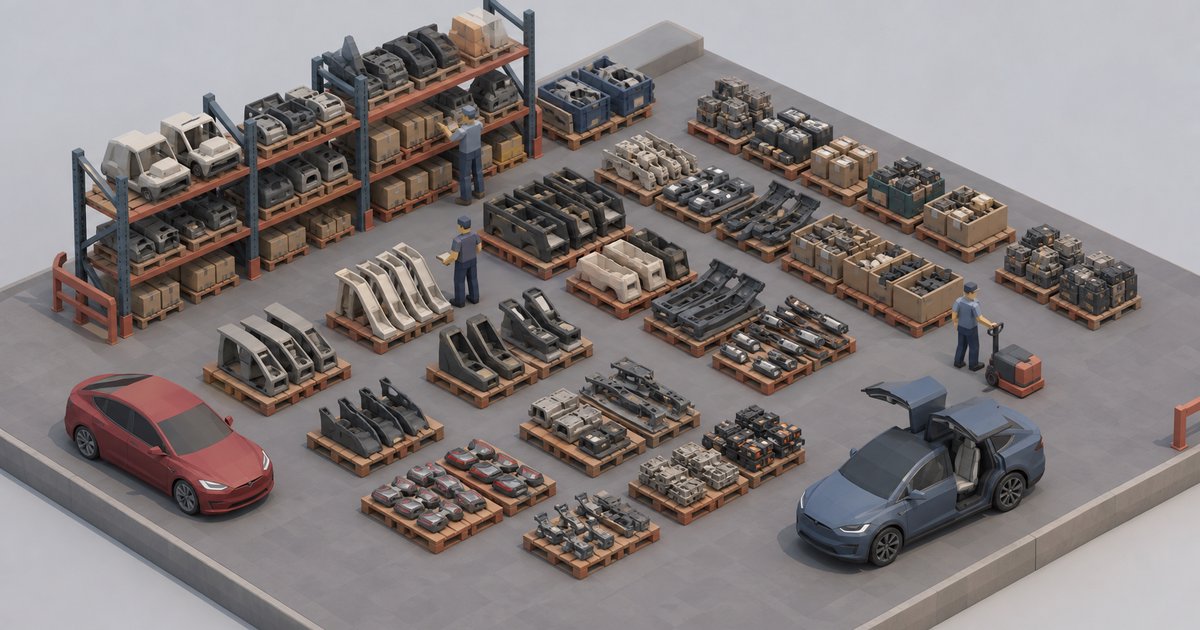
Tesla has begun selling off surplus Model S and Model X parts through B-Stock, the bulk liquidation marketplace it already uses to move excess and returned inventory. The lots are new, unused components, sold by the pallet, and they are aimed at repair businesses and resellers rather than at owners looking for a specific part.
What is actually in the lots
Not a Tesla App catalogued the listings, and the scale is the notable part.
| Lot | Contents | Retail value |
|---|---|---|
| Centre consoles | 171 assemblies and components | $114,875 |
| Model X interior pillars | 775 components | $270,645 |
| Exterior lighting and chassis | 6 pallets | $87,870 |
| Electrical components | 9 pallets, over 10,000 parts | $842,390 |
Starting bids sat as low as $100 to $175 against a combined retail value above $1.3 million. That is the arithmetic of liquidation rather than of a parts counter: mixed pallets, bought sight-unseen, with no guarantee that any given box contains the part a particular car needs.
Why the parts exist at all
Tesla ended Model S and Model X production this year and handed the Fremont line to Optimus. The stated reasoning was that the ageing architecture was becoming expensive to keep current with newer crash-safety requirements, and that the floor space was worth more to the robot programme. Not a Tesla App reports the manufacturing equipment came out in 46 days.
A line that stops still has a warehouse behind it, and everything staged for cars that will now never be built has to go somewhere.
What it means if you still drive one
Less than the headline suggests. These are supply-chain leftovers, not the service parts inventory. Hundreds of thousands of Model S and Model X are still on the road, still under Tesla's four-year, 50,000-mile basic warranty or the eight-year, 150,000-mile battery and drivetrain cover, and Tesla remains on the hook for all of it.
The more interesting effect is on the years after that. For any discontinued car, long-term parts supply eventually runs through the independent trade, and this auction is the trade stocking up. Pallets of new centre consoles and interior pillars landing with specialist repairers is the mechanism by which a 2019 Model X stays repairable in 2032 — at whatever price those repairers decide.
That sits alongside two other threads. Musk has said Tesla will open-source the Model S and Model X design and software, which would let third parties manufacture rather than merely resell — though Tesla has published nothing, and it should be treated as a promise, not a plan. And Tesla has been rebuilding a remanufactured-parts channel of its own, most visibly with an $8,000 remanufactured battery pack.
The European reading
Europe always had the thinnest Model S and X fleet, and it now has the thinnest support case: fewer cars, fewer specialists, and a US-only auction whose pallets will mostly stay in North America. European owners who bought late — Tesla only opened Signature Edition orders to European buyers in June — are furthest from this stock.
It also reads against collapsing used Model S prices: cheap cars whose parts drift into the independent channel is the normal end-of-life pattern for a low-volume model, arriving faster when the manufacturer clears the shelves in one go.
Bottom line
Nothing here changes what Tesla owes existing owners. It does mark the point where Model S and Model X stop being current products and start being cars the aftermarket keeps alive.