
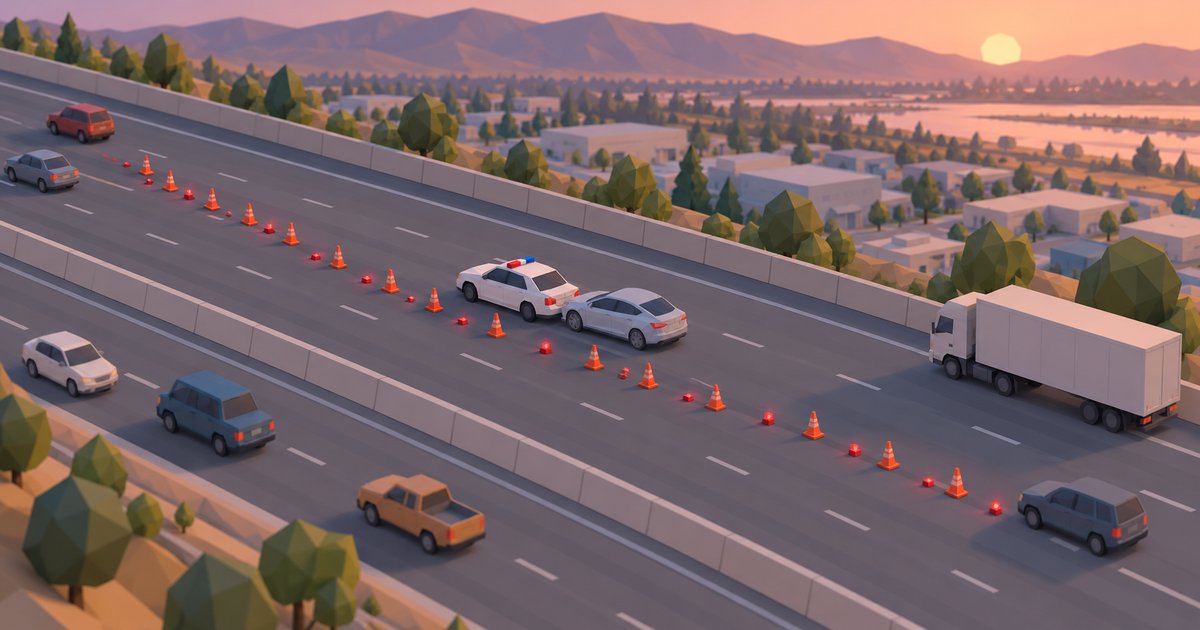
Just before midnight on Tuesday 13 October 2026, California Highway Patrol officers were working the scene of a fatal crash on eastbound Interstate 80 in Fairfield, west of Air Base Parkway. About an hour earlier, a 19-year-old from San Pablo had lost control of his Honda Civic and been hit by a Chevrolet Tahoe. He died. Four lanes were closed behind flares and cones.
According to CHP, a Tesla then drove into the closure at freeway speed and hit a Dodge Charger patrol car with two officers sitting in it. Both were seriously injured and are recovering. The Tesla's driver, a 22-year-old from Sacramento, had minor injuries. He told investigators he had been asleep and that the car was in Full Self-Driving mode. CHP released dashcam video of the impact, filmed from the patrol car and from another vehicle at the scene, on Thursday 15 October.
What is established, and what is not
The crash, the closure and the injuries come from CHP. That FSD was engaged is, for now, the driver's account. CHP has not released the Tesla's model or software version, no charges have been announced, and both crashes remain under investigation. CHP's own comment was pointed: "Technology does not relieve drivers of their responsibility to safely operate their vehicles."
The claim can be tested. Two officers taken to hospital put the crash over the injury threshold of the US regulator's Standing General Order, so if Autopilot or FSD was engaged in the 30 seconds before impact, Tesla has to report it to NHTSA. That is the federal file in which the Vineland median crash appeared as "Verified Engaged".
A scene regulators flagged five years ago
A stopped emergency vehicle behind flares, cones and flashing lights is the scenario NHTSA began investigating in August 2021, after a series of Teslas on Autopilot hit parked police cars and fire trucks, many of them at night. That probe ended with Tesla's December 2023 recall of more than two million vehicles, remedied over the air with extra driver-attention alerts.
FSD has its own precedent. In June 2024 a Tesla hit a Fullerton police car parked at another fatal-crash scene, and its driver admitted engaging the car's self-driving mode while using his phone. Last month TeslAnt reported on the same scenario when Tesla settled the death of a driver whose Model S hit a parked fire truck.
Why it matters in Europe
FSD (Supervised) checks attention with the cabin camera. When it decides the driver is not watching the road, it warns them and then switches itself off. If the driver's account holds, that safeguard did not stop a car whose driver says he was asleep before it reached a lit closure. A member of Congress had already asked NHTSA how effective that camera actually is.
In Europe the same software is now sold as Tesla Assisted Driving. It is legal in nine countries, Slovakia since 16 October. Tesla's request for an EU-wide approval asks for exemptions from several rules, attention-monitoring requirements among them, and the committee that decides cannot vote before its December meeting.
Nothing changes for owners in the approved countries. Fairfield adds a test case to that debate: Tesla's own logs will show whether the system was driving, and whether its driver monitoring noticed a driver who says he was asleep.