
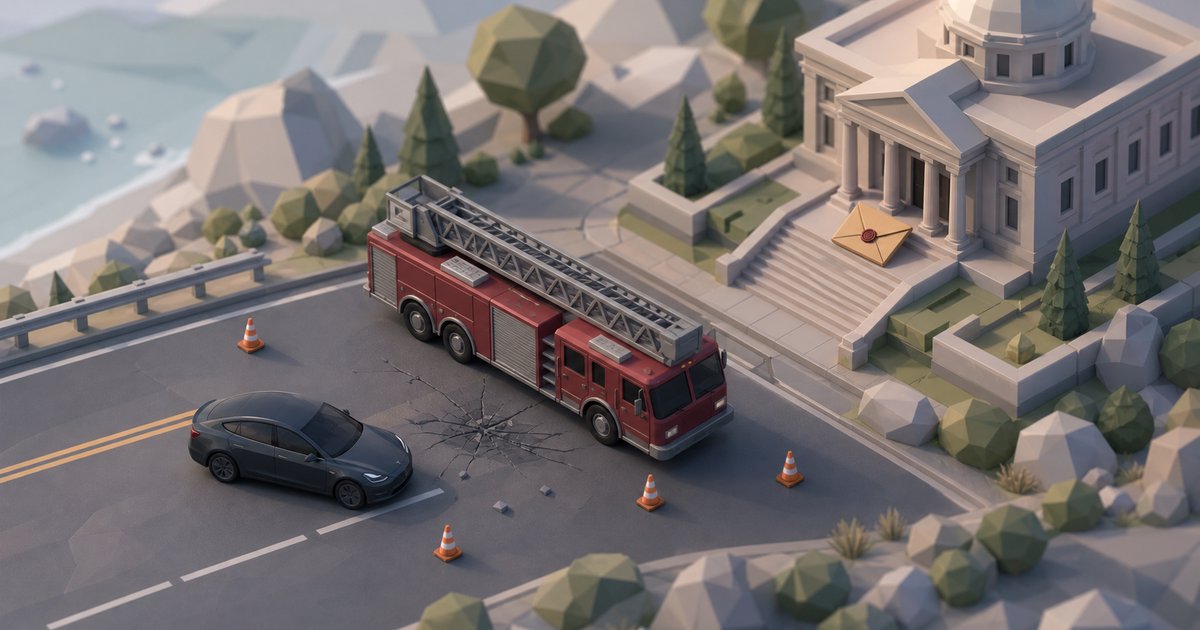
Tesla has confidentially settled a wrongful-death claim over a 2023 crash in which a Model S on Autopilot struck a parked fire truck at about 70 mph. The settlement ends a case that was heading for a California jury — and that jury would have been asked about Elon Musk's own statements on what Autopilot could do.
The crash
On 18 February 2023, at around 4 a.m., Genesis Giovanni Mendoza Martinez, 31, was driving his 2014 Model S on Interstate 680 in Contra Costa County, California, with Autopilot engaged. The car hit a county ladder fire truck parked across lanes at the scene of an earlier collision. Mendoza was killed. His brother Caleb, in the passenger seat, was seriously injured.
A stationary emergency vehicle across a live lane is not an incidental detail. It is the specific scenario that prompted NHTSA's 2021 investigation into Autopilot crashes involving parked first responders, which makes this crash an example of a documented failure mode rather than a novel one.
What made this case dangerous for Tesla
The suit — Caleb Mendoza et al. v. Tesla, Inc., No. 24-cv-08738-VC in the Northern District of California — did not rest only on the argument that Autopilot failed. It argued that Tesla and Musk misrepresented what the system could do, and that the driver over-trusted a Level 2 driver-assistance feature as a result.
Judge Vince Chhabria let that theory through. He found the "Autopilot" name itself plausibly misleading, allowed fraudulent-misrepresentation claims to proceed, and held that Musk's public statements — including that Autopilot was "probably better" than a human driver — were legally actionable rather than mere marketing puffery.
That is what a jury would have heard. Tesla settled instead, on undisclosed terms.
A pattern, not an isolated event
| Case | Outcome |
|---|---|
| 2019 Autopilot death (Florida federal jury) | $243 million verdict |
| Fatal FSD pedestrian crash | settled, June 2026 |
| Mendoza fire truck death | settled, September 2026 |
The Florida verdict is why the rest of this matters. Once a jury has priced an Autopilot death in nine figures, that number sits on the table in every subsequent negotiation. Electrek estimates Tesla's exposure across pending Autopilot and FSD claims at up to $14.5 billion.
Settling also leaves the central question unresolved. Chhabria's ruling stands as a district-court opinion on what a jury could be asked, not a jury's finding on whether Tesla's claims actually misled a buyer. Each settlement removes one more opportunity for that to be tested.
Why this lands in Europe now
The timing is awkward. EU member states vote on 6 October on whether to approve FSD (Supervised) through the Article 39 exemption route, and Tesla has published its own safety case in support of that bid.
European regulators are being asked to accept Tesla's characterisation of what its driver-assistance systems do and how drivers behave with them. In the United States, Tesla is paying — confidentially, and without admitting anything — to stop courts from testing that characterisation in front of juries.
Those two facts are not in contradiction. A settlement is a commercial decision, and Autopilot is a different product from FSD (Supervised), certified under different rules. But a regulator weighing an Article 39 derogation now has in its evidence base a US federal judge's finding that the product's name is plausibly misleading, and no jury verdict either confirming or clearing it — because the case was bought out first.